CART
ISO 31000 vs COSO ERM is a comparison between the two documents most organisations cite when they say they have a risk management framework — and they are different kinds of document, written for different readers, that can be used together. ISO 31000:2018, Risk management — Guidelines, is a sixteen-page international standard: eight principles, a framework of six components built around leadership and commitment, and a seven-step process from communication and consultation to recording and reporting; it applies to any organisation and any risk, uses “should” throughout, and cannot be certified against.
COSO’s Enterprise Risk Management — Integrating with Strategy and Performance (2017) is a much longer framework from the Committee of Sponsoring Organizations of the Treadway Commission: five components and twenty principles that follow the life of a strategy, written for boards and executives of entities that already use COSO’s internal control framework, and aimed at how risk shapes strategy and performance rather than at how risk is assessed. This guide sets the two side by side on five differences, maps the components of each to the other, explains which to adopt first for four common situations, and describes how organisations run one programme that answers both.
Free gap assessment
Is risk management actually changing decisions?
A maturity assessment against all eight principles, the framework and the process, free. Nobody can certify you to ISO 31000, so this scores distance from good practice instead.
Run the free ISO 31000 maturity assessment → or View premium report sample
ISO 31000:2018 is the second edition of the standard, developed by ISO/TC 262, published in February 2018 and confirmed in 2023. Clause 4 states eight principles — integrated, structured and comprehensive, customised, inclusive, dynamic, best available information, human and cultural factors, continual improvement — around the purpose of creating and protecting value. Clause 5 describes the framework: leadership and commitment at the centre, with integration, design, implementation, evaluation and improvement around it. Clause 6 describes the process: communication and consultation; scope, context and criteria; risk assessment (identification, analysis, evaluation); risk treatment; monitoring and review; recording and reporting. Its vocabulary is ISO 31073, and its techniques are in IEC 31010:2019. Our guide to ISO 31000 covers the three components.
Free enterprise risk assessment
Which of your business risks sit above your appetite?
Set your criteria and appetite, pick from 36 strategic, financial, operational and compliance scenarios, rate them and decide how to treat each. Built to ISO 31000, and free.
Run the free enterprise risk assessment → or View premium report sample
COSO ERM 2017 replaced the 2004 cube. Its five components — governance and culture; strategy and objective-setting; performance; review and revision; information, communication and reporting — carry twenty principles, from “exercises board risk oversight” (1) to “reports on risk, culture, and performance” (20). It is written for organisations that set strategy and manage performance against it, and it treats risk as a consideration in choosing strategy and objectives, not only in delivering them. It sits alongside COSO’s 2013 internal control framework, with its 17 principles, which is the framework SOX section 404 assessments are built on. Our guide to the COSO ERM principles lists all twenty.
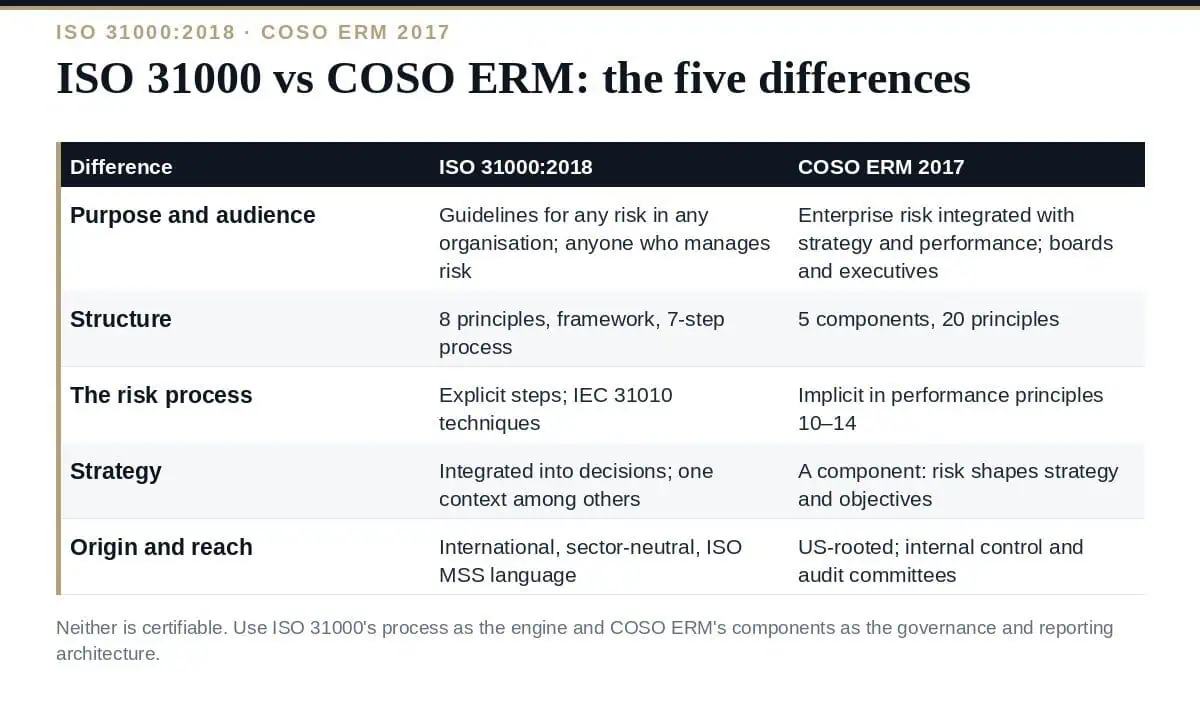
| Difference | ISO 31000:2018 | COSO ERM 2017 |
|---|---|---|
| 1. Purpose and audience | Guidelines for managing any risk in any organisation; written for anyone who manages risk, at any level | A framework for how enterprise risk management integrates with strategy and performance; written for boards, executives and the functions that serve them |
| 2. Structure | Principles, framework and process — a description of what risk management is and how it is done | Components and principles — a description of what an organisation with effective ERM demonstrates |
| 3. Treatment of the risk process | Explicit: a seven-step process with defined activities for identification, analysis, evaluation and treatment, and a companion standard of techniques | Implicit: performance principles 10–14 (identifies risk, assesses severity, prioritises, implements responses, develops portfolio view) describe outcomes rather than method |
| 4. Relationship to strategy | Risk management integrated into decision-making and objectives; strategy is one context among others | Central: strategy and objective-setting is a component; risk is considered in choosing strategy, not only in executing it |
| 5. Origin and reach | International, sector-neutral, adopted by national standards bodies worldwide; referenced by other ISO management system standards | US-rooted, rooted in financial reporting and internal control; strongest in listed companies, financial services and organisations already using COSO 2013 |
ISO 31000 tells a risk manager, a project manager or a plant manager how to manage the risks in front of them. COSO ERM tells a board and an executive team how the organisation’s approach to risk should shape and be shaped by its strategy. A safety engineer can use ISO 31000 without a board; a board can use COSO ERM without a safety engineer.
The visible ISO 31000 vs COSO ERM difference is that ISO 31000 has a process and COSO ERM has principles. Clause 6 of ISO 31000 says what to do and in what order, and IEC 31010 says how; COSO’s performance component says what an organisation with effective ERM does — identifies risk, assesses severity, prioritises, responds, takes a portfolio view — and leaves the method to the organisation. Organisations that adopt COSO ERM and need a method usually borrow ISO 31000’s process, which is why the two are so often found together.
COSO’s argument is that risk belongs in the choice of strategy: an entity considers risk appetite when setting strategy, evaluates alternative strategies for their risk, and sets business objectives that reflect both. ISO 31000 agrees that risk management is part of decision-making, but its framework is organised around leadership, integration and the process rather than around the strategic planning cycle. For a board, COSO’s framing is the more natural; for the people who run the assessments, ISO 31000’s is.
ISO 31000 is what a regulator or a management-system auditor outside the United States expects to see referenced; COSO is what an audit committee and an external auditor in a listed company expect. Neither is certifiable; both are cited in policies far more often than they are implemented.
| ISO 31000:2018 element | COSO ERM 2017 counterpart | Note |
|---|---|---|
| Principles (clause 4): integrated, structured, customised, inclusive, dynamic, best information, human factors, improvement | Governance and culture principles 1–5; the framework’s overall stance | COSO’s culture principles (3–5) go further into values and behaviour |
| Framework — leadership and commitment (5.2) | Principle 1 exercises board risk oversight; 2 establishes operating structures; 4 demonstrates commitment to core values | Both put accountability at the top |
| Framework — integration (5.3) | Principles 6–9: analyses business context, defines risk appetite, evaluates alternative strategies, formulates business objectives | COSO’s strategy component is where ISO’s integration is most demanding |
| Framework — design, implementation, evaluation, improvement (5.4–5.7) | Principles 15–17 review and revision: assesses substantial change, reviews risk and performance, pursues improvement | ISO’s framework cycle; COSO’s review component |
| Process — communication and consultation (6.2) | Principles 18–20: leverages information systems, communicates risk information, reports on risk, culture and performance | COSO adds explicit reporting on culture |
| Process — scope, context and criteria (6.3) | Principle 6 analyses business context; 7 defines risk appetite | ISO’s risk criteria and COSO’s risk appetite overlap; our guide to risk appetite covers the terms |
| Process — risk assessment and treatment (6.4–6.5) | Principles 10–14: identifies risk, assesses severity, prioritises risks, implements risk responses, develops portfolio view | ISO supplies the method; COSO adds the portfolio view |
| Process — monitoring, review, recording, reporting (6.6–6.7) | Principles 15–20 | Both require it; COSO ties it to performance |
The gaps run both ways. COSO has no equivalent of ISO’s explicit process steps or of IEC 31010’s techniques; ISO has no equivalent of COSO’s strategy component, portfolio view or culture reporting.
| Situation | Start with | Then |
|---|---|---|
| Building risk management from nothing, any sector | ISO 31000 process and framework, with IEC 31010 techniques | COSO ERM’s strategy and portfolio principles when the board asks how risk informs strategy |
| US-listed company with SOX 404 on COSO 2013 | COSO ERM, which the audit committee and auditors already speak | ISO 31000 as the method beneath the performance principles |
| Certified to an ISO management system (9001, 27001, 45001) | ISO 31000 — the risk clauses of those standards are written in its language | COSO ERM only if the board wants a strategy-level framework |
| Financial services under a regulator that expects enterprise risk management | Both: COSO ERM for the governance and appetite architecture, ISO 31000 for the assessment process | One risk taxonomy, one register, two reporting views |
What is the difference between ISO 31000 and COSO ERM?
ISO 31000:2018 is a sixteen-page international guideline — eight principles, a framework and a seven-step process — for managing any risk in any organisation. COSO ERM 2017 is a framework of five components and twenty principles describing how enterprise risk management integrates with strategy and performance, written for boards and executives. ISO supplies the method; COSO supplies the strategy-level architecture.
Can you be certified to either?
No. ISO 31000 is a guidelines standard using ‘should’ and cannot be certified against; COSO ERM has no certification scheme. Both are frameworks to align with, not standards to comply with.
Do they conflict?
No. Their elements map to each other closely — ISO’s leadership, integration and process to COSO’s governance, strategy, performance and reporting components — and most organisations that use COSO ERM borrow ISO 31000’s process for assessment.
Which is better for a non-US organisation?
ISO 31000 is the international reference and the language of the ISO management system standards; COSO ERM is most useful where a board or regulator expects enterprise-level strategy integration, or where COSO 2013 internal control is already in use.
Where do techniques like bow-tie and FMEA come from?
IEC 31010:2019, the companion to ISO 31000; COSO ERM does not prescribe techniques.
Settle ISO 31000 vs COSO ERM by role rather than by choice: ISO 31000 is the process and the principles every assessment runs on, COSO ERM is the architecture a board uses to tie risk to strategy, and one programme can carry both — one policy, one set of criteria and appetite, ISO’s seven steps as the engine and COSO’s five components as the reporting shape.
The risk management policy and framework document, the risk criteria and appetite statement, the risk assessment procedure on the ISO 31000 process and the board reporting templates are in the ISO 31000 Risk Management Toolkit, or start with the free templates.

October 11, 2026
October 11, 2026
October 11, 2026
October 11, 2026
October 11, 2026

