
CART
No products in the cart.
ISO Compliance Insights & Best Practices
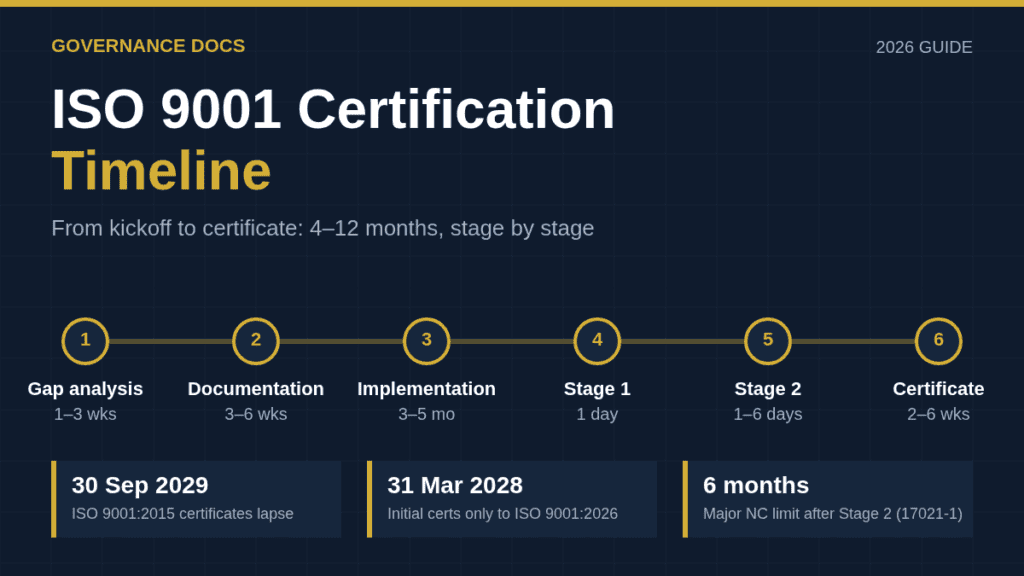
The ISO 9001 certification timeline for most companies runs four to twelve months from kickoff to certificate, and the spread is not random. It comes down to four things: how much of a quality management system you already run, how fast you can produce three months of records, how quickly your certification body can schedule you, and, new for this year, which edition of the standard you are aiming at. ISO 9001:2026 was published on 16 September 2026, and the accreditation rules that followed it change the calendar for anyone starting now.
This guide walks the whole ISO 9001 certification timeline stage by stage, gives labelled typical durations for each step, shows the audit-day table your registrar will use to quote you, and explains the 2026 transition dates so you do not book a Stage 2 against the wrong edition.
Free gap assessment
Are you ready for the 2026 edition of ISO 9001?
Score yourself against the new edition, free, including the risk and opportunity split and the clause 10 renumbering that breaks converted checklists.
Run the free ISO 9001 gap assessment → or View premium report sample
Everything below assumes a single-site company without an existing certified management system. Durations are typical ranges from implementation projects and certification body lead times, not guarantees. If you already hold ISO 14001, ISO 45001 or ISO 27001, the first three phases compress sharply because the management system skeleton, internal audit programme and management review are already running.
| Phase | What has to happen | Typical duration |
|---|---|---|
| 1. Scope and gap analysis | Define the certification scope, map your processes, compare current practice against clauses 4–10 | 1–3 weeks |
| 2. Documentation | Quality policy, objectives, process descriptions, procedures and the records structure the standard requires | 3–6 weeks with templates; 2–4 months from a blank page |
| 3. Implementation and records | Run the system, train staff, generate evidence, complete at least one internal audit and one management review | 3 months minimum; 3–5 months typical |
| 4. Certification body selection and booking | Quotes, contract, audit programme, auditor allocation | 4–8 weeks lead time (start this during phase 2) |
| 5. Stage 1 audit | Documentation review and readiness check, often partly remote | 1 day for most small firms |
| 6. Stage 2 audit | On-site evaluation of implementation and effectiveness | 1–6 days depending on headcount; typically 2–8 weeks after Stage 1 |
| 7. Nonconformity closure and decision | Corrective actions verified, independent certification decision, certificate issued | 2–6 weeks; up to 6 months if a major nonconformity is open |
| Total | 4–6 months (small, templated); 6–9 months (mid-size); 9–12+ months (large or multi-site) |
The single biggest lever is phase 3. Nothing shortens the ISO 9001 certification timeline below roughly four months, because your auditor needs to see the system operating, not just described. ISO/IEC 17021-1, the standard that governs certification bodies, makes checking that internal audits and management reviews “are being planned and performed” an explicit objective of the Stage 1 audit, and Stage 2 then samples the records those activities produced.
Decide what the certificate will cover: which sites, which products or services, which processes. A narrow, honest scope certifies faster than an ambitious one. Then run a gap analysis against the clauses of the standard. If you are starting now, run it against ISO 9001:2026, not the 2015 edition; the reasons are in the transition section below. The output is a prioritised list of missing documents, missing records and processes that exist in practice but not on paper.
This is where the widest variance in any ISO 9001 certification timeline sits. ISO 9001 is deliberately light on mandatory documents, but a working system still needs a quality policy, measurable objectives, a scope statement, process maps, and the procedures and forms that generate the records an auditor will sample: calibration, supplier evaluation, nonconformity and corrective action, internal audit, management review, customer complaints. Companies that write everything from scratch typically spend two to four months here. Companies that start from a template pack and edit it to fit typically finish in three to six weeks, because the effort shifts from authoring to tailoring. Either way, the test is whether staff can follow the document, not whether it reads well.
Now the system has to run long enough to leave a trail. Train people on the procedures that affect them, start the calibration and supplier records, log nonconformities as they happen, and, critically, complete a full internal audit cycle and at least one management review before you book Stage 2. Three months of operation is the practical floor: it gives you enough data for the management review to be a real review rather than a first meeting, and enough closed corrective actions to show the improvement loop works. Most first-time projects need four to five months once training delays and audit findings are factored in.
Do this in parallel with phase 2, not after phase 3, or you add two months to the ISO 9001 certification timeline for nothing. Accredited certification bodies quote from a headcount-based audit-time table (next section), and popular registrars book auditors six to eight weeks out. Ask two questions in every quote conversation: is the body accredited by a Global ACI member for ISO 9001, and is it already accredited to certify against the 2026 edition? In late 2026 and early 2027, the second answer is not automatically yes.
Stage 1 is a readiness review. The auditor reads your documentation, confirms the scope, checks that statutory and regulatory requirements have been identified, and evaluates whether you are ready for Stage 2. The report will list “areas of concern”, which are findings that would become nonconformities if still present at Stage 2. ISO/IEC 17021-1 does not fix a number of days between Stage 1 and Stage 2; it requires the certification body to set the interval based on how long you need to resolve those concerns, and allows it to repeat Stage 1 if too much time passes. In practice most bodies schedule Stage 2 between two and eight weeks later.
Stage 2 evaluates implementation and effectiveness. The auditor samples records, interviews staff, follows a product or service through your processes and checks performance against objectives. Duration is driven by the audit-time table below. At the closing meeting you will hear whether any nonconformities were raised and whether the auditor intends to recommend certification.
The certificate is not issued by the auditor. Under ISO/IEC 17021-1 clause 9.5, a separate reviewer must confirm that every major nonconformity is closed and every minor one has an accepted corrective action plan before the decision is taken. With a clean Stage 2 this takes two to six weeks depending on the body’s review queue. With a major nonconformity, the clock is yours: clause 9.5.3.2 says that if the body cannot verify your correction and corrective action within six months of the last day of Stage 2, it must conduct another Stage 2 before recommending certification. That six-month rule is the hard ceiling on the back end of the ISO 9001 certification timeline.
Accredited certification bodies do not invent audit durations. They start from the mandatory audit-time table in Global ACI-TECH-3-004 (M), formerly IAF MD 5, which was reissued in July 2026 without substantive change after the International Accreditation Forum was succeeded by the Global Accreditation Cooperation Incorporated. The figures below are the initial-audit totals for a quality management system, covering Stage 1 and Stage 2 together, by effective number of personnel.
| Effective personnel | Initial audit time (days) | Approximate annual surveillance |
|---|---|---|
| 1–5 | 1.5 | 0.5 |
| 6–10 | 2 | 0.5–1 |
| 11–15 | 2.5 | 1 |
| 16–25 | 3 | 1 |
| 26–45 | 4 | 1.5 |
| 46–65 | 5 | 1.5–2 |
| 66–85 | 6 | 2 |
| 86–125 | 7 | 2.5 |
| 126–175 | 8 | 2.5–3 |
| 176–275 | 9 | 3 |
Three rules from the same document matter for scheduling. Surveillance visits are about one third of the initial audit time per year. A recertification audit is about two thirds of a fresh initial audit. And the body may adjust the table by up to 30 percent for factors such as low process complexity, a small site or a mature system, but not by more. “Effective personnel” includes part-time and shift staff on a full-time-equivalent basis, so a 40-person operation running two shifts is not a 20-person audit.
Combining the phase durations with the audit-time table gives realistic end-to-end figures. These are typical ranges for a first certification with a competent internal owner and, where noted, a template pack rather than blank-page documentation.
| Company profile | Implementation | Stage 1 + Stage 2 | End-to-end typical |
|---|---|---|---|
| Under 25 staff, single site, templated documents | 3–4 months | 1.5–3 days | 4–6 months |
| 25–85 staff, single site, some existing procedures | 4–6 months | 4–6 days | 6–9 months |
| 85–275 staff or multiple sites | 6–9 months | 7–9 days plus per-site sampling | 9–12+ months |
| Any size, already certified to ISO 14001 or ISO 45001 | 2–4 months | Combined audit, integrated time reduction | 3–6 months |
The fourth row is the reason integrated management systems exist. If your certification body already audits you against another Annex SL standard, the shared clauses (context, leadership, planning, support, performance evaluation, improvement) are largely done, and Global ACI’s integrated-audit rules allow the combined audit time to be reduced by up to 20 percent. The ISO 9001 certification cost guide works the same tables into a budget.
ISO 9001:2026, the sixth edition, was published in September 2026 and replaces ISO 9001:2015 including its 2024 climate amendment, which are now listed as withdrawn on iso.org. Global ACI published the binding transition rules for accreditation bodies and certification bodies the same week, in a document titled Global ACI-TECH-3-TR 2029-09-30 (M) Transition Requirements for ISO 9001:2026. The dates that matter to a company planning its ISO 9001 certification timeline are these.
| Date | Rule | What it means for you |
|---|---|---|
| 16 September 2026 | ISO 9001:2026 published | Gap analysis and documentation should target the 2026 clauses from now on |
| 31 March 2027 | Accreditation bodies ready to assess against ISO 9001:2026 (no later than) | Before this, an accredited 2026 certificate may not be available from every body; ask your registrar |
| 30 June 2027 | Certification bodies submit transition declarations to their accreditation body | A body that has not declared cannot yet be assessed for 2026 accreditation |
| 30 September 2027 | Accreditation body transition decisions complete | By this date every accredited body should be able to certify against 2026 |
| 31 March 2028 | New and initial accredited certifications may only be issued to ISO 9001:2026 | A first-time Stage 2 after this date is a 2026 audit, no exceptions |
| 30 September 2029 | End of the three-year transition | Any certificate still on ISO 9001:2015 lapses; certified companies must have transitioned by a surveillance, recertification or special audit before then |
The practical advice for anyone starting a project today is to build the system to the 2026 text. A 2015 certificate obtained in 2027 would need to be transitioned within two years anyway, at the cost of an extra audit. The differences are manageable: the 2026 edition splits clause 6.1 into separate treatment of risks and opportunities, adds quality culture and ethical behaviour to leadership and awareness, expands the change-planning considerations in clause 6.3, moves climate change into the main text of clause 4.1, and renumbers clause 10 so that continual improvement comes first. What changed clause by clause is covered in our ISO 9001:2026 transition guide.
The one timing trap is accreditation lag. A certification body can audit you against ISO 9001:2026 before its accreditation body has completed the transition decision, but the certificate it issues may not carry the accreditation mark for the 2026 edition until that decision lands. If a customer or tender requires an accredited certificate, confirm your body’s status in writing before booking a Stage 2 in the first half of 2027.
Certification is not the end of the ISO 9001 certification timeline. The certificate is valid for three years, and ISO/IEC 17021-1 requires the first surveillance audit to take place no more than 12 months from the certification decision date, with surveillance at least once every calendar year except in the recertification year. Surveillance visits are shorter than the initial audit and focus on internal audits, management review, actions on previous findings, complaints and progress against objectives.
The recertification audit must be planned and completed in time for a renewal decision before the certificate expires. If the certificate does expire, the body can restore it within six months provided the outstanding recertification activities are completed; beyond that, at least a full Stage 2 is required again. Put those dates in the management review calendar in year one, because the most common way to lose a certificate is not a failed audit but a missed one. The ISO 9001 internal audit guide covers how to run the annual programme that feeds every surveillance visit.
If you want to compare how the same accreditation rules play out for a regulated sector, the ISO 13485 certification timeline follows an identical Stage 1 and Stage 2 structure but uses a different audit-time document, and the broader ISO 9001 explained guide covers what the standard requires before you plan the schedule.
Our ISO 9001 Toolkit was rebuilt on the published ISO 9001:2026 text and contains 84 templates covering the policy, procedures, registers and audit tools described above, for $149. It is the fastest way we know to take phase 2 from months to weeks.
Only in narrow cases: a very small company with an existing documented system, a management review and internal audit already on record, and a certification body with immediate availability. For a company starting from nothing, three months is not enough to generate the records Stage 2 will sample. Four to six months is the realistic ISO 9001 certification timeline floor.
Typically two to six weeks with no major nonconformities. The delay is the independent certification decision required by ISO/IEC 17021-1 clause 9.5, plus certificate production. A major nonconformity adds the time it takes you to fix it and the body to verify the fix, up to a six-month ceiling.
ISO 9001:2026. From 31 March 2028 no new accredited certificate may be issued to the 2015 edition, and all 2015 certificates lapse on 30 September 2029. A 2015 certificate obtained in 2027 would need a transition audit within two years. Confirm your certification body is accredited for the 2026 edition before booking Stage 2.
Yes, substantially: the ISO 9001 certification timeline roughly halves. The shared Annex SL clauses are already implemented and audited, so implementation typically drops to two to four months and the certification body can run a combined audit with a reduced total audit time under Global ACI’s integrated management system rules.
Three years from the certification decision, subject to surveillance audits at least once a calendar year and a recertification audit completed before the expiry date. Miss the recertification and the certificate can be restored within six months; after that you start again from Stage 2.

October 12, 2026

October 12, 2026

October 12, 2026
October 12, 2026
October 12, 2026
