CART
AS9100 vs ISO 9001 is not a choice between two standards so much as a question of how much is added to one. AS9100 Rev D contains the complete text of ISO 9001:2015 — every clause, in the same order, with the same numbering — and inserts aerospace, space and defence requirements around it, printed in bold italic so a reader can see exactly where the sector begins. An AS9100 certificate therefore covers ISO 9001 in full; an ISO 9001 certificate covers a fraction of AS9100.
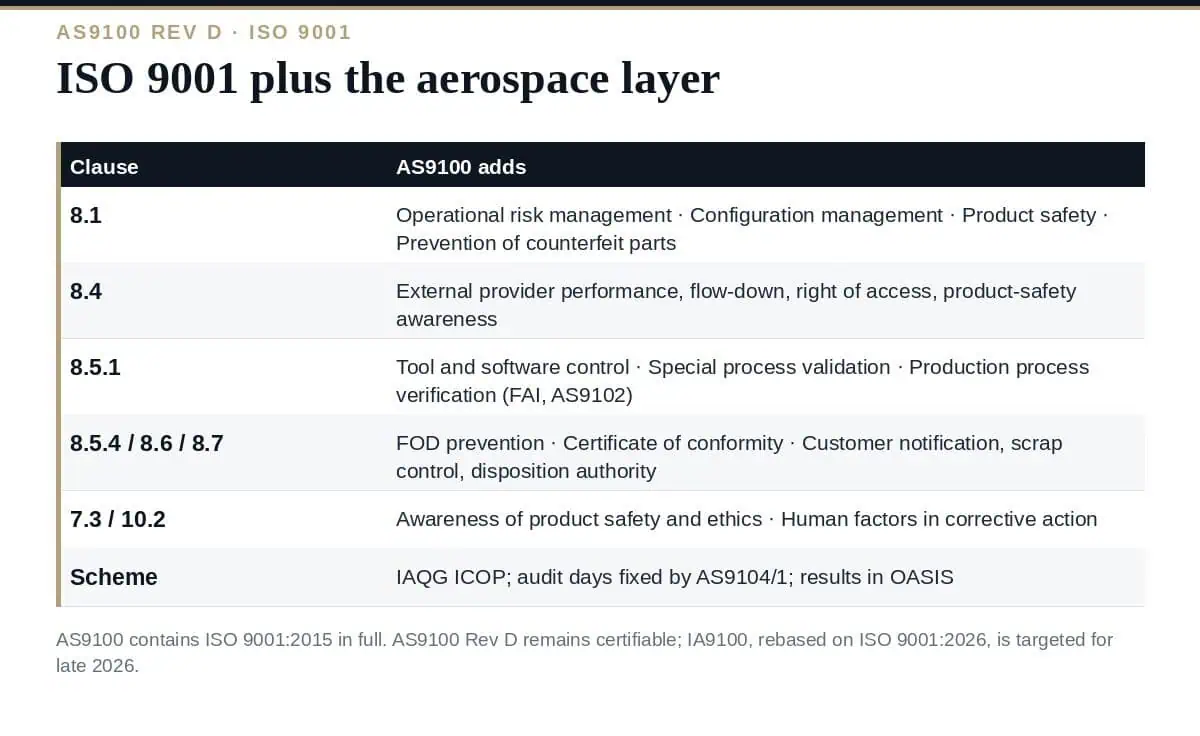
What the additions ask for is the substance of the comparison: operational risk management, configuration management, product safety and counterfeit-part prevention as named processes; first article inspection; special process validation; a stricter grip on external providers and on nonconforming product; human factors in corrective action; and a certification scheme, run by the IAQG through the OASIS database, that fixes audit days and publishes results. This guide sets the two side by side, walks the additions clause by clause, explains who needs AS9100 and who is fine with ISO 9001, and describes the upgrade path — including what the pending IA9100 revision does and does not change.
| ISO 9001:2015 | AS9100 Rev D (2016) | |
|---|---|---|
| What it is | The generic quality management system standard | ISO 9001:2015 in full, plus aviation, space and defence requirements |
| Published by | ISO | SAE International (AS9100), with EN 9100 and JISQ 9100 as the regional equivalents of the same IAQG document |
| Structure | Clauses 4–10, harmonized structure | Identical clauses 4–10; additions printed in bold italic within them |
| Named additional processes | None | Operational risk management, configuration management, product safety, prevention of counterfeit parts, production process verification, control of special processes |
| Certification scheme | Accredited certification bodies; audit time from IAF MD 5 | IAQG Industry Controlled Other Party (ICOP) scheme; audit days fixed by AS9104/1 Table 8; results published in OASIS |
| Auditors | Accredited CB auditors | Aerospace Auditors and Aerospace Experienced Auditors authenticated under AS9104/3 |
| Who asks for it | Customers across every sector | Primes and their supply chains; often a condition of the approved supplier list |
| Current edition | ISO 9001:2026, published September 2026, replacing 2015 | AS9100 Rev D remains certifiable; IA9100, rebased on ISO 9001:2026, targeted for late 2026 |
| Clause | What AS9100D adds to the ISO 9001 text | What an auditor looks for |
|---|---|---|
| 4.4 QMS and its processes | Documented information on processes must address customer and applicable statutory and regulatory requirements | Process documentation that names the requirements each process meets |
| 5.3 Roles | Top management appoints a management representative with responsibility and authority for the QMS | A named person with organisational freedom to resolve quality matters |
| 7.1.5 Monitoring and measuring resources | A register of monitoring and measuring equipment; calibration with recall; environmental conditions | The register, the recall system, records of out-of-tolerance impact assessment |
| 7.3 Awareness | People aware of their contribution to product safety and the importance of ethical behaviour | Training and awareness evidence on safety and ethics, not only quality policy |
| 8.1 Operational planning | Planning covers the added processes; 8.1.1 operational risk management; 8.1.2 configuration management; 8.1.3 product safety; 8.1.4 prevention of counterfeit parts | Each of the four as a defined, operating process |
| 8.3 Design and development | Design phases with reviews, verification and validation; testing planned and controlled; design records include authorisation | Test plans, test records and design authorisation evidence |
| 8.4 External providers | Control of external provider performance; flow-down of requirements including the four named processes; right of access for customer and authorities; awareness of external providers’ contribution to product safety | Supplier performance data, purchase orders carrying the flow-downs, right-of-access clauses |
| 8.5.1 Production | Control of equipment, tools and software programs; validation and control of special processes; production process verification — first article inspection per AS9102 | Tool control, special process qualification records, FAI reports |
| 8.5.2 Identification and traceability | Configuration identification; traceability through the life of the product | Part marking and lot traceability records |
| 8.5.4 Preservation | Prevention, detection and removal of foreign objects | A FOD programme |
| 8.6 Release | Certificate of conformity; release only when planned arrangements are complete | CoCs and release authority records |
| 8.7 Nonconforming outputs | Customer and authority notification; scrap conspicuously marked or positively controlled; ‘use as is’ or ‘repair’ only with customer approval where required | Nonconformance records showing notification and disposition authority |
| 9.1 Performance evaluation | Customer satisfaction measured with on-time delivery and quality escape data among others | OTD and escape metrics reviewed |
| 10.2 Corrective action | Human factors considered in root cause; flow-down of corrective action to external providers where they caused the problem | Root cause analyses that address human factors; supplier corrective action requests |
Two of the additions are large enough to be standards of their own. First article inspection follows AS9102, and our guide to first article inspection covers the three forms. Counterfeit-part prevention draws on AS5553 and AS6174, and counterfeit parts prevention under 8.1.4 covers the process.
| Organisation | Standard | Why |
|---|---|---|
| Design, manufacture or assembly of aviation, space or defence products or parts | AS9100 | Primes and tier-one suppliers require it for the approved supplier list, and flow it down |
| Maintenance, repair and overhaul of aircraft and components | AS9110 | The MRO variant, with maintenance-specific requirements; AS9100 does not fit |
| Stockist or distributor of aerospace parts without manufacturing | AS9120 | The distributor variant; design and manufacturing clauses are not applicable |
| Supplier of commodity items or services with no aerospace-specific requirements | ISO 9001, unless the customer says otherwise | The customer’s flow-down decides; many primes accept ISO 9001 for non-critical suppliers |
| Organisation entering the sector | ISO 9001 first if the QMS is new; straight to AS9100 if a customer has asked | An ISO 9001 QMS is the base; the additions are added to it, not built beside it |
Our guide to AS9110 vs AS9120 covers the two variants; AS9100 certification cost covers what the IAQG scheme’s fixed audit days mean for the price.
What is the difference in AS9100 vs ISO 9001?
AS9100 contains ISO 9001:2015 in full and adds aviation, space and defence requirements: operational risk management, configuration management, product safety, counterfeit-part prevention, first article inspection, special process validation, stricter external provider and nonconformance control, human factors in corrective action, and a certification scheme run by the IAQG with fixed audit days and results published in OASIS.
Does AS9100 certification include ISO 9001?
Yes. Because the full ISO 9001 text is inside AS9100, an AS9100-certified QMS meets ISO 9001, and certification bodies commonly issue both certificates from the same audit. The reverse is not true.
Can we hold ISO 9001 and supply aerospace customers?
If the customer’s flow-down allows it. Many primes accept ISO 9001 from suppliers of non-critical items; suppliers of flight or safety-critical parts, or those on an approved supplier list that specifies AS9100, need the aerospace standard.
Is AS9100 harder to audit?
The audit is longer and more prescribed: AS9104/1 fixes the days by headcount, auditors are authenticated under the IAQG scheme, and results are reported into OASIS where customers can see them. The additions also give auditors more specific requirements to test.
What happens with IA9100 and ISO 9001:2026?
ISO 9001:2026 was published in September 2026. IA9100, the renamed successor to AS9100 Rev D rebased on it, is targeted for late 2026 with a transition period to follow. AS9100 Rev D remains the certifiable standard until the IAQG publishes the transition rules.
Read AS9100 vs ISO 9001 as ISO 9001 plus a bold-italic layer: the same ten clauses, with the sector’s processes, records and scheme added. If your customers are aerospace, space or defence primes, the layer is not optional; build it onto the ISO 9001 system you have, register in OASIS, and keep one eye on IA9100.
The quality manual with the AS9100 additions marked, the operational risk, configuration management, product safety and counterfeit-part procedures, the FAI and special process records and the supplier flow-down templates are in the AS 9100/9110/9120 Aerospace QMS Toolkit, or start with the free templates.

September 21, 2026
September 20, 2026
September 20, 2026
September 19, 2026

September 19, 2026

