

NIST 800-171 vs 800-53 is a comparison between a catalog and a derivative of it. SP 800-53 is the full control catalog for federal information systems — twenty families, more than a thousand controls and enhancements, with low, moderate and high baselines published separately in SP 800-53B. SP 800-171 is what you get when the moderate baseline is tailored for one purpose only: protecting the confidentiality of Controlled Unclassified Information on systems the federal government does not own.
Revision 3 of 800-171 makes the derivation explicit — its Appendix C walks every moderate-baseline control through five tailoring criteria and shows which of them became the 97 requirements. This guide sets out the difference on purpose, scope, size, structure and who must comply; shows the tailoring arithmetic from NIST’s own tables; explains what 800-53 covers that 800-171 does not; and answers the question most contractors are really asking, which is whether an 800-53 program satisfies 800-171 and vice versa.
Free gap assessment
What would your SPRS score be today?
Score all 110 NIST SP 800-171 requirements, free, plus the DFARS duties around them: plans of action, 72-hour incident reporting and flow-down.
Run the free NIST SP 800-171 gap assessment → or View premium report sample
NIST 800-171 vs 800-53 at a glance
| NIST SP 800-53 Rev 5 | NIST SP 800-171 (Rev 3 / Rev 2) | |
|---|---|---|
| Purpose | Security and privacy controls for federal information systems and organizations | Security requirements for protecting the confidentiality of CUI in nonfederal systems |
| Who must use it | Federal agencies under FISMA and OMB A-130; cloud providers under FedRAMP; anyone a contract binds to it | Nonfederal organizations that process, store or transmit CUI under a contract or agreement — DoD contractors under DFARS 252.204-7012 and CMMC |
| Security objectives | Confidentiality, integrity, availability — and privacy | Confidentiality only |
| Size | 20 families; more than 1,000 controls and enhancements in the catalog; the moderate baseline selects 287 | 17 families, 97 requirements (Rev 3); 14 families, 110 requirements (Rev 2) |
| Baselines | Low, moderate, high and privacy, in SP 800-53B; tailored per system | One set, applicable to every CUI system; tailoring is done by NIST, not the organization |
| Parameters | Organization-defined parameters throughout | 88 ODPs in 50 requirements (Rev 3); none in Rev 2 |
| Assessment companion | SP 800-53A | SP 800-171A |
| Certification or authorization | Authorization to operate (ATO) by the agency; FedRAMP authorization for cloud | Self-assessment and SPRS score; CMMC certification for DoD (Phase 2 contract requirements suspended since July 2026; self-assessment and SPRS continue) |
NIST 800-171 vs 800-53 family by family
SP 800-53 Rev 5 has 20 control families. SP 800-171 borrows the family names and two-letter identifiers, so the cleanest way to read NIST 800-171 vs 800-53 is family by family: which ones carry over, which ones Revision 3 added, and which ones never make it across.
| 800-53 family | 800-171 Rev 2 (DFARS / CMMC today) | 800-171 Rev 3 (NIST current) | What happens to it |
|---|---|---|---|
| AC Access Control | 3.1 — 22 requirements | 03.01 | Largest family in both; account, session and remote-access controls |
| AT Awareness and Training | 3.2 — 3 | 03.02 | Carried over |
| AU Audit and Accountability | 3.3 — 9 | 03.03 | Carried over |
| CM Configuration Management | 3.4 — 9 | 03.04 | Carried over |
| IA Identification and Authentication | 3.5 — 11 | 03.05 | Carried over; MFA is the common sticking point |
| IR Incident Response | 3.6 — 3 | 03.06 | Carried over |
| MA Maintenance | 3.7 — 6 | 03.07 | Carried over |
| MP Media Protection | 3.8 — 9 | 03.08 | Carried over |
| PS Personnel Security | 3.9 — 2 | 03.09 | Carried over |
| PE Physical and Environmental Protection | 3.10 — 6 | 03.10 | Environmental controls tailored out; physical access kept |
| RA Risk Assessment | 3.11 — 3 | 03.11 | Carried over |
| CA Assessment, Authorization and Monitoring | 3.12 — 4 | 03.12 | Authorization itself is FED; the SSP sits here in Rev 2 (3.12.4) |
| SC System and Communications Protection | 3.13 — 16 | 03.13 | Confidentiality controls kept; availability enhancements tailored out |
| SI System and Information Integrity | 3.14 — 7 | 03.14 | Flaw remediation and malware protection kept |
| PL Planning | — | 03.15 (new) | Was NFO in Rev 2; now explicit, and holds the SSP (03.15.02) |
| SA System and Services Acquisition | — | 03.16 (new) | Was NFO in Rev 2 |
| SR Supply Chain Risk Management | — | 03.17 (new) | Family did not exist in 800-53 Rev 4, so Rev 2 could not draw on it |
| CP Contingency Planning | — | — | NCO: availability, not confidentiality |
| PM Program Management | — | — | N/A: sits in no baseline |
| PT PII Processing and Transparency | — | — | N/A: privacy, not CUI confidentiality |
The Rev 2 column adds up to 110 requirements across 14 families; that is still the list a DoD contractor is scored against. Three 800-53 families — CP, PM and PT — have no 800-171 counterpart in either revision, and that gap is most of the answer to whether an 800-171 program can stand in for an 800-53 one.
Free ISO 27001 risk assessment
Which of your risks sit above your appetite line?
Set your own risk criteria, pick from 61 information security risk scenarios, rate likelihood and impact, and decide how to treat each one. You get a heat map, a process score and the findings an auditor would raise, free.
Run the free risk assessment → or View premium report sample
NIST 800-171 vs 800-53: the tailoring arithmetic
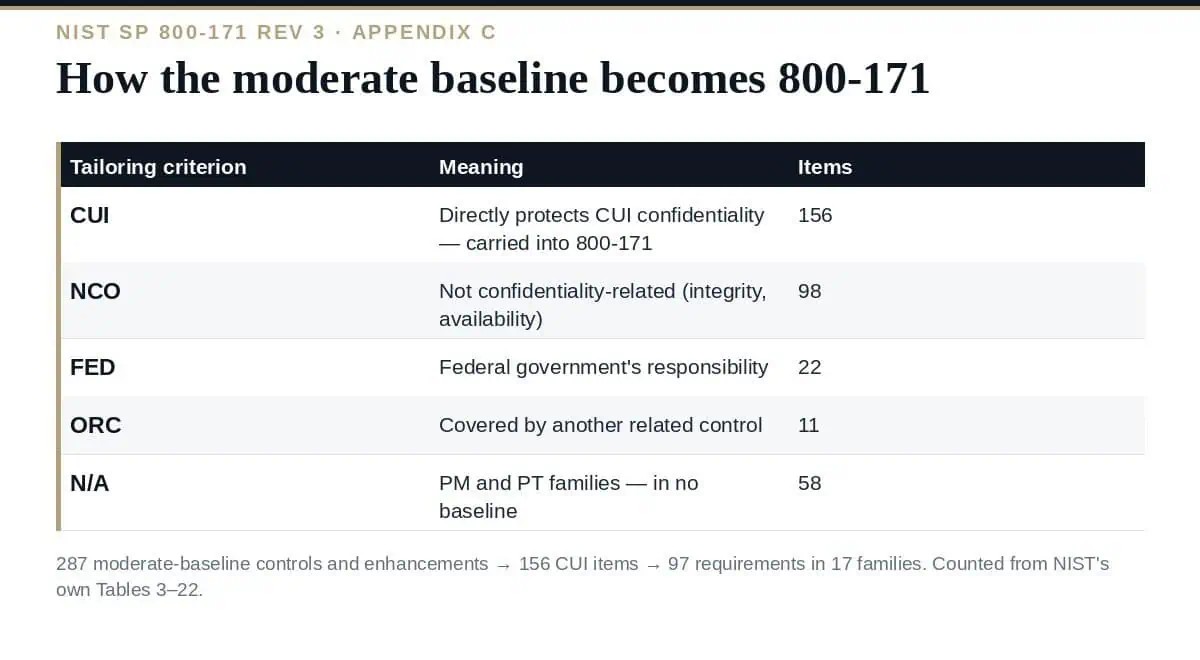
SP 800-171 Rev 3, Appendix C, lists every control and enhancement in the SP 800-53B moderate baseline and assigns it one of five tailoring criteria. Counting NIST’s own tables gives the derivation in numbers.
| Tailoring criterion | Meaning | Controls and enhancements |
|---|---|---|
| CUI | Directly related to protecting the confidentiality of CUI — carried into 800-171 as, or within, a requirement | 156 |
| NCO | Not directly related to confidentiality of CUI (integrity- or availability-focused, for example) | 98 |
| FED | Primarily the responsibility of the federal government | 22 |
| ORC | Outcome adequately covered by another related control | 11 |
| N/A | Not applicable — the Program Management and PII Processing families, which sit in no baseline | 58 |
The 287 moderate-baseline items (the rows other than N/A) reduce to 156 that matter to CUI confidentiality, and those 156 are expressed as 97 requirements because a single requirement often carries a control and its enhancements together. Revision 2 did the same derivation from SP 800-53 Rev 4 with an extra criterion, NFO — controls “expected to be routinely satisfied by nonfederal organizations without specification” — which Revision 3 eliminated after NIST found that NFO controls such as the family policy controls were simply not being implemented. That is why Planning is now a family of its own. Our guide to NIST 800-171 Rev 3 vs Rev 2 covers the change in full.
What 800-53 has that 800-171 does not
- Integrity and availability. Contingency Planning (CP) is absent from 800-171 entirely: backups, alternate sites and recovery are NCO. So are most of the availability-oriented enhancements in System and Communications Protection.
- Privacy. The PT family and the privacy baseline have no counterpart; 800-171 is about confidentiality of government information, not about personal data rights.
- Program-level controls. Program Management (PM) is N/A; the enterprise-level governance an agency’s CISO runs is assumed, not required.
- Federal responsibilities. The 22 FED items — authorization, interconnection agreements, certain assessments — belong to the agency that owns the risk.
- Tailoring freedom. An agency tailors its own baseline per system under SP 800-53B; a contractor implementing 800-171 does not get to drop a requirement because its system is low-impact. The tailoring has been done once, for everyone.
What 800-171 adds that a plain 800-53 baseline does not
Nothing new in substance — on the NIST 800-171 vs 800-53 ledger every 800-171 requirement traces to an 800-53 control, and Rev 3 cites the source in each requirement’s references section. What 800-171 adds is specificity and scope discipline: it applies to “components of nonfederal systems that process, store, or transmit CUI or that provide protection for such components”, which makes system boundary and CUI flow the first task rather than an afterthought. It also adds an assessment regime with consequences: the DoD Assessment Methodology’s score in SPRS, and CMMC’s MET/NOT MET determinations at objective level. Our guide to NIST 800-171A covers the objectives.
Above 800-171: SP 800-172 and CMMC Level 3
There is a third document in the family. NIST SP 800-172 sets enhanced security requirements for CUI tied to critical programs or high-value assets, aimed at advanced persistent threats. It is not a baseline anyone inherits automatically: NIST says the requirements apply only when a federal agency selects them in a contract or agreement, and that there is no expectation every agency will select all of them.
NIST published SP 800-172 Revision 3 and its assessment companion SP 800-172A Revision 3 on 13 May 2026, superseding the February 2021 edition. Revision 3 is aligned with the 800-171 Rev 3 structure, and its scope now covers integrity and availability of CUI as well as confidentiality — a step back toward 800-53 territory that 800-171 itself does not take.
For DoD work, the 800-172 layer is CMMC Level 3: 24 requirements selected from the February 2021 edition of SP 800-172, listed in Table 1 to 32 CFR 170.14(c)(4), on top of a Level 2 certificate covering all 110 Rev 2 requirements. Level 3 is assessed by the government’s DIBCAC, not by a C3PAO. Because the CMMC rule incorporates the 2021 edition by name, the May 2026 revision does not change what a Level 3 assessment checks until the rule itself is amended.
How NIST 800-171 vs 800-53 compliance is assessed
The control catalogs differ less than the consequences of failing them. An 800-53 assessment feeds a risk decision by a federal official; an 800-171 assessment, for a DoD contractor, produces a number that goes into a government database and a contracting decision.
| NIST SP 800-53 | NIST SP 800-171 (DoD contractor) | |
|---|---|---|
| Assessment procedures | SP 800-53A Rev 5 (updated with Release 5.2.0) | SP 800-171A (Rev 2 objectives for DFARS and CMMC; 800-171A Rev 3 for Rev 3) |
| Who assesses | Agency assessors or an independent assessor; a 3PAO for FedRAMP | The contractor (Basic self-assessment), DCMA DIBCAC (Medium/High), a C3PAO (CMMC Level 2 certification), DIBCAC (CMMC Level 3) |
| Output | Security assessment report feeding an authorization decision | A score posted to SPRS; for CMMC, MET / NOT MET per requirement |
| Pass mark | No numeric pass mark; the authorizing official accepts or rejects residual risk | SPRS score from 110 (everything met) down to −203, with requirements weighted 5, 3 or 1 point |
| Open items | POA&M under CA-5, tracked through continuous monitoring (CA-7) | POA&M allowed, but CMMC conditional status needs a score of at least 88 of 110 and closeout within 180 days; some requirements may never be on a POA&M |
| Decision maker | Authorizing official (ATO); FedRAMP for cloud | Contracting officer, using SPRS and CMMC status at award |
That last row is why the two are not interchangeable in practice even where the controls overlap: an agency official can accept a risk under 800-53, but a DoD contracting officer looks at a score that was fixed by a methodology, not negotiated.
NIST 800-171 vs 800-53 in practice: does one satisfy the other?
| Situation | Answer | Caveat |
|---|---|---|
| You run a moderate-baseline 800-53 program and a customer asks for 800-171 | Substantially yes | Map each 800-171 requirement to its 800-53 sources and produce the SSP in 800-171 terms; check the ODP values (Rev 3) and the CUI boundary. FedRAMP Moderate-authorized cloud services are commonly accepted as meeting the requirements for the CUI they host — the DFARS clause says ‘equivalent’ to FedRAMP Moderate |
| You have implemented 800-171 and an agency asks for 800-53 moderate | No | 800-171 omits contingency planning, integrity and availability controls, privacy, and the federal-responsibility controls; a 287-item baseline is roughly twice the 156 items 800-171 keeps |
| You are a DoD contractor deciding which to implement | 800-171 Rev 2 | It is what DFARS 252.204-7012 and CMMC assess; implementing 800-53 moderate instead is not wrong, but the SSP must still be written against the 110 requirements |
| You want one program that satisfies both | Build to 800-53 moderate, document to 800-171 | The 800-171 requirements are a subset; keep a crosswalk and state the CUI scope in the 800-171 SSP |
Our guides to NIST SP 800-53 and NIST 800-53 tailoring cover the catalog side; CMMC vs NIST 800-171 covers the assessment layer on the 800-171 side.
What changed for NIST 800-171 vs 800-53 in 2025 and 2026
Neither SP 800-53 Rev 5 nor SP 800-171 Rev 3 has been replaced, but the ground around them moved. Status as at 16 November 2026:
| Date | Change | Effect on the comparison |
|---|---|---|
| 15 Apr 2025 | DoD published its organization-defined parameter (ODP) values for 800-171 Rev 3 | Prepares for Rev 3; Rev 2 still applies under Class Deviation 2024-O0013 until that deviation is rescinded |
| 27 Aug 2025 | SP 800-53 Release 5.2.0: new SA-15(13), SA-24 (design for cyber resiliency) and SI-02(07); SI-07(12) revised | The catalog grew; 800-171 Rev 3 was not reissued, so the new controls are not 800-171 requirements |
| 13 May 2026 | SP 800-172 Rev 3 and 800-172A Rev 3 published | Enhanced requirements now cover integrity and availability; CMMC Level 3 still cites the 2021 edition |
| 23 Jun 2026 | FAR CUI rule re-proposed (91 FR 37550) as part of the FAR overhaul; comments closed 23 July | Would extend 800-171 obligations to civilian-agency contracts; not final as at this date |
| 13 Jul 2026 | CMMC Phase 2 suspended, with later milestones | No new C3PAO requirements in solicitations; DFARS 252.204-7012, SPRS and Level 1/Level 2 self-assessments continue; the Reform Task Force findings had not been published as at mid-October |
The practical reading: for DoD contracts the comparison is still 800-53 Rev 5 against 800-171 Rev 2, scored in SPRS. Rev 3 is the revision to design toward, and the one civilian agencies are most likely to name once the FAR CUI rule is final. Our CMMC compliance guide tracks the Phase 2 status.
Frequently asked questions
What is the difference in NIST 800-171 vs 800-53?
800-53 is the full security and privacy control catalog for federal systems, with baselines tailored per system; 800-171 is a fixed set of confidentiality requirements for CUI on nonfederal systems, derived by NIST from the 800-53 moderate baseline — 97 requirements in Rev 3, 110 in Rev 2.
Is 800-171 a subset of 800-53?
In substance, yes: every 800-171 requirement traces to 800-53 controls, and Rev 3’s Appendix C shows 156 of the 287 moderate-baseline controls and enhancements carried through as CUI-relevant. The requirement language is more specific than the source controls.
Which one do government contractors need?
800-171 for CUI on their own systems — Rev 2 under DFARS 252.204-7012 and CMMC, the revision named in other agreements otherwise. 800-53 applies when the contractor operates a system on the agency’s behalf, or as a FedRAMP cloud provider.
Does FedRAMP Moderate satisfy 800-171?
For cloud services that store, process or transmit CUI, DFARS 252.204-7012 requires FedRAMP Moderate or equivalent, and the 800-171 requirements are drawn from the same moderate baseline. The contractor still owns the requirements for its own systems and the shared-responsibility split.
Why does 800-171 leave out backups and contingency planning?
Because it protects confidentiality only. Contingency Planning is tailored out as NCO — not directly related to confidentiality of CUI. An organization that wants resilience adds it from 800-53 or ISO 22301 on its own account.
Did the 2025 SP 800-53 update change NIST 800-171?
No. Release 5.2.0 (27 August 2025) added SA-15(13), SA-24 and SI-02(07) to the 800-53 catalog and revised SI-07(12). SP 800-171 Rev 3 has not been reissued to take them in, and DoD contracts still require Rev 2.
What SPRS score do I need under 800-171?
The DoD Assessment Methodology scores from 110 down to −203. There is no published pass mark for SPRS itself, but a conditional CMMC Level 2 status needs at least 88 with the POA&M closed within 180 days, and a final status needs every requirement met.
Do I need NIST 800-172 as well?
Only if a contract selects it. For DoD that means CMMC Level 3: 24 requirements from the 2021 edition of SP 800-172, assessed by DIBCAC, after a Level 2 certificate. Most contractors handling CUI never see it.
Where this leaves you
Read NIST 800-171 vs 800-53 as tailoring, not competition: 800-53 is the catalog and the baselines, 800-171 is the moderate baseline cut to CUI confidentiality by NIST’s own criteria — 287 items to 156, expressed as 97 requirements. Implement 800-171 in the revision your contract names, document it in 800-171 terms, and reach for 800-53 when integrity, availability, privacy or a federal authorization is actually in scope.
References
- NIST SP 800-171 Rev. 3 — Appendix C, Tailoring Criteria — Tables 3–22: every moderate-baseline control and enhancement with its tailoring criterion and resulting requirement.
- NIST SP 800-53 Rev. 5 — Security and Privacy Controls for Information Systems and Organizations — The control catalog; SP 800-53B holds the baselines.
- NIST FAQ: SP 800-171r3 and SP 800-171Ar3 — Why the NFO criterion was eliminated and the ORC and N/A criteria added.
- NIST SP 800-172 Rev. 3 — Enhanced Security Requirements for Protecting CUI — Published May 2026; supersedes the February 2021 edition that CMMC Level 3 still cites.
More on NIST SP 800-171
- NIST 800-171 vs 800-53 — you are here
- NIST SP 800-171: the complete guide
- NIST 800-171 Rev 3 vs Rev 2
- NIST 800-171A: the assessment objectives
- Controlled unclassified information explained
- NIST 800-171 compliance cost
The System Security Plan, the 800-171-to-800-53 cross-mapping matrix, the control-family policies and the CUI scoping workbook are in the NIST SP 800-171 CUI Protection Toolkit, or start with the free templates.
When a standard changes, know first
One email a month: edition changes, new deadlines, and what they mean for documentation you already have. No sales sequence.

Recent Posts
November 24, 2026
November 23, 2026

November 22, 2026
November 21, 2026
November 20, 2026