CART
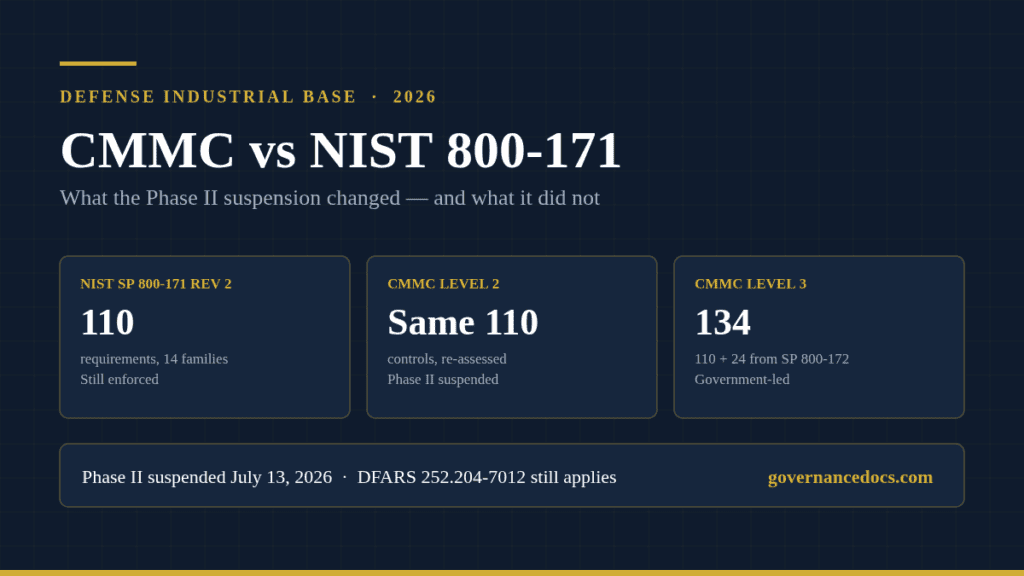
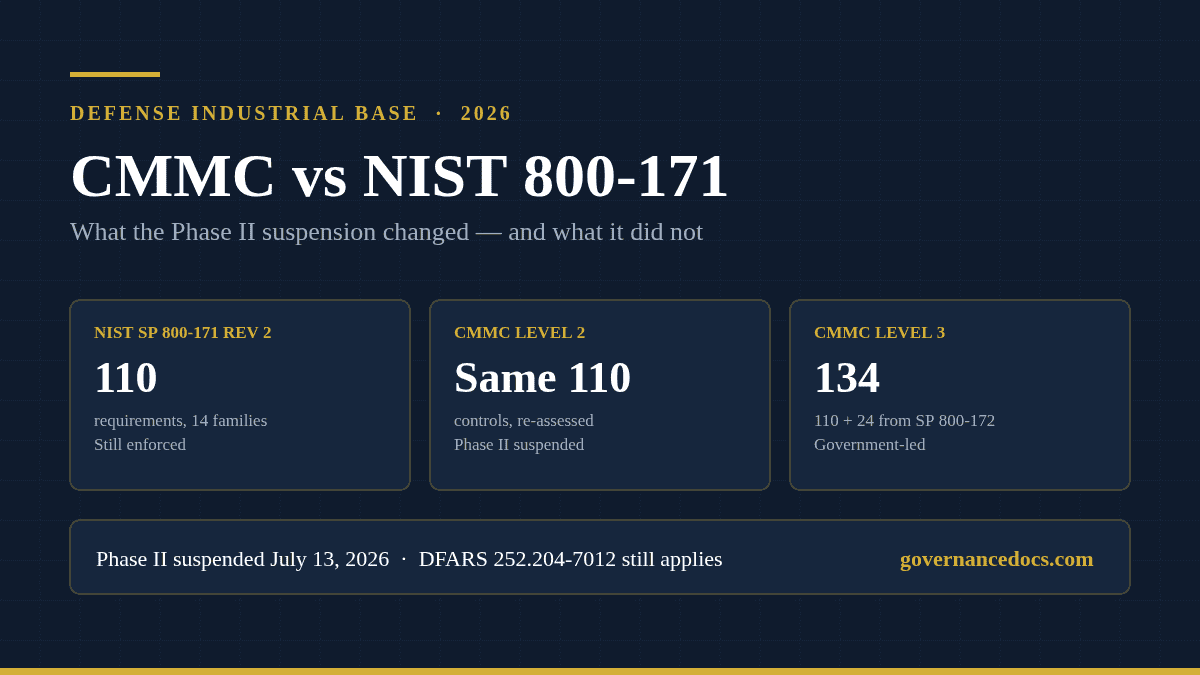
The CMMC vs NIST 800-171 question became harder to answer on July 13, 2026, not easier. That was the day the Department of War suspended CMMC Phase II — the milestone that would have forced third-party certification on contractors handling controlled unclassified information (CUI) from November 10, 2026. Plenty of contractors read the headline, concluded the program had been canceled, and quietly stood their remediation projects down. That was the wrong call. The verification layer paused. The underlying security requirements did not move an inch.
Here is the short version: NIST SP 800-171 tells you what to implement. CMMC tells you how you prove it. One is a control catalog, the other is an audit regime bolted on top. That single distinction resolves most of the CMMC vs NIST 800-171 confusion, and the suspension has made it commercially important rather than academic.
Free gap assessment
What is your CMMC Level 2 readiness, really?
Score all 110 practices, free, plus the scoping and POA&M questions that decide whether your SPRS score is usable.
Run the free CMMC gap assessment → or View premium report sample
NIST Special Publication 800-171 is a catalog of security requirements for protecting CUI on non-federal systems. Revision 2 contains 110 security requirements grouped into 14 families — access control, audit and accountability, configuration management, incident response, and so on. It is published by the National Institute of Standards and Technology and it carries no enforcement mechanism of its own. It becomes binding when a contract clause points at it.
CMMC — the Cybersecurity Maturity Model Certification — is the Department’s assurance program, codified at 32 CFR Part 170 and made contractually operational through DFARS clause 252.204-7021. At Level 2 it invents no new controls. It assesses the same 110 requirements from Revision 2. What CMMC adds is evidence, scoring rules, and, at higher levels, an independent assessor.
The cleanest way to hold the CMMC vs NIST 800-171 relationship in your head is this: 800-171 is the syllabus, CMMC is the proctored exam. Suspending the exam does not delete the syllabus.
On July 13, 2026 the Department of War announced the immediate suspension of CMMC Phase II, along with all pending and future CMMC implementation milestones across departmental solicitations and contracts. Phases 3 and 4 are frozen with it.
The stated reasoning was blunt. DoW Chief Information Officer Kirsten A. Davies described the move as a response to compliance barriers facing small and medium businesses, and the release cited Small Business Administration reporting that CMMC costs were pushing innovative companies out of the Defense Industrial Base altogether. A CMMC Reform Task Force was established the same day to run a 60-day top-to-bottom review, with its report due to the CIO in mid-September 2026. An accompanying request for information closed to industry responses on August 14, 2026.
Now the part most summaries skip. Three things explicitly survived the suspension:
That last point deserves emphasis, and it is where CMMC vs NIST 800-171 stops being a theory question. Government-led assessment did not go away. If anything, the removal of the C3PAO bottleneck makes a DIBCAC-style review the more likely form of scrutiny in the near term, and those are conducted against the same 110 requirements you were already supposed to have met.
Free ISO 27001 risk assessment
Which of your risks sit above your appetite line?
Set your own risk criteria, pick from 61 information security risk scenarios, rate likelihood and impact, and decide how to treat each one. You get a heat map, a process score and the findings an auditor would raise, free.
Run the free risk assessment → or View premium report sample
| Dimension | NIST SP 800-171 (Rev 2) | CMMC |
|---|---|---|
| What it is | Security requirements catalog | Assessment and certification program |
| Issued by | NIST | Department of War, via 32 CFR Part 170 |
| Contract hook | DFARS 252.204-7012 | DFARS 252.204-7021 |
| Content | 110 requirements across 14 families | Level 1: 15 requirements. Level 2: the same 110. Level 3: 110 plus 24 selected from NIST SP 800-172 |
| How you demonstrate it | Self-assessment scored into SPRS | Level 1 self-assessment; Level 2 self or C3PAO; Level 3 government-led (DIBCAC) |
| Who it applies to | Any non-federal organization holding CUI, including for civilian agencies | DoW contracts and their subcontract flow-down |
| Status, August 2026 | In force and actively enforced | Phase I in force; Phase II onward suspended |
| Main cost driver | Remediation and documentation | Assessment fees layered on top of remediation |
Read down the “status” row and the practical answer to CMMC vs NIST 800-171 in late 2026 becomes obvious: the column that can cost you a contract today is the left one.
Revision choice is the second place the CMMC vs NIST 800-171 distinction trips people up. NIST withdrew Revision 2 on May 14, 2024 and superseded it with Revision 3, which reorganizes the catalog into 97 requirements across 17 families, adding Planning, System and Services Acquisition, and Supply Chain Risk Management. Revision 3 also introduced organization-defined parameters, which give assessors far more to argue about.
Despite that, the Department of War’s July 2026 release named Revision 2 as the standard it will enforce. So the position today is genuinely odd, and worth stating plainly: the standard your DoW contract requires is a publication NIST has formally withdrawn. Building your system security plan against Revision 3 because it is the current document is a common and expensive mistake. Read the clause in your contract, not the NIST website. Our guide to which NIST SP 800-171 revision your contract actually names works through the traps in more detail.
Even suspended, the level structure is the yardstick any reformed program will be measured against, so it is worth knowing where you sit.
Fifteen basic safeguarding requirements drawn from FAR 52.204-21, covering federal contract information rather than CUI. Annual self-assessment with an affirmation. This tier was never in scope for the Phase II certification requirement.
All 110 Revision 2 requirements. This is where the great majority of CUI-handling contractors land, and where the suspended Phase II milestone would have replaced self-assessment with a C3PAO assessment on a three-year cycle. A limited plan of action and milestones was permitted for certain requirements, with a closure window rather than an indefinite reprieve.
The 110 requirements plus 24 selected from NIST SP 800-172, aimed at advanced persistent threats — 134 assessed requirements in total, assessed by the government’s DIBCAC rather than a commercial body. Reserved for the most sensitive programs.
Under the DoD Assessment Methodology, a self-assessment produces a score that starts at 110 and subtracts weighted points for each unmet requirement, with a floor of −203. That score goes into the Supplier Performance Risk System, and primes look at it when they build their supply chains.
Nothing in the Phase II suspension makes a negative SPRS score attractive. With certification off the table for now, the score reverts to being the main discriminator a prime has available — which is why the CMMC vs NIST 800-171 answer matters most to subcontractors. This is also where third-party risk management bites: flow-down obligations do not evaporate because a departmental milestone slipped, and primes have every incentive to keep asking.
The temptation to pause is understandable and, in most cases, wrong. Remediation and documentation work is the part that typically takes twelve to eighteen months for a mid-sized contractor; assessment scheduling is measured in weeks. Suspending the fast part is not a reason to stop the slow one.
For the full phase-by-phase background, our CMMC compliance guide sets out how the rollout was designed and which parts of it still bind you.
Yes. DFARS 252.204-7012 is untouched, and the Department confirmed it will enforce Revision 2 through self-assessments and government-led assessments during the interim period.
No, and this is the central misunderstanding in the whole CMMC vs NIST 800-171 debate. CMMC Level 2 assesses the 110 Revision 2 requirements. Remove CMMC and the 110 requirements remain.
Revision 2, unless your contract says otherwise. NIST withdrew it in May 2024, but the Department of War has continued to name it as the enforced standard.
Not as a precondition of new awards while Phase II is suspended. If your existing contract already carries a certification obligation, check the clause before assuming the relief applies to you.
The Department framed this as reform rather than cancellation, with a task force reporting in mid-September 2026 on scalable alternatives including expanded self-attestation. Treat a changed program as the likely outcome, not a vanished one.
Most of the work sitting between a contractor and a defensible position is documentation: the system security plan, the POA&M, incident response and access control policies, and evidence registers mapped to each of the 110 requirements. That is exactly the work that does not benefit from waiting for a task force.
Our CMMC Documentation Toolkit gives you 107 editable templates mapped to the CMMC control set for $99, so you can spend your time on implementation and evidence instead of drafting from a blank page.

October 11, 2026
October 11, 2026

October 11, 2026
October 11, 2026
October 11, 2026

