CART
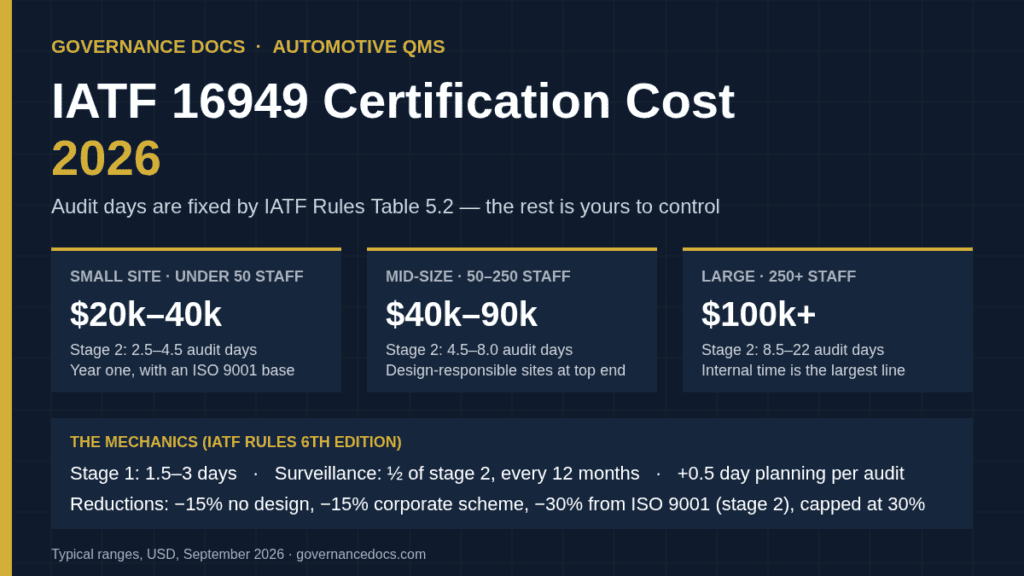
IATF 16949 certification cost is the one number every automotive supplier wants before committing, and the one number most guides refuse to give. The honest answer has two halves. The audit half is more predictable than people think, because the International Automotive Task Force fixes the minimum audit days by headcount and publishes the rules for reducing them. The implementation half is where the real spread lives. This guide separates the two, shows the audit-day tables the registrars work from, and prices three typical plants over a full three-year certification cycle.
Figures are in US dollars, labelled as typical ranges, and current as of September 2026. Get written quotes from three or four IATF-recognized certification bodies before you budget; day rates vary by country and by CB.
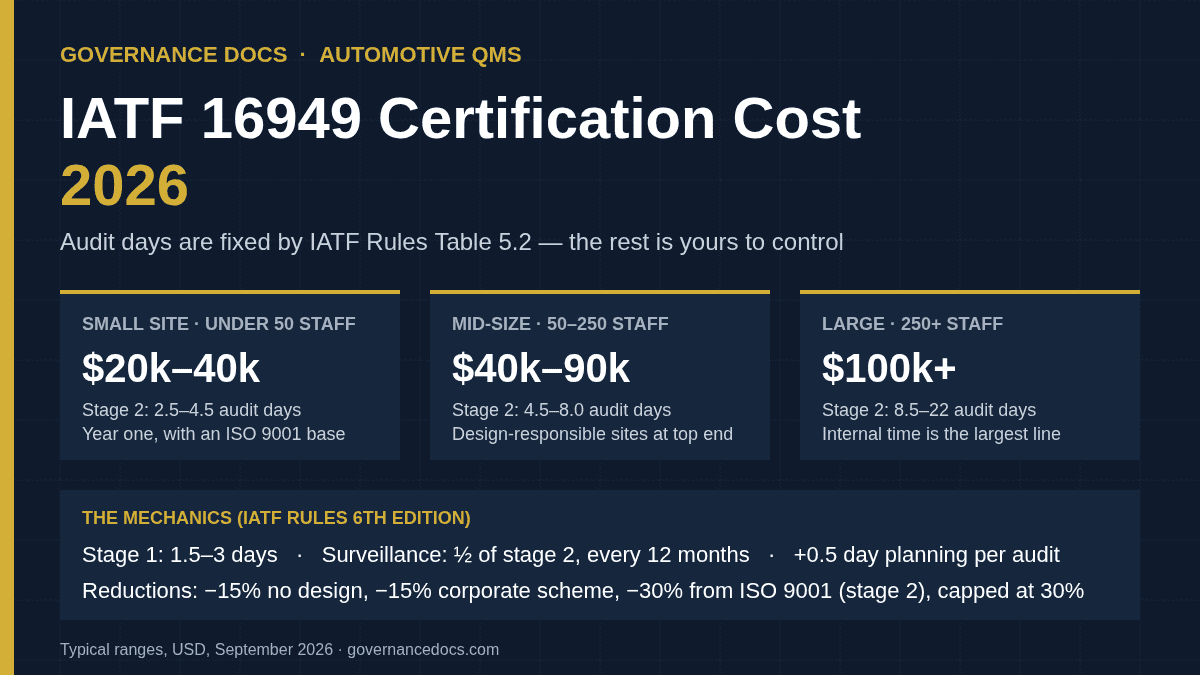
For a single manufacturing site, a realistic first-year IATF 16949 certification cost runs from roughly $20,000 for a small make-to-print shop that already holds ISO 9001 to $100,000 or more for a design-responsible tier-1 plant with several hundred employees building its system from scratch. Consultancies publishing ranges cluster in the same place: one US registrar’s October 2024 guide puts small-to-mid companies at $15,000–35,000 and large enterprises at $50,000–100,000, with initial certification audits at $10,000–25,000, consulting at $5,000–50,000, internal costs at $5,000–20,000 and surveillance at $5,000–15,000 a year.
| Cost component | Small site (under 50 staff) | Mid-size (50–250) | Large (250+) | What sets it |
|---|---|---|---|---|
| Certification body audits, year 1 (stage 1 + stage 2) | $6,000–12,000 | $12,000–20,000 | $20,000–40,000 | IATF Rules Table 5.2 days × CB day rate |
| Surveillance audits, years 2 and 3 | $3,500–6,000 each | $6,000–10,000 each | $9,000–18,000 each | Half the stage 2 days, every 12 months |
| Consultant or gap assessment | $0–15,000 | $10,000–35,000 | $25,000–60,000+ | Optional; scales with QMS maturity |
| Training (core tools, internal auditors) | $2,000–6,000 | $5,000–15,000 | $15,000–40,000 | Headcount and how much is already in place |
| Internal time and documentation | $5,000–15,000 | $15,000–40,000 | $40,000–100,000+ | The largest line and the least visible |
| Standards, manuals, software | $500–3,000 | $1,000–10,000 | $5,000–25,000 | AIAG documents, calibration or QMS software |
Every one of these ranges is an estimate built from published vendor figures and the audit-day mathematics below; none is an IATF or CB price list. The audit lines are the ones you can pin down precisely, so start there.
Most certification schemes let the certification body decide audit duration within loose guidance. IATF does not. The Rules for achieving and maintaining IATF Recognition, 6th Edition (published April 2024, effective 1 January 2025) fixes minimum audit days per manufacturing site in Table 5.2, and every IATF-recognized CB must apply them. That is why two registrars quoting the same plant should land on the same number of days and differ only on day rate, expenses and add-ons.
The Rules document itself is a paid publication, but the International Automotive Oversight Bureau, the IATF oversight office for the Americas, publishes a free audit day calculator built on Rules sections 5.2–5.4. The brackets below are taken from it.
| Employees at the site | Stage 2 (initial) days | Each surveillance audit | Recertification days |
|---|---|---|---|
| Up to 11 | 2.5 | 1.5 | 2.0 |
| 12–18 | 3.0 | 1.5 | 2.0–2.5 |
| 19–27 | 3.5 | 2.0 | 2.5 |
| 28–39 | 4.0 | 2.0 | 2.5–3.0 |
| 40–54 | 4.5 | 2.5 | 3.0–3.5 |
| 55–71 | 5.0 | 2.5 | 3.5 |
| 72–93 | 5.5 | 3.0 | 3.5–4.0 |
| 94–117 | 6.0 | 3.0 | 4.0 |
| 118–146 | 6.5 | 3.5 | 4.0–4.5 |
| 147–179 | 7.0 | 3.5 | 4.5–5.0 |
| 180–257 | 7.5–8.0 | 4.0 | 5.0–5.5 |
| 258–422 | 8.5–9.5 | 4.5–5.0 | 5.5–6.0 |
| 423–711 | 10.0–11.0 | 5.0–5.5 | 6.0–7.5 |
| 712–1,119 | 11.5–12.5 | 6.0–6.5 | 7.5–8.5 |
| 7,677 and above | 22.0 + 0.5 per extra 1,000 | 11.0+ | 15.0+ |
Read the table with these rules from the same source:
Headcount is counted per manufacturing site, but a head office, design center or warehouse that supports the plant is a remote support location and its people count too. The method most CBs use, and the one the IAOB calculator applies, is apportionment: the remote location’s employees are split across the manufacturing sites it supports in proportion to each site’s headcount, and the site’s Table 5.2 bracket is read off the combined figure. A 120-person plant supported by a 40-person shared design office is therefore audited as a 160-person site, which moves it up a bracket. Rules 6th Edition also requires one certification body per manufacturing site and its remote locations, so a group cannot split the work between registrars to shop on price. What a group can do is run a corporate scheme, which earns the 15% reduction on every audit at every site, and that is often the largest lever in a multi-plant IATF 16949 certification cost model.
A reasonable planning benchmark for a North American or Western European CB is about $1,500 per auditor-day, a figure quoted in supplier forums for years and consistent with the ranges above; some markets sit at $1,000 and some at $2,000+. Auditor travel and accommodation are billed on top, and since IATF Stakeholder Communiqué 2024-001 they are invoiced through the certification body, never paid to the auditor directly.
These use the IAOB brackets and reductions, the mandatory 0.5-day planning allowance, and a flat $1,500 day rate. Expenses, consultants and internal time are added separately below.
| Scenario | Stage 1 | Stage 2 | Surveillance ×2 | Recertification | Auditor-days, 3-year cycle | CB fees at $1,500/day |
|---|---|---|---|---|---|---|
| A. 45-staff stamping plant, no design responsibility, upgrading from ISO 9001 | 2.0 | 3.5 (4.5 less 30% cap) | 2.0 each | 3.0 | ~12.5 + 2.0 planning | ≈ $22,000 |
| B. 150-staff tier-2 with product design, no reductions | 2.5 | 7.0 | 3.5 each | 4.5 | ~21.0 + 2.0 planning | ≈ $34,500 |
| C. 400-staff tier-1, make-to-print, no ISO 9001 certificate | 3.0 | 8.5 (9.5 less 15%) | 4.5 each | 5.5 | ~26 + 2.0 planning | ≈ $42,000 |
Adding the other lines from the first table gives a full three-year picture. Plant A, with an existing ISO 9001 system and in-house quality staff, can realistically reach $35,000–55,000 over three years. Plant B, which needs core tools training and some outside help, lands around $70,000–120,000. Plant C, building a system from nothing with design and launch processes to prove, should budget $150,000–250,000, most of it internal labor. The audit fees are the smaller share in every case, which is the point of running the numbers: the registrar quote is not the budget.
The lines below rarely appear in a certification body proposal, and together they can move an IATF 16949 certification cost estimate by tens of thousands of dollars.
The documents. IATF 16949:2016 is sold by AIAG at $177 for non-members ($60 for members). It is written to be used alongside ISO 9001, so you need that text too; ISO published ISO 9001:2026 in September 2026 at CHF 196, and while IATF 16949:2016 with ISO 9001:2015 remains the audited pairing until the second edition lands, a new copy of the 2026 text is the sensible purchase now. Budget a few hundred dollars more for the AIAG core tools manuals (APQP, PPAP, FMEA, MSA, SPC), which auditors expect you to hold and apply.
Customer-specific requirements. Every OEM you supply layers its own requirements on the standard. Building and maintaining a CSR matrix, and proving it is deployed, is a recurring internal cost that no certification body prices for you.
A major nonconformity buys a special audit. Under Rules 6th Edition a major finding requires a one-time on-site special audit within 90 calendar days of the closing meeting to verify the corrective action, on top of the 15-day response deadline. That is an extra billable visit plus expenses, so the cheapest audit is the one you pass.
The pass-through fee. Several registrars itemize an “IATF fee” of around 5% of audit fees, described on supplier forums as a scheme fee passed back to the IATF; others fold it into the day rate. Ask which model your quote uses so you compare like with like.
The clock. Rules 6th Edition requires your audit dates confirmed at least 90 days ahead and your planning information delivered at least 30 days before the audit. Miss the 30-day submission and the CB can reschedule, which in a tight production year means a later certificate and, for some contracts, delayed sourcing approval.
Two things moved this year. ISO 9001:2026 is now published, and IATF Global Oversight confirmed in July 2026 (Stakeholder Communiqué SC-2026-005) that the IATF 16949 second edition is planned for mid-2027, with the end of its transition aligned to the ISO 9001 transition; the standard three-year pattern would put both around 2029, subject to the IAF’s formal resolution. Neither changes your IATF 16949 certification cost today. You are audited to IATF 16949:2016 under Rules 6th Edition, the Table 5.2 days apply, and a certificate issued now runs its full three-year cycle. What it does mean is that a transition audit will fall inside your next cycle, so keep the system lean enough to revise. Our IATF 16949 second edition guide tracks the timeline, and the ISO 9001 cost breakdown covers the base standard.
If you are new to the standard, start with our pillar guide to IATF 16949 quality management for automotive suppliers, then the core tools guide for the five AIAG manuals your auditor will test you on.
A site under 50 employees that is not design responsible and already holds ISO 9001 typically pays $6,000–12,000 in certification body fees for stage 1 and stage 2, then $3,500–6,000 per surveillance audit. With training and internal time, a first-year IATF 16949 certification cost of $20,000–40,000 is realistic; without an ISO 9001 base, plan for the upper half.
IATF Rules Table 5.2 sets the minimum by headcount: 2.5 days at stage 2 for a site of up to 11 employees, 6.0 days at around 100, 9.5 at 400 and 12.5 at 1,000, before reductions of up to 30% and plus a 1.5–3.0 day stage 1. Surveillance audits are half the stage 2 days, once a year.
Yes, on both halves. Audit days are longer because the tables are automotive-specific and the 30% floor rule applies, and implementation costs more because of the core tools, customer-specific requirements and design and launch controls the standard adds on top of ISO 9001. Holding ISO 9001 first earns a 30% stage 2 reduction.
Yes, and recertification is a standing part of IATF 16949 certification cost rather than a one-off. Rules 6th Edition uses a three-year cycle with two annual surveillance audits and a recertification audit, which is shorter than the initial stage 2 (for example 4.0 days at 100 employees versus 6.0). At a $1,500 day rate that is roughly $6,000–9,000 for a mid-size site, plus expenses.
A site with a working ISO 9001 system typically needs 6–12 months from gap assessment to certificate; a site starting from nothing usually needs 12–18 months. Both are typical ranges, not scheme rules. The fixed parts are the CB’s: at least 20 calendar days between stage 1 and stage 2, audit dates confirmed 90 days ahead, your planning pack in 30 days ahead, and a certification decision after the audit report. Time itself is the cost driver, because the months before the certificate are months of internal labor on documentation, training and the first internal audit cycle, which is why the internal line in the table above dwarfs the audit fees.
Often, yes, if you have a quality manager who knows the standard and time to build the documentation. The pieces a consultant would otherwise draft (quality manual, procedures, control plans, PFMEA formats, internal audit and management review records) are exactly what a template pack supplies, which is the cheapest lever in the whole budget.
The audit fees in this guide are largely fixed by the Rules. The part you control is how much of the system you build yourself. The IATF 16949 Toolkit gives you 250+ editable templates covering the quality manual, documented processes, core tools formats, internal audit and management review records for $99, so the gap assessment starts on day one and the consultant, if you use one, spends their days on your processes rather than your paperwork. It is a small line in any IATF 16949 certification cost estimate, and it shrinks the biggest one.

September 20, 2026
September 19, 2026
September 19, 2026

September 19, 2026

September 19, 2026

