CART
An ISO 22301 gap analysis that scores every clause out of ten and averages the result will finish late. Not because the scoring is wrong, but because the clauses are not equal — one of them carries everything built on top of it.
Weighting by dependency rather than by count is the difference between a plan that lands and a plan that discovers its real problem in month five.
Free gap assessment
Would your continuity programme survive an audit?
Score every clause of ISO 22301:2019, free, including the business impact analysis and exercise records most programmes fail on.
Run the free ISO 22301 gap assessment → or View premium report sample
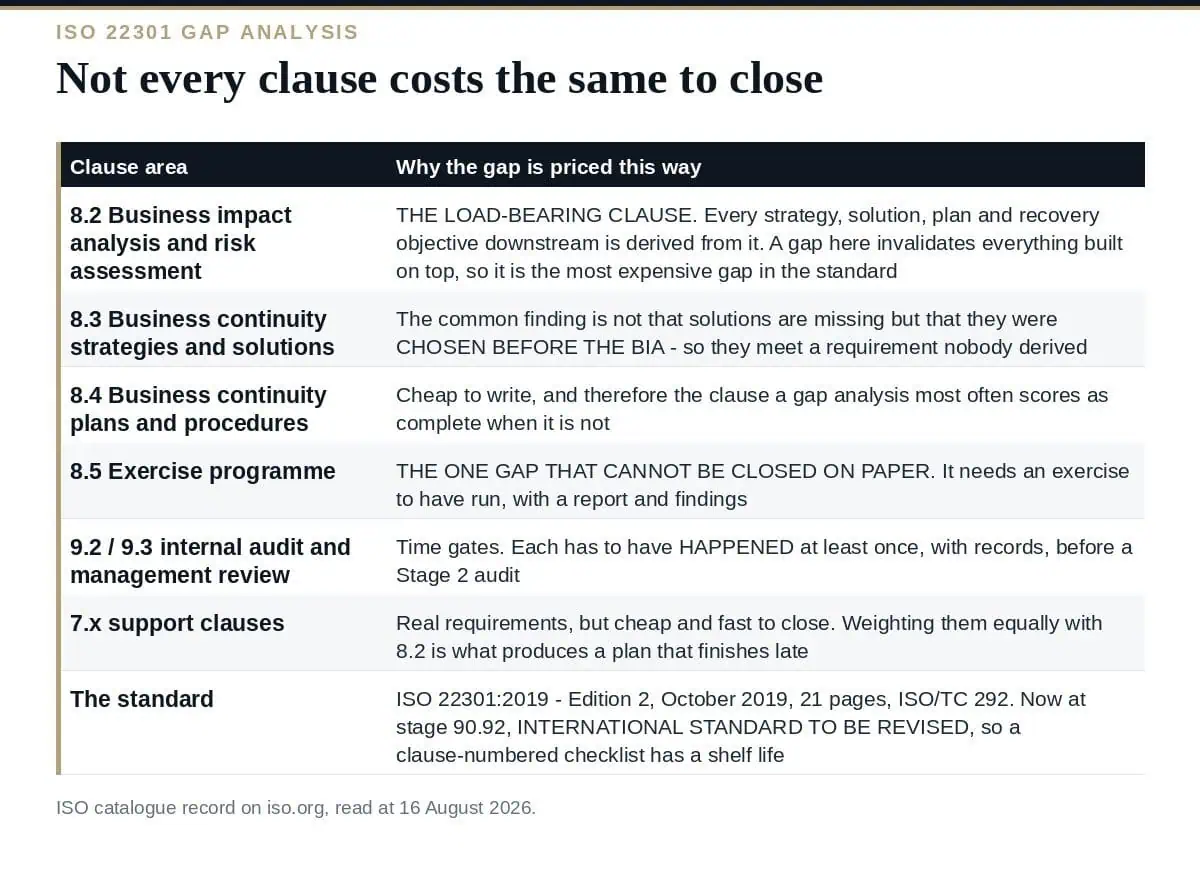
Clause 8.2 — business impact analysis and risk assessment — is load-bearing in a way no other clause is. The recovery objectives, the continuity strategies, the solutions you buy and the plans you write are all derived from it.
Free business impact analysis
How long can each activity really be down?
Rate the impact of an outage over time, set RTOs and maximum tolerable periods of disruption, map the people, systems and suppliers behind each activity, and get a recovery sequence back, free.
Run the free business impact analysis → or View premium report sample
So a gap in 8.2 is not one gap. It invalidates whatever has been built on top of it, and the work has to be redone rather than extended. An ISO 22301 gap analysis that scores 8.2 as “partial” alongside a “partial” in clause 7.4 communications is telling you the two are comparable. They are not remotely comparable.
Score dependency, not just conformity. For each gap, ask what else has to change if this one turns out to be wrong.
Business continuity strategies and solutions is rarely empty. The usual finding is subtler and more expensive: the solutions were selected before the business impact analysis was done.
A secondary site, a replication arrangement, a standby contract — chosen on engineering judgement or on what was already in the budget, then retrofitted to a BIA written afterwards to agree with them. It reads as conformity in a document review and falls apart the moment an auditor asks which requirement drove which solution.
This is worth a specific question in the gap analysis rather than a score: for each continuity solution, which BIA output justifies it, and which came first?
Free business continuity risk assessment
What could stop your most important activities?
List your prioritized activities and what they depend on, pick from 32 disruption scenarios, rate them and choose continuity measures for each. Built to ISO 22301 clause 8.2.3, and free.
Run the free continuity risk assessment → or View premium report sample
Clause 8.4, business continuity plans and procedures, is the clause an ISO 22301 gap analysis most often scores complete when it is not — precisely because plans are cheap to produce. Volume of documentation is not evidence of conformity here; a plan that names roles that no longer exist scores zero in an audit and full marks in a document count.
Clause 8.5, the exercise programme, is the opposite. It is the one gap in the standard that cannot be closed on paper. An exercise has to have run, with a report, findings and consequent changes. Discover that gap late and it sets your certification date regardless of everything else — the same way exercising gates the regulated regimes.
Two clauses behave like 8.5 and are missed for the same reason. Clause 9.2, internal audit and clause 9.3, management review each have to have happened at least once, with records, before a certification body can test them. Documenting the procedure takes an afternoon; satisfying the clause takes a cycle.
Put these three — 8.5, 9.2 and 9.3 — at the top of the ISO 22301 gap analysis output, because between them they determine the earliest date an audit is worth booking. Everything else is a resourcing question.
The clause 7 support requirements — competence, awareness, communication, documented information — are real and they are also fast. They cost days, not months, and they rarely block anything downstream.
Weighting them equally with clause 8 is what produces a remediation plan where the team spends the first six weeks on the cheap half and hits the expensive half with no time left. If a gap analysis output is going to drive a plan, the sequencing has to come out of the weighting.
ISO 22301:2019 is the second edition, published October 2019, 21 pages, maintained by ISO/TC 292. Its catalogue record now shows stage 90.92 — International Standard to be revised, so a third edition is in development.
Two practical consequences. A gap analysis keyed to clause numbers will need reworking when the new edition lands, so record findings against the requirement in your own words as well as the clause reference. And this is not a reason to wait — certification runs against the current edition, and transition periods exist for exactly this.
The output of an ISO 22301 gap analysis is not the assessment; it is the plan that comes out of it. Three things make that plan credible:
| Area | Connection |
|---|---|
| Business impact analysis | Clause 8.2, the load-bearing input everything downstream is derived from |
| ISO 22301 certification | What the two audit stages test, and where the gap analysis output has to land |
| Business continuity exercise | Clause 8.5, the gap that cannot be closed on paper |
| ISO 22301 mandatory documents | What the documented information requirements actually amount to |
This guide reflects the ISO 22301:2019 catalogue record on iso.org, read at 16 August 2026. A third edition is in development — check the record before building a clause-numbered checklist you intend to keep.
The ISO 22301 Assessment Tool is an Excel workbook that scores the BCMS clause by clause, weights the findings and produces the remediation list a gap analysis is meant to output — and the ISO 22301 Toolkit supplies the 75+ templates you use to close what it finds.

October 15, 2026

October 15, 2026
October 14, 2026
October 14, 2026
October 14, 2026

