CART
A bridge letter is what a service organisation sends when its SOC 2 report ends in September and a customer needs assurance through December. It is also the most over-trusted document in third-party assurance.
It is written by management, not the auditor. Nothing in it is tested. Understanding exactly what it does and does not carry is the difference between a reasonable stopgap and a false sense of coverage.
Free gap assessment
How much of your SOC 2 report can you already evidence?
Score yourself against the Trust Services Criteria, free, before an auditor charges you to find out.
Run the free SOC 2 gap assessment → or View premium report sample
SOC 2 Type 2 reports cover a defined period. Once that period ends, the report says nothing about what happened afterwards — and customers with a different financial year end, or a diligence deadline, need to cover the interval.
The bridge letter — sometimes called a gap letter — fills it. Typically it states that between the end of the report period and the date of the letter, management is not aware of any material changes to the control environment, and not aware of control failures that would affect the conclusions in the report.
That phrasing is the whole story. Not aware of. It is a management representation about the absence of known problems, not evidence that anyone went looking.
Three limits, and none of them is a technicality.
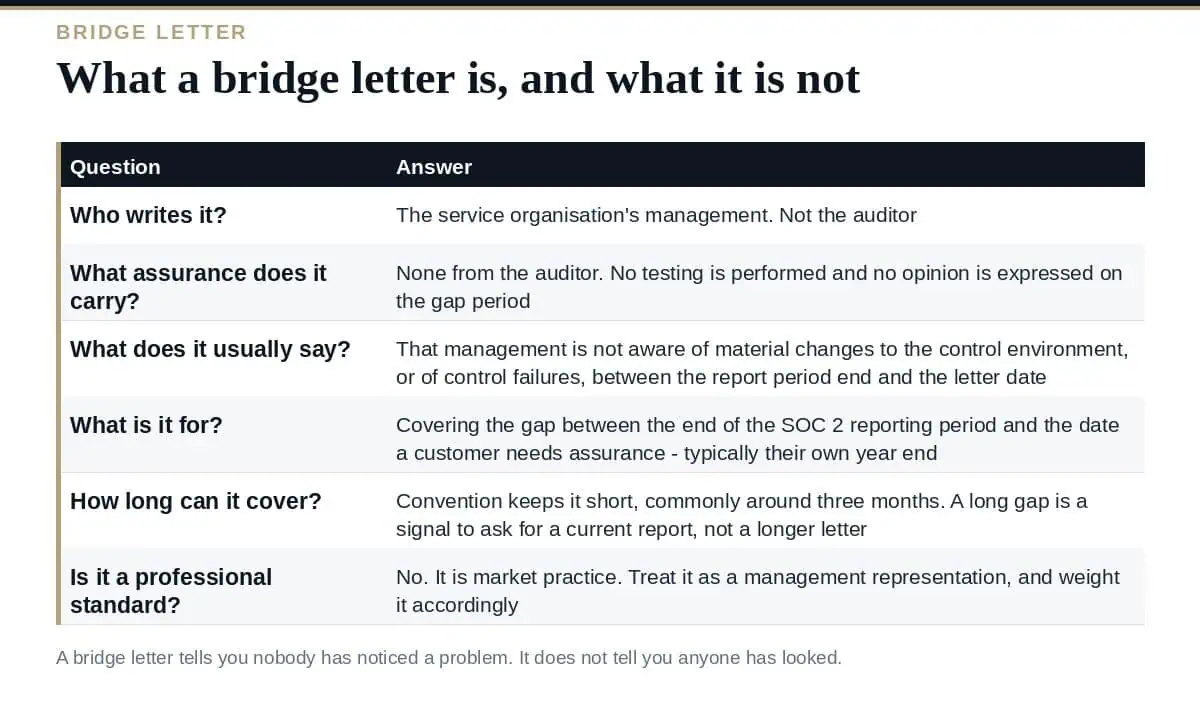
It is not an auditor product. The service organisation’s management writes and signs it. The service auditor does not issue it, does not test the gap period, and expresses no opinion on it. A bridge letter on the provider’s letterhead is exactly what it appears to be.
It is not an attestation. No procedures are performed. There is no examination, no sampling, no testing of operating effectiveness across the gap.
It is not a professional standard. The bridge letter is market convention that grew up around a real scheduling problem. That does not make it worthless — it makes it a representation whose weight depends entirely on how much you trust the party signing it.
Convention keeps bridge letters short, commonly around three months. The logic is straightforward: the further you get from tested evidence, the less a statement of unawareness is worth.
A long gap is a signal, not a formatting problem. If a provider is offering to bridge six or nine months, the useful questions are about the report cycle rather than the letter:
The right answer to a long gap is a current report, not a longer letter.
If you receive a bridge letter, three checks take two minutes and are usually skipped.
Check the dates line up. The letter should start where the report period ended, with no unexplained space between them, and run to a date that actually covers your requirement.
Check who signed it. A named officer of the service organisation with the standing to make the representation — not an account manager.
Check what it actually asserts. Some letters say only that no material changes occurred. Better ones also confirm that the controls continued to operate, and disclose known changes. A letter that discloses a change is more useful than one that is silent, and considerably more credible.
The same letter is issued for a SOC 1 report, and there it matters more: a user entity’s financial-statement auditor needs coverage to the user entity’s year end, and a SOC 1 bridge letter is management’s statement that the system, the control objectives, the controls, the complementary user entity controls and the subservice organisations described in the report have not materially changed since the period ended. Our SOC 1 audit checklist covers both sides of that exchange — the bridge letter a service organisation issues, with the control-owner confirmations it rests on, and the request a user entity sends to obtain one.
Two things make a bridge letter defensible for the provider.
Do not represent more than you know. A statement that no control failures occurred is a stronger claim than a statement that management is not aware of any. Only sign the one you can support.
Disclose changes rather than omitting them. A migration or a new subprocessor disclosed in the letter is a routine conversation. The same fact discovered later, after a silent letter, is a credibility problem that outlasts the gap period.
And the structural fix is to stop needing them: aligning your report period with the year end your major customers care about removes the gap for most of your base.
| Area | Connection |
|---|---|
| SOC 2 compliance | The programme behind the report, and why the reporting period is chosen as it is |
| Type 1 vs Type 2 | Bridge letters exist because Type 2 covers a period. A Type 1 speaks to a point in time and raises a different question |
| Complementary user entity controls | The other half of the report that customers must act on — and unlike the bridge letter, it creates obligations for you |
| Third-party risk management | Record report periods and expiry in the supplier inventory, so gaps are anticipated rather than discovered |
This guide describes SOC 2 market practice as at 16 August 2026. Bridge letters are a convention rather than a matter of professional standards, and their content varies between providers — your service auditor is the authority on what a given report covers.
The SOC2 Toolkit provides the documentation pack behind a SOC 2 programme, including the system description, the control descriptions and the evidence records a service auditor works from.

October 15, 2026
October 15, 2026
October 14, 2026
October 14, 2026
October 14, 2026

