CART
International data transfers under the GDPR are governed by a chapter with a strict order of priority, and the route most organisations reach for when the others look difficult is the one the Regulation designed to be almost unusable.
Chapter V is also broader than people assume: international data transfers include onward transfers, and the rules bind processors as well as controllers.
Free gap assessment
Could you demonstrate GDPR compliance today?
Score yourself against what a supervisory authority actually asks for, free — the records, not the policy.
Run the free GDPR gap assessment → or View premium report sample
Article 44 sets the frame. Any transfer to a third country or international organisation may take place only if the conditions in Chapter V are complied with by the controller and processor — including for onward transfers from that third country or organisation to another.
Two consequences follow immediately.
Your processor’s transfers are in scope. Chapter V does not stop at your own contract. If your supplier moves the data on, that onward transfer needs a basis too.
And the closing sentence of Article 44 is the interpretive rule for everything after it: all provisions in the chapter shall be applied in order to ensure that the level of protection guaranteed by this Regulation is not undermined. Where a route looks technically available but would hollow out that protection, that sentence is the answer.
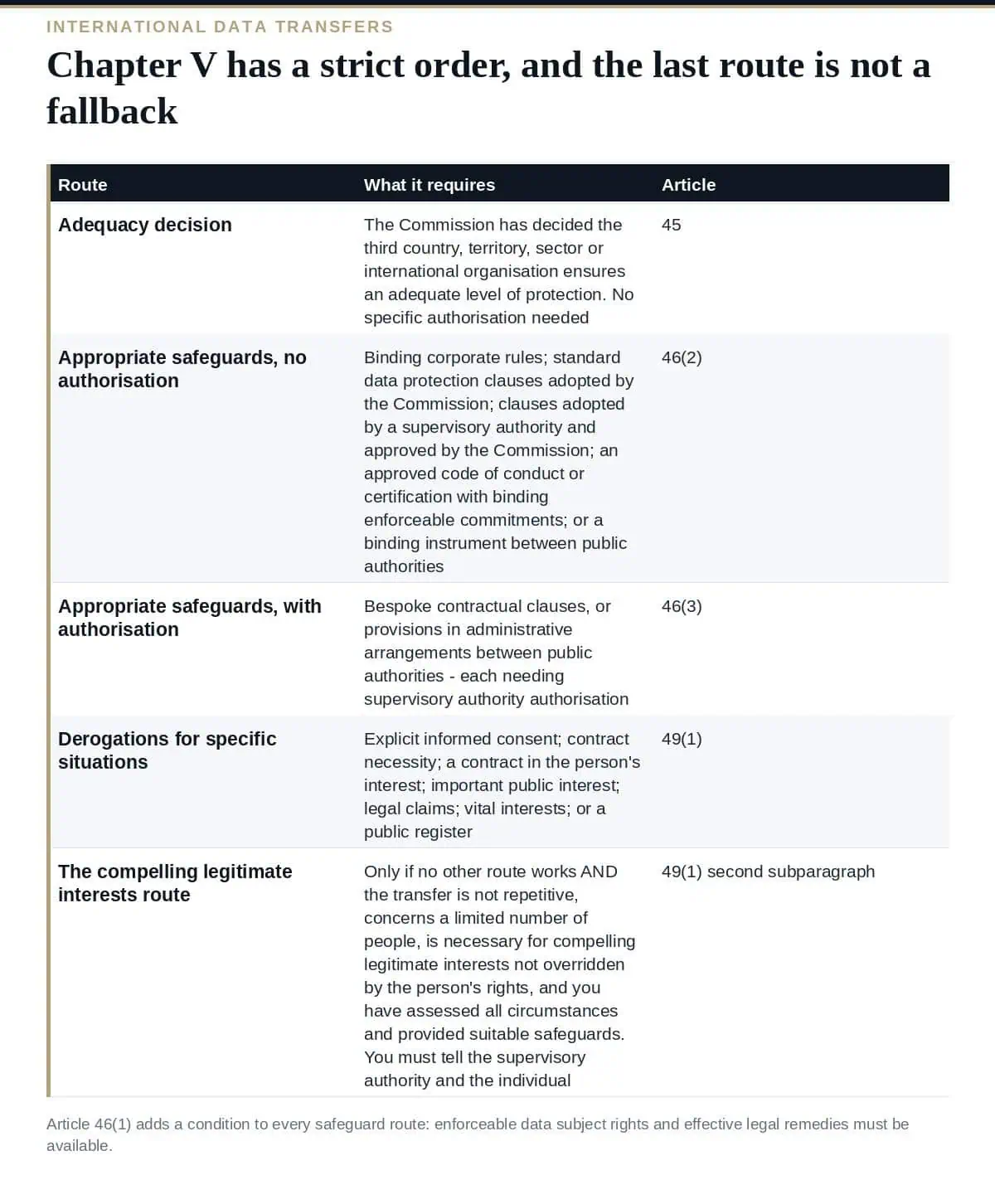
Adequacy first. This is the cheapest route for international data transfers. Article 45 lets the Commission decide that a third country, a territory, a specified sector within a country, or an international organisation ensures an adequate level of protection. Where an adequacy decision applies, the transfer needs no specific authorisation. Nothing else to do — which is why the first question in any transfer analysis is whether adequacy covers this destination and this sector.
Then appropriate safeguards. Article 46 applies in the absence of an adequacy decision, and it carries a condition that is easy to skim past: safeguards work on condition that enforceable data subject rights and effective legal remedies for data subjects are available. That condition sits above the list, not inside it.
Article 46(2) lists the safeguards available without any specific authorisation: binding corporate rules; standard data protection clauses adopted by the Commission; standard clauses adopted by a supervisory authority and approved by the Commission; an approved code of conduct or an approved certification mechanism, each together with binding and enforceable commitments from the party in the third country; and a legally binding instrument between public authorities.
Article 46(3) covers the routes that do need supervisory authority authorisation: bespoke contractual clauses, and provisions inserted into administrative arrangements between public authorities. Writing your own clauses is possible — it is simply not a shortcut.
Article 49(1) applies only in the absence of adequacy or appropriate safeguards, and lists seven conditions: explicit consent after being informed of the possible risks arising from the absence of adequacy and safeguards; necessity for a contract with the data subject or pre-contractual measures at their request; a contract concluded in the data subject’s interest; important reasons of public interest; the establishment, exercise or defence of legal claims; vital interests where the person is physically or legally incapable of consenting; and transfers from a public register.
Read them as what they are — specific situations, not a general licence. Consent under (a) requires the person to have been told about the missing adequacy decision and safeguards specifically, which is a very different conversation from a tick box. Contract necessity under (b) means necessary, not convenient: routing data through an overseas support desk is rarely necessary for performing the contract itself.
The second subparagraph of Article 49(1) is the one organisations discover when everything else has failed, and it is deliberately narrow. It applies only where the transfer could not be based on Article 45 or 46 — including binding corporate rules — and no derogation applies. Then a transfer may take place only if all of the following hold:
Then two disclosures, both mandatory: the controller shall inform the supervisory authority of the transfer, and shall inform the data subject of the transfer and of the compelling legitimate interests pursued — in addition to the usual Article 13 and 14 information.
“Not repetitive” and “a limited number of data subjects” together rule out any ongoing operational flow. This is a route for an exceptional, bounded transfer — and telling your regulator about it is part of the price.
International data transfers surface in documents you already maintain, and inconsistency between them is a common audit finding.
| Document | What it must say about transfers |
|---|---|
| Records of processing | Article 30 requires transfers to be recorded with the third country or organisation identified — and for Article 49(1) second subparagraph transfers, the documentation of suitable safeguards |
| Access requests | Article 15(2) gives the person the right to be informed of the Article 46 safeguards relating to the transfer |
| DPIA | Where transfers contribute to high risk, the assessment and the safeguards belong there too |
| DPDP Act | India’s rule 15 governs transfers out of India on a different model. Mapping flows once serves both |
This guide reflects Regulation (EU) 2016/679 as published on EUR-Lex, read at 16 August 2026. Adequacy decisions are added, amended and repealed over time — check the current list before relying on one.
The GDPR Toolkit provides 100+ editable templates including the transfer register and transfer risk assessment, the records of processing, the DPIA template and the data subject rights procedures.
Free transfer impact assessment
Can this transfer of personal data go ahead?
Check whether the transfer needs a TIA, map it, assess the laws and practice of the destination, rate the risks from 27 transfer scenarios and choose supplementary measures. Covers the EU SCCs and the UK IDTA and Addendum, free.
The UK rewrote its transfer provisions in 2026 with a “not materially lower” test and its own instruments: see UK GDPR vs EU GDPR for where the two regimes now differ.
Transfers out of Saudi Arabia run on a different mechanism, with no adequacy list yet and SDAIA’s own clauses: see Saudi standard contractual clauses.


October 15, 2026

October 15, 2026
October 14, 2026
October 14, 2026
October 14, 2026

