CART

Records of processing under GDPR Article 30 are the document a supervisory authority asks for first, and the one most organisations under 250 employees believe they do not need.
That belief is usually wrong, and the reason is a single word in Article 30(5).
Free gap assessment
Could you demonstrate GDPR compliance today?
Score yourself against what a supervisory authority actually asks for, free — the records, not the policy.
Run the free GDPR gap assessment → or View premium report sample
Article 30(5) does say the obligation does not apply to an enterprise or organisation employing fewer than 250 persons. Then it adds three exceptions, and any one of them removes the exemption.
The obligation applies anyway where:
The second one settles it for nearly everybody. Paying employees is not occasional. Holding a customer database is not occasional. Routine, ongoing processing is the opposite of occasional, and virtually every organisation does some.
Note also that the exception is about risk being likely, not high risk — a lower bar than the DPIA trigger in Article 35.
The practical position: if you have staff and customers, assume records of processing are required and spend your energy on making the record useful rather than on arguing you are exempt.
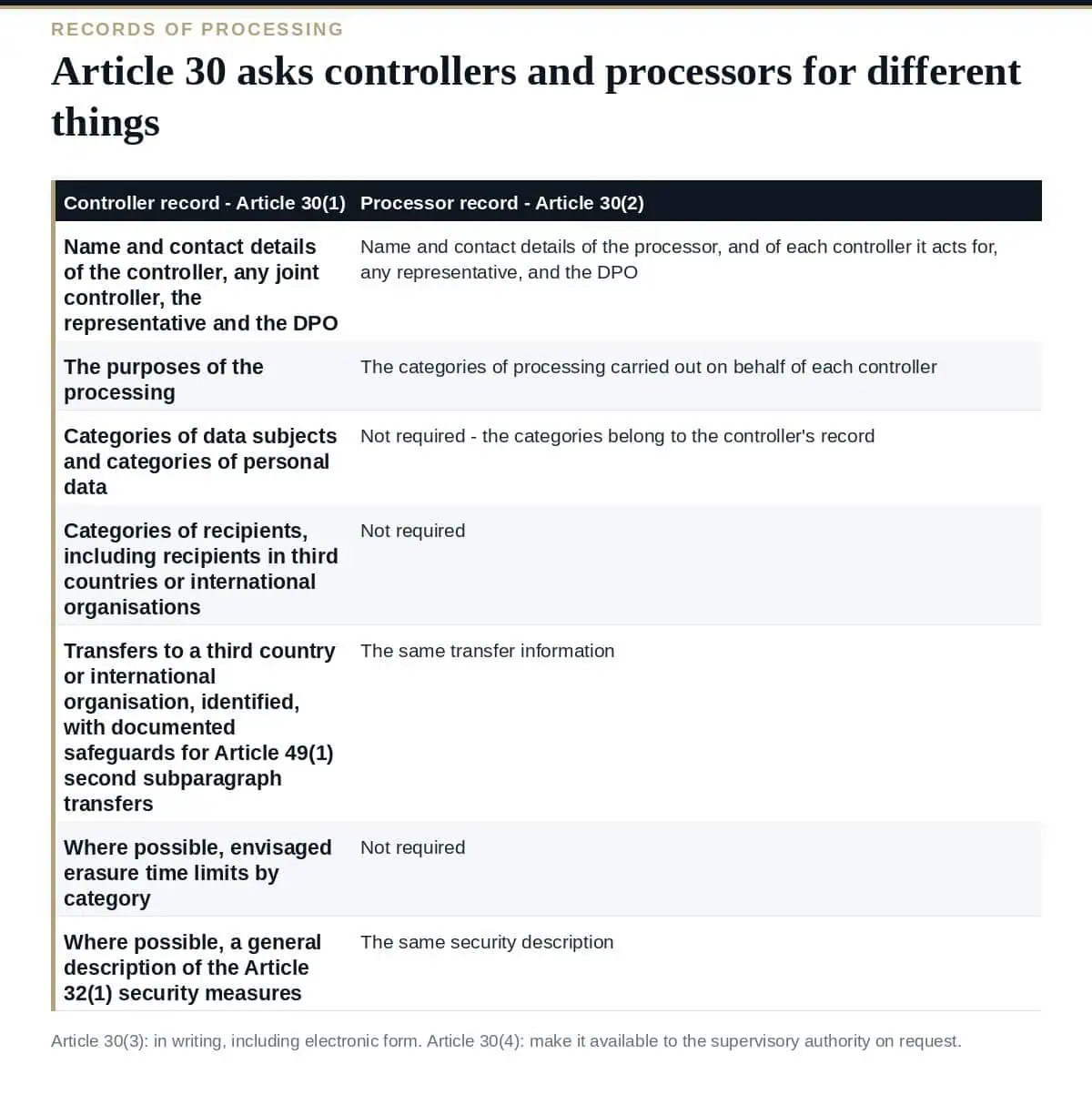
Article 30(1) says the record shall contain all of the following — there is no “where appropriate” on the list as a whole:
Only the last two carry “where possible”. The rest are unqualified — which means a record with blank purposes or unnamed recipient categories is incomplete on the face of it.
Free ROPA template and builder
Could you hand your records of processing to a regulator tomorrow?
Check whether Article 30 applies to you, add your processing activities from a library organized by department, complete every Article 30 content, and see which activities are missing a lawful basis, a transfer safeguard, a DPIA or an LIA. Free, with a record score and findings.
This is the part processors routinely miss: Article 30(2) places a separate, independent obligation on the processor. It is not satisfied by appearing in a client’s record.
The processor record covers all categories of processing carried out on behalf of a controller, and contains:
Notice what is absent: purposes, categories of data subjects, categories of personal data and retention periods are not in the processor list. That is deliberate — those belong to the controller, whose record carries them. A processor that copies the controller template is documenting decisions it does not own.
Article 30(3) requires records of processing to be in writing, including in electronic form. A spreadsheet is fine. A shared understanding is not.
Article 30(4) requires the controller or processor — and where applicable the representative — to make the record available to the supervisory authority on request.
That last obligation is why this document matters more than its dull name suggests. It is frequently the opening request in an investigation or complaint, and it is read as a proxy for whether the organisation knows what it is doing. A thin or contradictory record shapes everything that follows.
Treated as a compliance chore, records of processing produce a spreadsheet nobody opens. Treated as an inventory, it is the foundation several other obligations quietly assume:
| Obligation | What it takes from the record |
|---|---|
| DPIA | Article 35(7)(a) requires a systematic description of the processing and purposes. Most DPIA delays are really inventory delays |
| Data subject rights | You cannot answer an access or erasure request across systems you have not listed |
| Breach notification | Under time pressure, the record tells you what categories and whose data are involved |
| Data governance | The same inventory, with ownership and quality added. Build one, not two |
The same artefact also does most of the work for India’s DPDP Act and CCPA obligations, which is the strongest argument for maintaining it properly rather than annually.
This guide reflects Regulation (EU) 2016/679 as published on EUR-Lex, read at 15 August 2026.
The GDPR Toolkit provides 100+ editable templates including separate controller and processor records of processing, the DPIA template and screening questionnaire, retention schedules and the data subject rights procedures.

October 15, 2026
October 15, 2026
October 14, 2026
October 14, 2026
October 14, 2026

