

What Is a Policy Brief? The Essential 2026 Guide With Examples
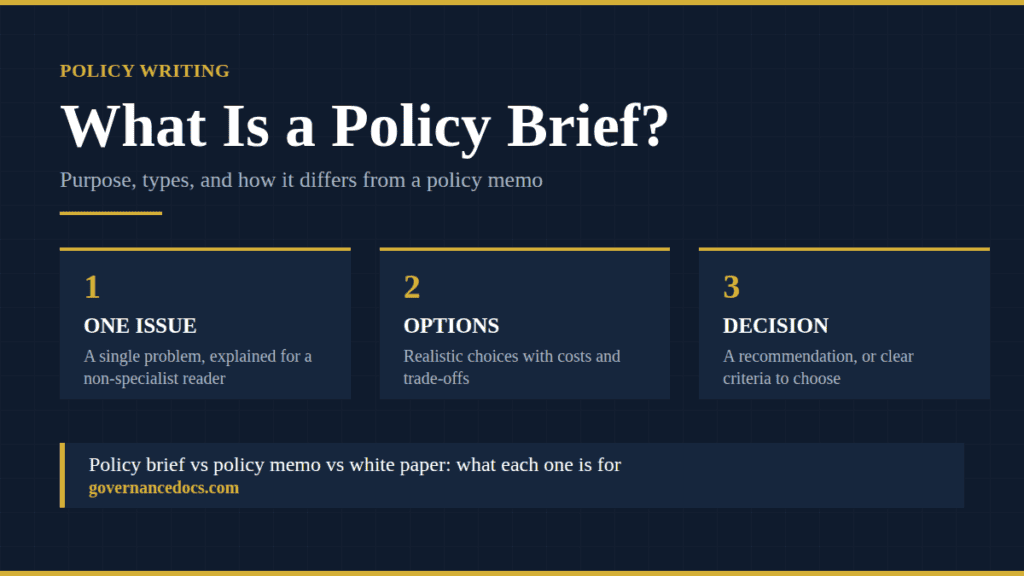
A policy brief is a short, stand-alone document that explains one issue to a decision-maker, sets out the realistic options, and usually recommends one of them. It is written for people who have to act, not for other experts, so it trades academic depth for speed: the main point sits on the first page, the evidence is summarized, and every section points toward a decision.
This guide answers what is a policy brief in practical terms: what it is for, the two main types, how it differs from a policy memo and other policy documents, and what one looks like inside. If you already know the basics and want a fill-in structure, go straight to our policy brief template with fill-in wording.
What is a policy brief?
The University of Waterloo’s Writing and Communication Centre defines it as a concise summary of an issue designed to help policymakers reach a decision. The brief pulls together research on the issue’s context, causes, stakeholders, scope and impact, and then makes a recommendation.
Canada’s International Development Research Centre (IDRC) puts it in similar terms in its guide to writing a policy brief: a policy brief presents research and recommendations to a non-specialized audience, focuses on a single topic, and works as a clear, concise stand-alone document. Its guidance for grantees sets a hard ceiling of 1,500 words or two pages.
Three features separate a policy brief from other short documents:
- A decision-maker as the reader. The audience is a minister, legislator, agency head, board or senior official who is not a specialist in the subject.
- One issue. A brief that tries to cover three problems ends up convincing nobody on any of them.
- A route to action. Even a neutral brief lays out options and their consequences so the reader can choose.
What is the purpose of a policy brief?
If you are asking what is a policy brief for, the short answer is: the purpose of a policy brief is to turn evidence into a decision. Waterloo’s guidance lists four jobs the document has to do: give enough background for the reader to understand the problem, convince them it is urgent, present alternative solutions with evidence, and prompt them to decide.
That purpose explains most of the format choices. Decision-makers read in short bursts and often only read the first page, so the conclusion comes first. They are not specialists, so jargon is defined or cut. They need to defend their choice to others, so each option comes with its costs and trade-offs, not only its benefits.
Who writes them? Mostly think tanks, NGOs, university research teams, government policy analysts, international bodies and advocacy groups. Public policy and public health students write them as coursework, because the format is a core professional skill in those fields. Companies write them too, usually through a government affairs team responding to proposed legislation or regulation.
Types of policy brief: advocacy vs objective
Writing guides generally split briefs into two types, and you should decide which one you are writing before you draft a word.
| Advocacy brief | Objective brief | |
|---|---|---|
| Goal | Argue for one course of action | Present several options fairly so the reader decides |
| Tone | Persuasive, but evidence-led | Neutral and balanced |
| Options section | Alternatives shown, then rejected with reasons | Alternatives compared side by side |
| Recommendation | One clear recommendation | Often none, or criteria for choosing |
| Typical author | NGOs, advocacy groups, industry bodies | Research institutes, legislative research services, civil servants |
| Main risk | Reads as lobbying if the evidence is thin | Reads as indecisive if the comparison is vague |
Neither type is better. An advocacy brief from a group with an obvious interest has to work harder on its evidence, because the reader will discount it. An objective brief from a research service earns trust by refusing to pick a side, but it still has to make the trade-offs sharp enough to be useful.
Policy brief vs policy memo: what is the difference?
The policy memo vs policy brief question comes up constantly in public policy courses, and the honest answer is that the line is blurry. Organizations and instructors use the terms differently. But the conventions below hold in most settings.
Duke University’s Writing Studio, in its policy memo handout, describes a policy memo as written for a specific, often limited audience, formatted like an email with “To:”, “From:”, “Date:” and “RE:” lines, and built so the reader gets the main points after one quick read. A policy brief, by contrast, is usually a designed document with a title, often published, and aimed at a wider group of decision-makers.
| Policy memo | Policy brief | |
|---|---|---|
| Reader | One named person or office | A wider set of decision-makers, sometimes the public |
| Format | To / From / Date / RE header, plain text | Title, sections, often a designed layout with a callout box |
| Circulation | Usually internal, sometimes confidential | Often published or shared outside the organization |
| Trigger | Often requested by the reader | Often produced on the author’s own initiative |
| Context assumed | Reader already knows the background | Reader may know little about the issue |
| Length | Short; limits vary by organization | Short; limits vary by publisher |
A useful test: if you know exactly who will read it and they asked for it, write a memo. If you want to put evidence in front of decision-makers who have not asked, write a brief. For the six differences in detail and the same issue written both ways, see our policy memo vs policy brief comparison.
Policy brief vs white paper, research paper and op-ed
People also confuse a policy brief with longer or more public formats. Here is how they usually compare.
| Document | Main reader | Typical length | Main job |
|---|---|---|---|
| Policy brief | Non-specialist decision-makers | Usually 1–4 pages | Recommend or compare options on one issue |
| Policy memo | One named decision-maker | Usually 1–3 pages | Answer a specific question for that reader |
| White paper | Informed practitioners, industry or government | Often 10+ pages | Explain a problem and a proposed approach in depth |
| Research paper | Other researchers | Varies, often long | Report methods and findings for peer scrutiny |
| Op-ed | The general public | Usually under 1,000 words | Persuade readers through a newspaper or site |
Lengths in this table are typical ranges, not rules. Always follow the limit your publisher, funder or instructor sets. IDRC, for example, caps briefs at two pages.
One more confusion is common on a site like ours. A policy brief argues about public policy. An organizational policy, such as an information security or code of conduct policy, is an internal rule that staff must follow. If that is what you need, our guide to writing a company policy template is the right starting point.
What does a policy brief look like?
Most guides agree on a two-part structure: an overview the reader can stop after, and a main body that holds the evidence.
- Title that states the point, not just the topic.
- Executive summary of the problem, the options and the recommendation, readable on its own.
- Introduction on why the problem matters now and why policy action is needed.
- Analysis of the causes, effects and current policy.
- Policy options, each with its advantages and disadvantages.
- Recommendations, specific about who should do what.
- Sources, kept short and placed at the end.
Here is an illustrative executive summary, with a made-up issue and placeholder figures, to show the tone:
Rural bus routes in [County] lost [X]% of riders after the [year] timetable cut, leaving residents without cars unable to reach the regional hospital. Three options were assessed: restoring the old timetable, funding demand-responsive minibuses, and a taxi voucher scheme. We recommend a two-year minibus pilot, which serves the most affected residents at the lowest cost per trip of the three options assessed.
Notice what it does: problem, options and recommendation in three sentences, with no background the reader has to wade through first. For the full section-by-section layout with example wording, see the policy brief format and fill-in template.
What makes a policy brief effective?
- Write the purpose down first. IDRC advises writing out the purpose before drafting and checking every paragraph against it.
- Put the answer at the top. Duke’s guidance calls this the inverted pyramid: most important information first, details after.
- Use headings that summarize. A reader who skims only the headings should still get the argument.
- Be honest about trade-offs. A recommendation with no stated downside looks like advocacy dressed up as analysis.
- Cut the methodology. Readers need to trust the evidence, not replicate it. A line on sources and a link is enough.
- Make the ask specific. “Improve transport” is not a recommendation. “Fund a two-year pilot through the [named] grant line” is.
If your work involves writing internal governance documents as well as external briefs, the same discipline of short sections, clear owners and plain words applies. Our guide to the policy and procedure template shows how that looks for internal rules.
Policy brief FAQ
What is a policy brief in simple terms?
It is a short document that tells a busy decision-maker what the problem is, what they could do about it, and what you think they should do. Think of it as evidence packaged for someone who has ten minutes, not ten hours.
How long is a policy brief?
Most guidance puts it at two to four pages. IDRC’s guidance for its grantees sets a maximum of 1,500 words or two pages. Some academic and think-tank series run longer, but the shorter the brief, the more likely a busy reader finishes it.
Is a policy brief the same as an executive summary?
No. An executive summary condenses a longer report and is not meant to stand alone. A policy brief is a complete document in its own right, though it usually opens with its own short summary.
Does a policy brief need references?
Yes, but keep them light. List the key sources at the end or in notes so the reader can check your evidence. Don’t fill the page with in-text citations the way an academic paper would.
Can a policy brief be neutral?
Yes. An objective brief compares options without recommending one, which is common for legislative research services and civil servants. It still has to make the consequences of each option clear enough for the reader to choose.
Who is the audience for a policy brief?
A non-specialist decision-maker: an elected official, senior civil servant, agency head, funder or board. Write for someone intelligent and busy who does not know your field.
Ready to write one? Start from our free policy brief template, which gives you the seven standard sections with example wording you can adapt, plus step-by-step guidance on drafting each one.
When a standard changes, know first
One email a month: edition changes, new deadlines, and what they mean for documentation you already have. No sales sequence.

Governance Docs
Governance Docs LLC
Recent Posts
November 27, 2026

November 27, 2026

November 26, 2026

November 26, 2026

November 26, 2026