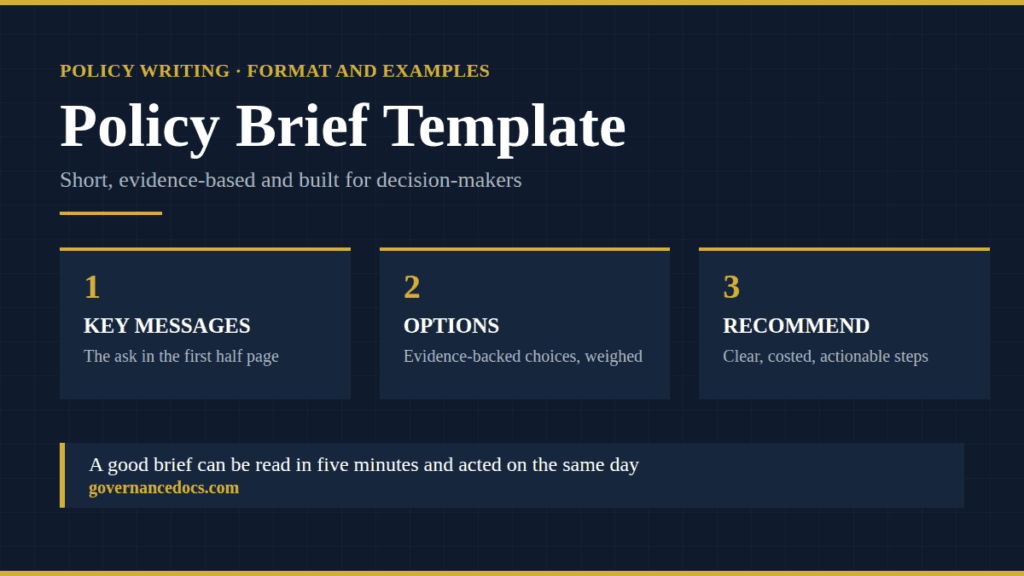
A policy brief template gives you a fixed structure for turning research or analysis into a short document that tells decision-makers what the problem is, what the options are and what you recommend. Think tanks, NGOs, government analysts, researchers and students all use the format, because officials rarely have time for anything longer.
This guide covers the standard policy brief format, a fill-in template with example wording, how to write a policy brief step by step, what published examples of policy briefs have in common, and how to lay the template out in Word. One distinction up front: a policy memo is usually written for a single named decision-maker, often internally, while a policy brief is written for a wider policy audience and is usually published. For the full comparison, and the two types of brief, see our explainer on what a policy brief is and how it differs from a memo.
Policy brief format: sections and length
There is no single official format, but the guidance from funders and universities converges. The International Development Research Centre’s guide to writing a policy brief tells authors not to exceed 1,500 words or two pages. The University of Sussex suggests two or four A4 pages, roughly 1,000 to 2,000 words. In practice, two pages is the common target and four is the usual ceiling.
Within that length, most briefs use the same building blocks. The word ranges below follow the University of Sussex guidance and suit a four-page brief; halve the body sections for a two-pager.
Section
Job it does
Typical length
Title
States the issue, ideally with the direction of the argument
One line
Key messages / executive summary
Gives a busy reader the whole argument at a glance
100–200 words or 3–5 bullets
Introduction / context
Explains the problem, why it matters now and who is affected
50–100 words
Findings or analysis
Presents the evidence and what it means, including limits
Up to 1,500 words
Policy options
Sets out realistic alternatives with costs and consequences
Often inside the analysis
Recommendations
Specific, feasible actions: who, what, by when
250–500 words
Sources and contact
References, authors, funders and how to get in touch
Short list
Policy brief template: fill-in version
Copy this policy brief template into a document and replace the bracketed text. The example wording uses an illustrative topic (cutting idling emissions from school buses in a mid-sized city) with placeholder figures, so swap in your own evidence.
Section
What to write
Example wording
Title
Issue plus direction, under about 12 words
Cleaner School Runs: Ending Bus Idling Outside [City] Schools
Key messages
3–5 bullets, each a complete claim
Idling buses expose children to avoidable exhaust at the school gate. A no-idling rule with driver training is a low-cost first step. [Agency] can act this school year without new legislation.
The problem
What is happening, to whom, and why now
Buses at [number] [City] schools idle during pick-up and drop-off, often for [X] minutes. Exhaust is concentrated where children queue and play.
Evidence
Your findings in plain language, with one chart or table if it helps
Monitoring at [number] sites in [year] recorded [finding]. [Source] links this exposure to [health outcome].
Options
Two to four realistic alternatives, each with cost, benefit and feasibility
Option A: voluntary pledge (low cost, weak compliance). Option B: district no-idling rule with training (low cost, moderate compliance). Option C: accelerated fleet replacement (high cost, long lead time).
Recommendation
The option you favor and the concrete next steps, with owners and dates
[Agency] should adopt Option B by [date], fund driver training from [budget line] and report compliance to the board each term.
Sources
Numbered references, ideally open access
1. [Author, title, publisher, year, link]
About / contact
Who wrote it, who funded it, how to follow up
Prepared by [organization]. Contact: [role, email].
In this policy brief template, the example recommendation names an owner, an action, a funding source and a date. Recommendations without those four elements read as aspirations and are easy for a decision-maker to set aside.
How to write a policy brief, step by step
Name the decision and the decision-maker. Write one sentence: “[Who] should [do what] because [why].” If you cannot, the brief is not ready to draft.
Know your reader. IDRC advises working out how much the audience already knows, what they need in order to decide and how receptive they are likely to be.
Keep to one topic. A brief that argues for three unrelated changes gets none of them.
Select the evidence that matters. Include what supports the decision and leave out lengthy methodology. Link to the full research instead.
Lay out the options fairly. Readers trust a brief that shows it considered alternatives, including doing nothing.
Make the recommendation specific and feasible. Who acts, what they do, what it costs and by when.
Write the summary last. IDRC recommends this, and it works: you only know your key messages once the body is done.
Edit for plain language. Active voice, short sentences, no unexplained acronyms. Keep any bulleted list to five to seven items.
Test it. Summarize the brief aloud in 20 seconds, then ask a colleague outside the field to read it and tell you what you are asking for.
Examples of policy briefs: three common anatomies
Before drafting, pull two or three recent briefs from the organization you are writing for, or from one your audience respects, and copy their conventions. Published examples of policy briefs tend to follow one of three patterns.
Type
Typical structure
Distinctive feature
Research-to-policy brief (the IDRC model)
Executive summary, introduction, research overview, discussion of findings, conclusion and recommendations
Translates one study or program into a clear recommendation for non-specialists
Evidence brief for policy (WHO EVIPNet)
The problem and its causes, policy options, implementation considerations
Presents options for policymakers to weigh rather than a single direct recommendation
Sets word ranges per section and expects named, achievable actions
Whichever model you follow, the strongest published briefs share a few traits: a title that states the argument, a summary that stands alone, one visual that does real work, and recommendations a reader could put on a meeting agenda the next day.
Policy brief template for Word: layout tips
Most briefs are drafted in Word and distributed as PDF. A good policy brief template for Word does the design work once, so every brief your team produces looks consistent. Set it up like this:
Page size and margins first. Choose A4 or US Letter to match your audience, and set margins before adding content so the two- or four-page limit is real from the start.
Styles, not manual formatting. Define Title, Heading 1, Heading 2, Normal, a caption style and a quote style. Headings also become PDF bookmarks later.
A key messages box on page one. A single-cell shaded table works better than a floating text box, because it stays in place when text reflows.
One column for the body. Two columns look polished but break tables and charts; use a narrow sidebar only for a short call-out.
Charts with captions and alt text. Insert captions (References > Insert Caption) and add alt text to every chart for readers using screen readers.
Endnotes for sources. They keep the pages clean and collect references in one place.
Save as a template. Save the file as .dotx so each new brief starts from the policy brief word template rather than from last month’s brief.
Check before release. Run Review > Check Accessibility, then save as PDF with the option to create bookmarks from headings.
A policy brief template Word file built this way also makes a reliable template for policy brief series: same masthead, same key-messages box, same contact block, issue after issue.
Common mistakes to avoid
Shrinking a report instead of writing a brief. IDRC advises writing a new, purpose-built document rather than cutting down an existing one.
Burying the recommendation on the last page. The key messages should already state it.
Too many numbers. Pick the two or three figures that carry the argument and cite them.
Hiding the limitations. Stating them plainly makes the rest of the brief more credible.
Recommending what the reader cannot do. Match each action to the authority of the person you are addressing.
Policy brief template FAQ
How long should a policy brief be?
Usually two to four pages. IDRC sets a limit of 1,500 words or two pages, and the University of Sussex suggests two or four A4 pages at roughly 1,000 to 2,000 words. Follow the target organization’s house style if it has one.
What is the difference between a policy brief and a research paper?
A research paper explains what was found and how, for specialists. A policy brief explains what the findings mean for a decision, for non-specialists, and ends with recommendations or options.
Should a policy brief include references?
Yes. Keep them short, numbered and preferably open access, and link to the full study for readers who want the method.
Can students use a policy brief template for coursework?
Yes, and many courses expect the same sections used by professional briefs. Check the assignment’s word limit and required headings first, then adapt the policy brief template to fit.
What happens after a recommendation is adopted?
If an organization adopts your recommendation, it typically becomes an internal policy with procedures that put it into practice. Our policy and procedure template guide shows how those two documents are written as a pair.
If your brief’s recommendation turns into an internal organizational policy, the next document you need is the policy itself. Our policy template guide gives the standard sections, fill-in wording and the document control an approved policy needs.
When a standard changes, know first
One email a month: edition changes, new deadlines, and what they mean for documentation you already have. No sales sequence.