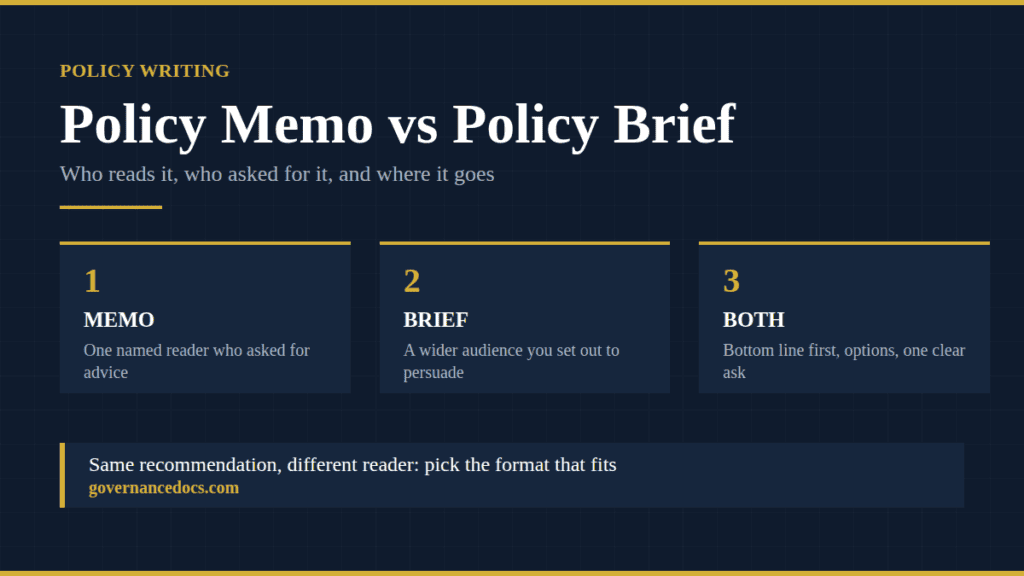
The policy memo vs policy brief choice comes down to one question: are you writing to a specific person who needs to make a decision, or to a wider policy audience you want to influence? A policy memo answers a named decision-maker, usually inside an organization. A policy brief makes an evidence-based case to anyone involved in the decision, and is usually published.
Both are short, both put the conclusion first, and both end in a recommendation, which is why the terms get mixed up. This guide sets out where they really differ, where they overlap, what each looks like on the page, and how to pick the right one. If you are new to the format, start with our explainer on what a policy brief is.
Policy memo vs policy brief at a glance
Policy memo
Policy brief
Reader
One named person or office
Anyone involved in the decision: officials, NGOs, advisers, sometimes the public
Who asked for it
Usually the reader
Usually nobody; the author chooses to publish
Opening
To / From / Date / RE header, then the bottom line
Title, then an executive summary or key messages
Background assumed
Reader knows the issue
Reader may know little about it
Circulation
Internal, often confidential
External, often published
Tone
Advice to a principal
An evidence-based argument to a wider audience
Layout
Plain document, headings, bullets
Often designed: branding, callout boxes, charts
Length
Short; limits vary by organization
Short; limits vary by publisher
In any policy memo vs policy brief decision, the rows that matter most are the first two. Get the reader and the trigger right, and the format follows.
What is a policy memo?
Duke University’s Writing Studio, in its policy memo handout, describes a policy memo as a document that provides analysis or recommendations on an issue for a specific, often limited, audience. It is formatted like an email, with “To:”, “From:”, “Date:” and “RE:” lines, and works if the reader gets the main points after one quick read.
Bottom line up front. The first paragraph states the problem and your solution.
Half problem, half answer. Spend about half the space on the problem and half on the options and recommendation.
A framework for analysis. Test each option against criteria such as political, operational and financial feasibility before you write, then tell the story of that analysis in prose rather than pasting the grid.
The memo’s defining feature is that it is written for someone who already knows the context and has asked for your advice. You don’t need to explain why the issue matters to them. You need to tell them what to do and why.
What is a policy brief?
A policy brief is a short, stand-alone document that explains one issue to decision-makers, compares the options and usually recommends one. Boston University School of Public Health’s guidance on policy briefs notes that the brief is similar to a policy memo but focuses more on an argument. It also says a brief should be broad enough that anyone involved in policymaking, including policymakers, NGOs and lobbyists, can understand and use it.
That wider audience changes the document. A brief has to establish why the problem matters before it can recommend anything. It needs a title that sells the point, because nobody is obliged to read it. And it usually carries the author’s name or logo, because it is a public statement of the organization’s position.
Where policy memo vs policy brief really differ
1. The reader
A memo is addressed to someone. A brief is addressed to everyone with a stake. This single difference drives most of the others.
2. The trigger
Memos are usually requested: a minister, director or board asks a question and an adviser answers it. Briefs are usually self-initiated: a research team, think tank or NGO decides an issue needs attention and publishes.
3. The opening
A memo opens with its header and the bottom line. A brief opens with a title and an executive summary, often set apart in a box so a skimming reader sees it first.
4. How much context you give
The memo reader already knows the background, so a memo spends little space on it. The brief reader may come in cold, so a brief explains the problem, its causes and why it is urgent.
5. Circulation and tone
Memos often stay internal and can be candid about politics, budgets and personalities. Briefs are written expecting a public audience, so they stick to evidence and avoid anything the author would not want quoted.
6. Design
A memo is plain text with headings. A brief is often laid out with charts, pull-quotes and a branded template. See our policy brief template for the standard layout.
Where they overlap
In the policy memo vs policy brief debate, length is the difference people expect, and it is the least reliable. Guidance disagrees. BU describes policy briefs as usually spanning about one page. IDRC caps briefs for its grantees at two pages or 1,500 words. Other university guides allow memos of several pages. The honest answer is that both are short, and the limit is whatever your organization, publisher or instructor sets.
The two also share their core discipline:
Conclusion first, details after (the “inverted pyramid”).
Headings that summarize, so a reader can skim.
Options weighed against clear criteria.
A specific, actionable recommendation.
Plain language and active voice.
Same issue, two documents: an example
The clearest way to see policy memo vs policy brief in practice is to write the same illustrative issue both ways. The issue and figures are placeholders, not real data.
As a policy memo:
TO: Director of Transport, [County] Council | FROM: [Name], Policy Adviser | DATE: [Date] | RE: Restoring hospital access on rural bus routes. You asked how to restore hospital access for rural residents after the [year] timetable cut. I recommend a two-year demand-responsive minibus pilot, funded from the [named] budget line. It serves the most affected residents at the lowest cost per trip of the three options we assessed, and can be cancelled if ridership targets are missed.
As a policy brief:
Stranded: How Bus Cuts Cut Rural Residents Off From Hospital Care. Rural bus routes in [County] lost [X]% of riders after the [year] timetable cut, leaving residents without cars unable to reach the regional hospital. We assessed three responses: restoring the old timetable, funding demand-responsive minibuses, and a taxi voucher scheme. We recommend that the County Council fund a two-year minibus pilot, which serves the most affected residents at the lowest cost per trip.
The recommendation is the same. The memo skips the case for why the issue matters, because the reader asked. The brief leads with it, because the reader did not.
Policy memo vs policy brief: which should you write?
Write a policy memo if:
You know exactly who will read it, by name or role.
They asked for advice, or you report to them.
The document will stay inside the organization.
You need to be candid about internal constraints.
Write a policy brief if:
You want to reach several decision-makers or stakeholders at once.
Nobody asked, and you need to make the case that the issue matters.
The document will be published or shared externally.
It represents your organization’s public position.
For coursework, follow the assignment rather than any general policy memo vs policy brief rule. Instructors often use the two terms loosely, and the rubric will tell you which conventions they expect.
Policy memo format: a simple template
Section
What to write
Header
To, From, Date, RE (the RE line states your main point, not just the topic)
Bottom line
Two to three sentences: the problem and your recommendation
Background
Only what the reader needs and does not already know
Options
Two to four realistic options, each assessed against the same criteria
Recommendation
What to do, who does it, by when, and the main risk
Next steps
The decision or approval you need from the reader
For the equivalent policy brief structure with example wording for each section, use our fill-in policy brief template.
Policy memo vs policy brief FAQ
Is a policy memo shorter than a policy brief?
Not reliably. Of all the policy memo vs policy brief differences, length is the weakest. Both are short, and published guidance gives overlapping lengths. Use the limit your organization or instructor sets.
Can a policy brief be addressed to one person?
It can, but then it is functioning as a memo. If you are writing for one named reader who asked for advice, the memo format is usually the better fit.
Does a policy memo need references?
Usually only light ones. Cite the sources behind your key numbers, in footnotes or a short list, so the reader can check them. Don’t fill the page with citations.
Is a white paper the same as a policy brief?
No. A white paper is normally longer and explains a problem and a proposed approach in depth. A policy brief condenses the argument for decision-makers who do not have time for that.
Which is better for a job application writing sample?
Match the job. Government and internal advisory roles usually expect a memo. Think tanks, NGOs and advocacy roles more often expect a brief.
Ready to write the public version? Our policy brief template gives you the seven standard sections with example wording and step-by-step guidance for each.
When a standard changes, know first
One email a month: edition changes, new deadlines, and what they mean for documentation you already have. No sales sequence.