

Policy and Procedure Template: The Practical 2026 Guide
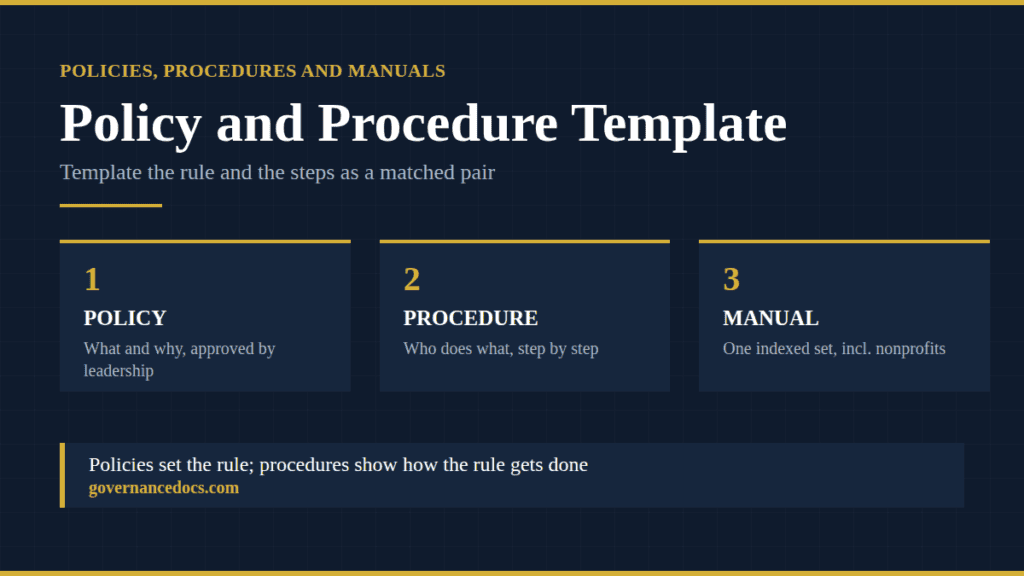
A policy and procedure template is really two templates that share one numbering scheme: a short policy that says what must happen and why, and a procedure that says who does what, in what order, and which record proves it was done. Write them as a pair and each stays short, readable and easy to update.
This guide shows how the two halves of a policy and procedure template differ, how to link them, a fill-in procedure template with example wording, how to assemble a policies and procedures manual (including one for a nonprofit), and how to set it all up in Word.
Policy and procedure template basics: what each document does
The most common fault in a manual is a policy that tries to be a procedure. It grows to thirty pages, needs board approval every time a form changes, and is out of date within months. Keeping the two apart is the whole point of a paired template.
| Attribute | Policy | Procedure |
|---|---|---|
| Answers | What must happen and why | How it happens, step by step |
| Language | Must, should, may | Numbered actions: who does what, when |
| Typical approver | Board or executive team | Policy owner or process owner |
| Change frequency | Low: reviewed on a cycle | Higher: changes with systems, forms and staff |
| Typical length | 2–6 pages | As long as the process needs |
| Produces records? | Rarely | Yes: each procedure names its records |
| Example | All supplier invoices must be approved before payment | How Accounts Payable matches, routes and releases an invoice |
A good policy and procedure template keeps these differences visible: the policy half is short and stable, the procedure half is detailed and expected to change.
How to pair a policy and procedure template
Pairing means the two documents point at each other and never overlap. Five rules make that work:
- One numbering family. If the policy is POL-FIN-003, its procedures are PRO-FIN-003-01, PRO-FIN-003-02 and so on. Anyone holding a procedure can find its parent policy from the ID alone.
- Each policy statement traces to a procedure step, or to nothing on purpose. Some statements are self-executing (“Staff must not accept cash gifts”). Others need a procedure. Mark which is which.
- The procedure never restates policy. It cites the policy in its purpose section and goes straight to the steps.
- Different approvers, same control. The procedure can be approved by the process owner, but it carries the same document control block, version history and review date as the policy.
- Shared related-documents list. The policy lists its procedures; each procedure lists its forms and records.
A simple trace looks like this. Policy statement 4.2: “Invoices above [amount] must be approved by a budget holder before payment.” Procedure PRO-FIN-003-01, step 5: “Accounts Payable routes invoices above [amount] to the budget holder named in the approval matrix and records the approval in [finance system].”
Procedure template: the six sections
The procedure half of a policy and procedure template needs the same document control block as a policy (ID, title, version, owner, approver, effective date, next review) followed by six sections. This policy procedure template uses an invoice approval procedure as the example.
| Section | What to write | Example wording |
|---|---|---|
| 1. Purpose | What the procedure achieves and which policy it implements | This procedure describes how supplier invoices are checked, approved and released for payment, implementing POL-FIN-003 Procurement and Payments Policy. |
| 2. Scope | Which processes, sites, systems and people it covers; exclusions | Applies to all supplier invoices received by [Organization] in any currency. Payroll and employee expense claims are excluded (see PRO-FIN-005). |
| 3. Responsibilities | Each role and its part in the process | Accounts Payable: receives, matches and routes invoices. Budget holder: approves invoices within delegated authority. Finance Manager: releases the payment run. |
| 4. Procedure steps | Numbered steps, one actor and one action each, with timing and decision points | 4.1 Accounts Payable logs the invoice within two working days of receipt. 4.2 Accounts Payable matches it to the purchase order and goods receipt. 4.3 If the match fails, Accounts Payable returns it to the requester with the reason. |
| 5. Records | Each record produced, where it is kept, and for how long | Approved invoice and approval trail: [finance system], retained [period] per the Records Retention Schedule. |
| 6. References | Parent policy, related procedures, forms, external requirements | POL-FIN-003; Delegation of Authority Matrix; Supplier Set-Up Form (FRM-FIN-011). |
Writing steps people can follow
- Start each step with the actor, then a verb. “Accounts Payable logs…” not “The invoice should be logged.”
- One action per step. If a step contains “and then”, split it.
- Write decisions as if/then. State what happens on both branches.
- Put timings in the step. “Within two working days” is auditable; “promptly” is not.
- Name the record. If a step produces evidence, say what and where. Records are what an auditor samples.
- Use a flowchart for complex flows, but keep the numbered text as the controlled version.
For a quality management system, our guide to ISO 9001 procedures and forms shows which procedures and records a working QMS actually contains.
Building a policy and procedure manual template
A manual is the organized collection of every policy, its procedures and the forms they use. The policy and procedure manual template below works whether you publish one combined PDF or, more practically, keep individual controlled documents and treat the manual as the index that ties them together.
- Front matter: title page, approval statement, how to use the manual, the document hierarchy and the controlled-verb definitions.
- Master document list: every document ID, title, version, owner and next review date in one register.
- Sections by function: governance, finance, HR, operations, IT and information security, health and safety. Within each, the policy comes first, followed by its procedures.
- Forms appendix: blank forms with their own IDs, referenced from the procedures that use them.
- Revision log: a manual-level summary of what changed and when.
Start every document in the manual from the same policy and procedure template. Keeping documents separate means a changed procedure does not force a new version of the whole manual. The IMS document control guide explains how one register and one set of rules can control documents across several standards.
Nonprofit policies and procedures manual template
Nonprofits need the same structure plus governance policies that boards, funders and regulators look for. In the US, the full Form 990 asks directly about several of them. Part VI, Section B is headed as requesting information about policies “not required by the Internal Revenue Code”, but the IRS Form 990 instructions say the IRS considers such policies to generally improve tax compliance, and the answers are public.
The instructions also set a test for answering “Yes”: the governing body (or an authorized committee) must have adopted the policy by the end of the tax year, and it must apply to the whole organization.
| Manual section | Policies to include | Where the IRS asks |
|---|---|---|
| Board governance | Bylaws reference, board roles, conflict of interest policy with annual disclosure | Form 990 Part VI, lines 12a–12c (written policy, annual disclosure, monitoring and enforcement) |
| Ethics and reporting | Whistleblower policy | Part VI, line 13 |
| Records | Document retention and destruction policy and schedule | Part VI, line 14 |
| Compensation | Executive compensation review process | Part VI, lines 15a–15b (independent review, comparability data, contemporaneous documentation) |
| Finance controls | Joint venture policy, where relevant | Part VI, line 16b |
| Fundraising | Gift acceptance policy covering nonstandard contributions | Schedule M, line 31 (noncash contributions) |
| Chapters and affiliates | Written policies governing local chapters | Part VI, line 10b |
| Transparency | How governing documents, the conflict of interest policy and financial statements are made public | Part VI, line 19 |
Add the operational sections every organization needs: finance controls (approval limits, segregation of duties, bank reconciliation, expense reimbursement), HR (recruitment, conduct, leave, grievance), volunteer management, privacy and IT use. Your nonprofit policies and procedures manual template should pair each of these with its procedures, using the same policy and procedure template as every other section.
Line numbers are from the 2025 form. State law and your funders may impose further requirements, so have counsel review board-level policies before adoption.
Policies and procedures template Word setup
Most organizations maintain manuals in Microsoft Word. To make a policy and procedure template Word file that keeps both documents consistent:
- One style set, two layouts. Build a policy .dotx and a procedure .dotx from the same styles (Heading 1–3, Normal, table style) so the manual looks like one system.
- Document properties for control fields. Add custom properties such as DocID, ParentPolicy, Version and Owner (File > Info > Properties > Advanced Properties > Custom) and insert them with Insert > Quick Parts > Field > DocProperty.
- Multilevel numbering for steps. Link a multilevel list to your headings so steps renumber when one is inserted.
- Reusable blocks. Save standard text such as the document control table or the definitions of must, should and may as Quick Parts (Insert > Quick Parts > Save Selection to Quick Part Gallery).
- A responsibilities table. A simple role-by-step grid in the procedure makes hand-offs visible.
- Version history in the library. Store masters in SharePoint or OneDrive so every save is versioned, and publish approved versions as PDF.
The same disciplines apply to information security documents. Our ISO 27001 document control guide covers approval, versioning and distribution in more depth.
Policy and procedure template FAQ
Should policies and procedures be in one document?
Usually not. Separate documents let you update a procedure without re-approving the policy. Link them through a shared numbering scheme and cross-references instead; that is what a policy and procedure template is designed to do.
How detailed should a procedure be?
Detailed enough that a competent new employee could follow it without asking. If a task needs judgment that cannot be written as steps, reference training or a work instruction rather than padding the procedure.
Where can I find policies and procedures templates?
Free policies and procedures templates are easy to find, but they rarely share one format or numbering scheme. Whatever source you use, convert each into your own paired template before adoption so the manual reads as one controlled set.
What policies does a nonprofit need first?
Start with the board-level policies the Form 990 asks about: conflict of interest, whistleblower, and document retention and destruction. Then add finance controls and HR policies, each with its procedures.
Our ISO 9001 Toolkit provides 84 editable templates for ISO 9001:2026, the edition published in September 2026 — including the Quality Manual, the Control of Documented Information Procedure and the Master Document and Records Register — for $89.
When a standard changes, know first
One email a month: edition changes, new deadlines, and what they mean for documentation you already have. No sales sequence.

Governance Docs
Governance Docs LLC
Recent Posts
November 27, 2026
November 27, 2026

November 26, 2026

November 26, 2026

November 26, 2026