CART
The privacy risk assessment vs DPIA question comes up in almost every privacy program, usually when someone asks whether the company “already did its DPIA” and nobody is sure which document that means. The two are related, they use the same vocabulary of likelihood, impact and safeguards, and they are often confused. They are not the same exercise, they answer different questions, and a regulator or auditor will expect to see both.
This guide sets out the difference in plain terms: what each assessment covers, when the law or a standard requires it, who owns it, and how the two fit together so the work is done once and reused.
A privacy risk assessment looks across all of your processing of personal data. It lists what you hold and what you do with it, identifies what could go wrong for the people the data is about and for the organization, rates each risk against criteria you set in advance, and records a treatment decision for every risk you are not prepared to accept. It is the privacy equivalent of the information security risk assessment in ISO 27001, and ISO/IEC 27701 asks for it as part of a privacy information management system.
Free DPIA template and tool
Does this processing need a DPIA, and what would it say?
Screen the processing against Article 35 and the nine WP248 criteria, describe it, test necessity and proportionality, rate the risks to the people concerned and record the DPO's advice and sign-off. Free, with findings and the Article 36 check.
A data protection impact assessment (DPIA) looks at one processing operation in depth, before it starts, because that operation is likely to result in a high risk to people’s rights and freedoms. It is a legal requirement under Article 35 of the GDPR, with a prescribed minimum content, and it can end in a duty to consult the supervisory authority before going ahead.
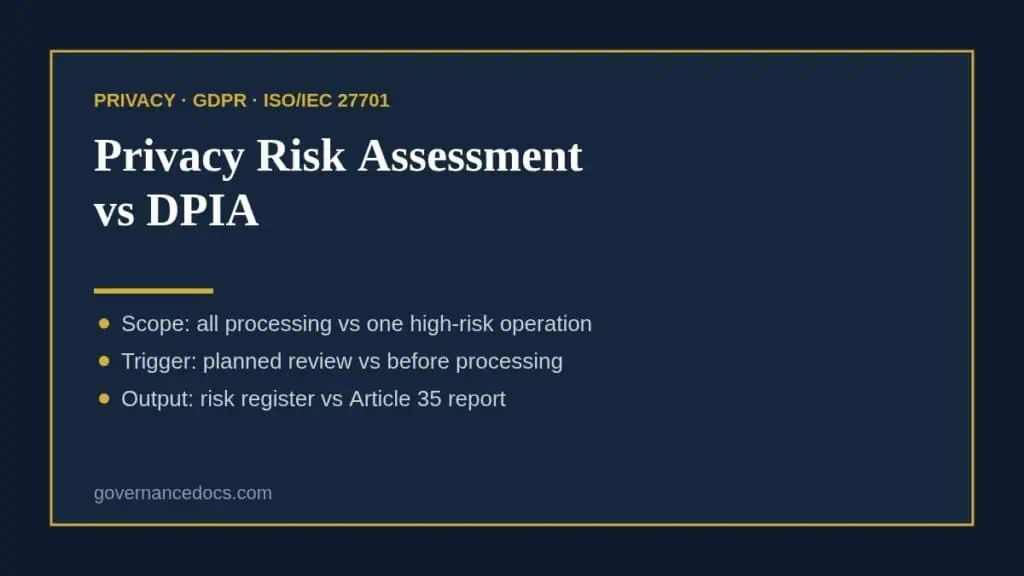
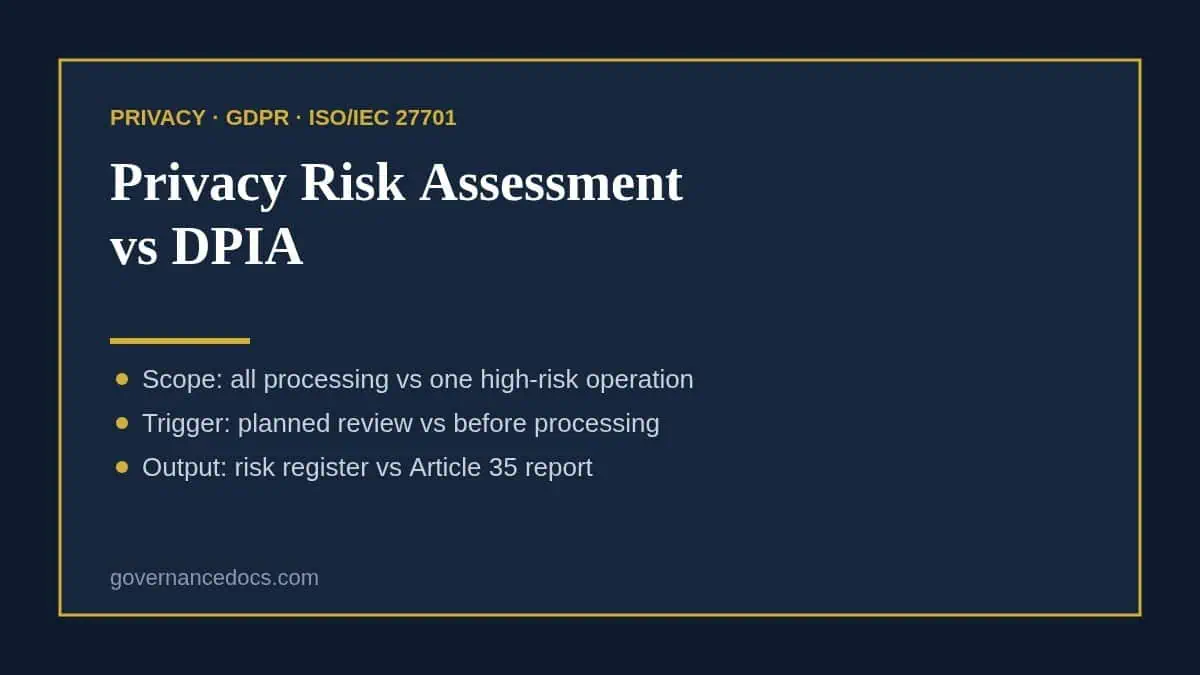
Put simply: the privacy risk assessment is the map of the whole territory; the DPIA is the survey of one dangerous stretch of road. In the privacy risk assessment vs DPIA comparison, neither replaces the other.
The table below sets out the privacy risk assessment vs DPIA differences that matter in an audit.
| Question | Privacy risk assessment | DPIA |
|---|---|---|
| Scope | All processing of personal data in scope of the program | One processing operation, or a set of similar operations |
| Trigger | Planned intervals (typically yearly) and significant change | Before processing that is likely to result in a high risk |
| Basis | ISO/IEC 27701 planning clauses; GDPR accountability and security (Articles 24 and 32) | GDPR Article 35 (and national lists of processing that always needs one) |
| Main question | Where are our privacy risks and what are we doing about them? | Is this specific processing necessary, proportionate and safe enough to go ahead? |
| Output | Privacy risk register, heat map, treatment plan, residual risk acceptance | DPIA report with necessity and proportionality analysis, risks, measures and DPO advice |
| Owner | Privacy or data protection lead, with risk owners across the business | The controller, with the DPO’s advice (Article 35(2)) |
| Possible outcome | Treat, avoid, share or retain each risk | Proceed, change the design, or consult the authority first (Article 36) |
Understanding the privacy risk assessment vs DPIA split starts with the broader exercise. A privacy risk assessment follows the same five steps as any management-system risk assessment:
ISO/IEC 27701:2025, published in October 2025, is now a standalone management system standard: it can be implemented without an ISO 27001 information security management system underneath it. Its planning clauses require privacy risks to be assessed and treated, and its Annex A controls play the role that ISO 27001 Annex A plays for security, including the requirement to compare your chosen controls with Annex A in a Statement of Applicability. If you want the wider picture, our comparison of privacy risk vs cybersecurity risk explains why the two registers overlap but are not the same.
Article 35(7) GDPR sets the minimum content of a DPIA:
The necessity and proportionality test is what a general privacy risk assessment does not do. A DPIA asks whether you need this data at all, whether a less intrusive design would achieve the same purpose, how long you will keep it and how people will be told. It is a design review as much as a risk review. Our DPIA guide walks through each step and the documents that support it.
Article 35(3) names three cases that always require a DPIA: systematic and extensive automated evaluation, including profiling, that produces legal or similarly significant effects; large-scale processing of special category data or criminal offence data; and systematic monitoring of a publicly accessible area on a large scale. Supervisory authorities also publish lists of processing that needs one.
Outside those cases, the European Data Protection Board endorses the Article 29 Working Party guidelines (WP248 rev.01), which set out nine criteria: evaluation or scoring; automated decisions with legal or similar effect; systematic monitoring; sensitive or highly personal data; large scale; matching or combining datasets; vulnerable data subjects such as children or employees; innovative technology; and processing that prevents people from exercising a right or using a service. As a rule of thumb, processing that meets two of the criteria will usually need a DPIA. You can read the criteria in full in the WP29 DPIA guidelines.
The privacy risk assessment vs DPIA debate is usually settled by using each for what it is good at. In practice the relationship runs both ways.
The privacy risk assessment tells you where DPIAs are needed. When you rate each processing activity in your register, the ones that score high on impact for individuals, involve children or special category data, or rely on profiling are the same ones the WP248 criteria point to. Add a column to your register that flags “DPIA required” and the register becomes your DPIA screening tool.
Each DPIA feeds back into the privacy risk assessment. A DPIA produces detailed risks and measures for one operation. Those risks belong in your register, with their owners and treatment dates, so they are reviewed with everything else rather than filed and forgotten.
They share criteria. If your privacy risk assessment already defines what “severe” impact for an individual means, reuse those definitions in your DPIA template. Consistent scales are one of the first things an auditor checks, and they stop two assessments of the same processing reaching different conclusions.
Most organizations that process personal data at any scale need both. If you are building toward ISO/IEC 27701 certification, the privacy risk assessment is mandatory evidence of the management system. If you are subject to the GDPR, DPIAs are mandatory for high-risk processing whatever management system you run, and a documented privacy risk assessment is the clearest way to show the accountability Article 24 expects. Our comparison of ISO 27701 vs GDPR covers how the standard and the regulation line up.
If you have not yet done the organization-wide view, start there. Our free privacy risk assessment tool takes you through criteria, scope, 38 privacy risk scenarios mapped to ISO/IEC 27701 Annex A, ratings and treatment, and gives you a heat map and the findings an auditor would raise. The high-rated activities it surfaces are your DPIA shortlist.
Often the terms are used interchangeably, but a DPIA is the specific assessment defined in Article 35 GDPR with a prescribed minimum content. “PIA” is a broader, older term used in many jurisdictions and in ISO/IEC 29134, which gives guidance on privacy impact assessment.
Only for a narrow scope. If your organization runs a single processing operation, one well-structured document may cover both. For anything larger, keep an organization-wide register and write separate DPIAs for high-risk operations, cross-referenced in the register.
No. The 2025 edition made ISO/IEC 27701 a standalone management system, but the logic is the same: the management system needs an organization-wide privacy risk assessment, and the GDPR still requires a DPIA for each high-risk processing operation.
At planned intervals, usually once a year, and whenever there is a significant change such as a new system, a new processor, a new country or a new category of data. A DPIA should be revisited when the processing it assessed changes.
If you want the policies, registers and DPIA templates ready to adapt, the ISO 27701 Toolkit includes the documents that support both assessments.

October 19, 2026
October 18, 2026
October 18, 2026
October 15, 2026
October 15, 2026

