

ISO 22000 certification cost is set by three things the standard does not price: how many auditor days the certification body needs for your site, what it charges per day, and how much preparation the food safety management system needs before it can pass a stage 2 audit. The auditor days are the most predictable part. ISO 22003-1:2022, the standard certification bodies are accredited against for FSMS audits, sets a minimum audit duration from a formula: a basic day count for your food chain category, extra time for each additional HACCP study, and extra time by the number of full-time-equivalent employees. A single-site processor with 120 staff and three HACCP plans is quoted from that table, not from a guess.
What follows is our own estimate, labelled as such and built the way we build every certification-cost guide on this site: the audit-day calculation first, then the certification-body fees by site size at the day rate accredited bodies charge for food safety audits in 2026, then the internal preparation cost, the three-year cycle total, a worked example, how to compare quotations and what the FSSC 22000 upgrade adds. None of the fee figures are ISO or certification-body figures; the right number for your site is the one on the quotation.
Quick answer. Audit days (ISO 22003-1: category basic days + additional HACCP studies + staff numbers) × $1,200–2,000 per day + preparation + surveillance in years 2 and 3 + recertification. For a typical single-site food processor that puts the certification-body side of the ISO 22000 certification cost at roughly $3,000–$24,000 for the initial audit and $7,700–$21,000 for a full three-year cycle at a medium site, before internal preparation. Our estimate, not an ISO figure.
Free gap assessment
Would your HACCP plan survive an inspection?
Score the whole of the Codex text, free - the good hygiene practices as well as the seven principles, with the US and EU overlays on top.
Run the free HACCP gap assessment → or View premium report sample
What drives the ISO 22000 certification cost
| Driver | Effect | What you control |
|---|---|---|
| Food chain category or subcategory | Sets the basic site audit duration (TD): 1.0 to 2.0 days depending on the category | None: it is what you do |
| Number of HACCP studies | Each study after the first adds 0.25 or 0.50 days (TH), depending on the category | Grouping products into fewer, well-justified HACCP studies |
| Full-time-equivalent employees | Adds 0 to 3 days (TFTE) by headcount band, counted on the main shift plus non-production staff with a food safety impact | Scope definition: the certified site and activities |
| Number of sites | Each site is audited; multi-site sampling is allowed only for certain categories (A, B, F, G and limited parts of E) | Whether to certify one site first |
| Integration with other standards | An integrated audit with a relevant quality or food safety system can cut the combined duration by 0% to 20% | Choosing one certification body and integrating the systems properly |
| Readiness | A system with PRPs, hazard analysis, validation and records in place needs no repeat stage 1 or stage 2 | Internal audit and a full management review before stage 1 |
| Day rate, travel and reporting time | Accredited bodies charge per auditor day; planning, travel and report writing sit outside the ISO minimum and are billed on top | Competitive quotations from three accredited bodies |
The audit-time table matters because it removes most of the negotiation. Certification bodies must document and justify any deviation from the ISO 22003-1 minimum, so the quotes you receive differ mainly on day rate, travel, reporting time and the body’s own overheads. Our guide to ISO 22000 covers the standard the audit tests.
How ISO 22003-1 sets the audit days behind the ISO 22000 certification cost
Annex B of ISO 22003-1:2022 gives the minimum initial certification audit duration as Ds = TD + TH + TFTE. The result covers stage 1 and stage 2 together; the certification body decides how to split the days between the two stages. It does not include audit planning, audit preparation, travel, follow-up of nonconformities, or time spent by technical experts, interpreters, observers or trainee auditors. Those are the lines that make two quotes for the same Ds look different.
| Food chain category (ISO 22003-1 Annex A) | TD: basic days, includes one HACCP study | TH: days per additional HACCP study |
|---|---|---|
| A and B: farming of animals and plants | 1.0 | 0.25 |
| C (CO, CI–CIV): food and animal food processing | 2.0 | 0.50 |
| D: feed production | 1.0 | 0.50 |
| E: catering | 1.5 | 0.50 |
| F (FI, FII): retail, wholesale and trading | 1.0 | 0.50 |
| G and H: transport and storage; services | 1.5 | 0.25 |
| I and J: packaging production; equipment manufacturing | 1.5 | 0.50 |
| K: (bio)chemicals | 2.0 | 0.50 |
| Full-time-equivalent employees | TFTE: added audit days |
|---|---|
| 1 to 5 | 0 |
| 6 to 49 | 0.5 |
| 50 to 99 | 1.0 |
| 100 to 199 | 1.5 |
| 200 to 499 | 2.0 |
| 500 to 999 | 2.5 |
| 1,000 or more | 3.0 |
Four further rules in Annex B shape the ISO 22000 certification cost over the cycle:
- Surveillance: at least one third of the initial audit duration, with a minimum of 1 audit day (0.5 day for categories A and B).
- Recertification: at least two thirds of the initial audit duration, with the same minimums.
- Multiple categories: the category with the highest TD sets the base, and the HACCP studies and staff across all categories are combined.
- Where the time goes: at least 50% of the audit duration must be spent on operational food safety planning and the implementation of PRPs and control measures, so a certification body cannot shorten the floor walk to save days.
The 2022 edition also dropped the old adjustment for not holding another certified management system, expanded the table to subcategory level and set out how combined and multi-site audits are calculated. Multi-site certification puts the central function at no less than Ds and each sampled site at no less than half of its own Ds.
Minimum audit days for typical sites
Applying the table to five example sites, our arithmetic from ISO 22003-1:2022 Table B.1 (the certification body does the real calculation and may add time for complexity, seasonality or regulatory history):
| Example site | Calculation | Initial (Ds) | Surveillance, each year (min.) | Recertification (min.) |
|---|---|---|---|---|
| Food distributor (FI), 25 staff, 1 HACCP study | 1.0 + 0 + 0.5 | 1.5 days | 1.0 day | 1.0 day |
| Bakery (C), 40 staff, 2 HACCP studies | 2.0 + 0.5 + 0.5 | 3.0 days | 1.0 day | 2.0 days |
| Sauce plant (C), 120 staff, 3 HACCP studies | 2.0 + 1.0 + 1.5 | 4.5 days | 1.5 days | 3.0 days |
| Dairy (C), 300 staff, 6 HACCP studies | 2.0 + 2.5 + 2.0 | 6.5 days | about 2.2 days | about 4.3 days |
| Multi-line processor (C), 800 staff, 10 HACCP studies | 2.0 + 4.5 + 2.5 | 9.0 days | 3.0 days | 6.0 days |
The HACCP-study column is where most sites over-pay. Ten studies at a processing site cost 4.5 audit days on their own, at every initial and, proportionally, at every surveillance and recertification audit.
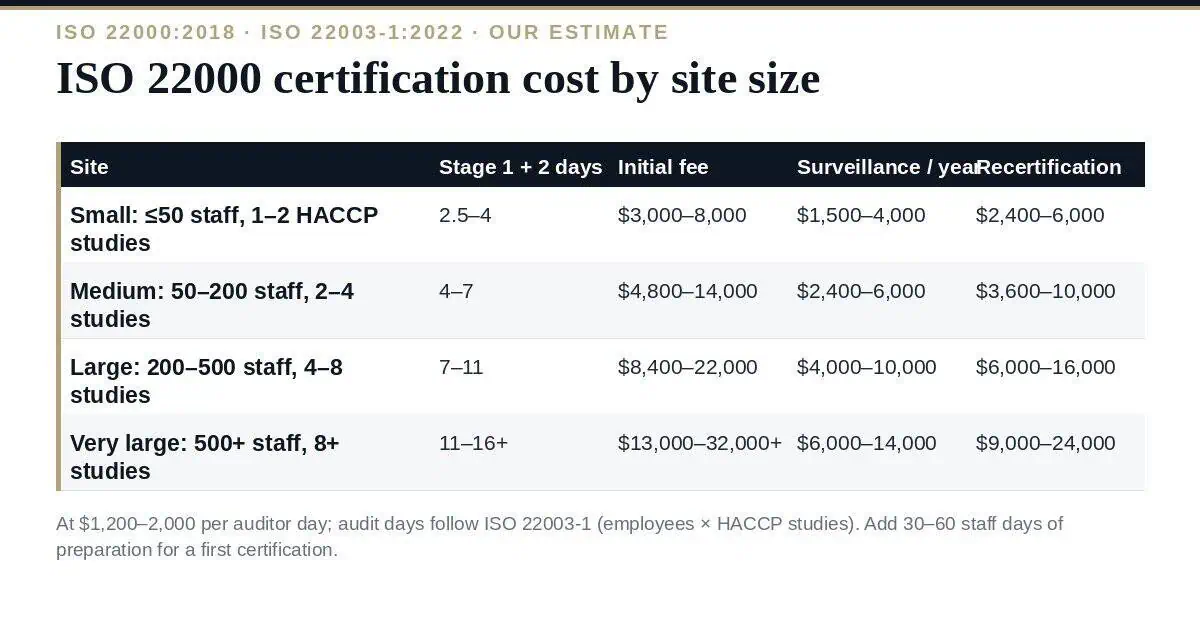
ISO 22000 certification cost by site size: our estimate
The estimates below assume one processing site (category C), a system ready for audit, and an accredited certification body at the $1,200 to $2,000 per auditor day that food safety audits typically command in North America and Western Europe in 2026, the same band used in our HACCP and FSSC 22000 cost guides. Day counts start from the Table B.1 minimum and allow for the extra time certification bodies commonly add.
| Site | Stage 1 + stage 2 days (our estimate) | Initial certification fee | Annual surveillance (each of 2 years) | Recertification (year 3) |
|---|---|---|---|---|
| Small: up to 49 staff, 1–2 HACCP studies | 2.5 – 4 | $3,000 – $8,000 | $1,200 – $3,000 | $2,100 – $5,000 |
| Medium: 50–199 staff, 2–4 HACCP studies | 3.5 – 6 | $4,200 – $12,000 | $1,500 – $4,000 | $3,000 – $8,000 |
| Large: 200–499 staff, 4–8 HACCP studies | 5.5 – 9 | $6,600 – $18,000 | $2,400 – $6,000 | $4,800 – $12,000 |
| Very large or multi-line: 500+ staff, 8+ HACCP studies | 8 – 12+ | $9,600 – $24,000+ | $3,600 – $8,000 | $6,600 – $16,000 |
Add application and certificate fees, typically a few hundred to around a thousand dollars, plus travel and any reporting time billed separately. A site whose stage 1 finds the hazard analysis unvalidated or the PRPs undocumented pays for a second stage 1 or a delayed stage 2, which is the commonest reason a first certification exceeds the quote. Sites outside category C start lower: a distributor or a warehouse can sit at 1.5 to 2.5 days.
The preparation cost that exists either way
The larger part of the ISO 22000 certification cost for a first-time site is internal: building the FSMS to the standard’s clause 8 (PRPs, the preliminary steps, hazard analysis, validation, the hazard control plan, traceability, emergency preparedness, verification and the handling of potentially unsafe product) and running it long enough to have records. Our estimate for a medium single-site processor starting from a working HACCP plan:
| Activity | Who | Staff days (our estimate) | External cost (our estimate) |
|---|---|---|---|
| Gap assessment against ISO 22000:2018 | Food safety team leader | 3 – 5 | $0 – $4,000 if outsourced |
| Documentation: policy, objectives, procedures, PRPs, hazard analysis, hazard control plan, records | Food safety team, QA | 15 – 30 | $0 – $2,000 (toolkit) to $10,000+ (consultant-drafted) |
| PRP implementation gaps: facility, pest control, hygiene, allergen, maintenance | Operations, engineering | Varies | $0 – $50,000+ depending on findings |
| Validation of control measures and verification records | Technical, laboratory | 5 – 10 | $1,000 – $5,000 in testing |
| Training: food safety team, internal auditors, staff awareness | HR, QA | 5 – 10 | $1,000 – $5,000 |
| Internal audit and management review | Internal auditor, management | 3 – 5 | $0 – $3,000 if outsourced |
| Consultant support, if used | External | — | $5,000 – $25,000 |
That is 30 to 60 staff days before facility remediation. A site that already runs a Codex HACCP plan with documented PRPs sits at the bottom; one certifying from a paper HACCP plan and informal hygiene practice sits at the top. Our guide to ISO 22000 mandatory documents lists what the documentation line has to produce, and the ISO 22002 prerequisite programmes guide covers the PRP line.
Since February 2024 the documentation line also has to show that climate change was considered. ISO 22000:2018/Amd 1:2024 added climate wording to clause 4.1 (whether climate change is a relevant issue) and clause 4.2 (interested-party requirements), as it did across ISO management system standards. For most food sites it is a short determination in the context analysis, not a cost line, but auditors check that it exists.
The three-year ISO 22000 certification cost
Read the ISO 22000 cost over the whole certificate cycle, not the year-1 quote alone: surveillance and recertification together usually cost more than the initial audit.
| Year | What happens | Medium site (our estimate) |
|---|---|---|
| Year 0 | Preparation: documentation, PRP gaps, validation, training, internal audit | $5,000 – $40,000 external plus 30–60 staff days |
| Year 1 | Stage 1 and stage 2 audits, application and certificate fees | $4,700 – $13,000 |
| Year 2 | Surveillance audit | $1,500 – $4,000 |
| Year 3 | Surveillance audit | $1,500 – $4,000 |
| Year 4 | Recertification audit before the certificate expires (new three-year cycle) | $3,000 – $8,000 |
| Three-year cycle total (certification body only) | $7,700 – $21,000 |
A worked example of the ISO 22000 certification cost
A single-site sauce manufacturer (category C), 120 staff, three HACCP studies, an existing HACCP plan and documented PRPs, certification body at $1,600 per day. Ds = 2.0 + 1.0 + 1.5 = 4.5 days. Our estimate, illustrative only:
| Line | Basis | Estimate |
|---|---|---|
| Stage 1 + stage 2 | 4.5 auditor days at $1,600 (the Table B.1 minimum) | $7,200 |
| Planning and reporting | 0.5 day billed by this body; some include it in the day count | $800 |
| Application and certificate fees | Typical | $800 |
| Preparation, external | Toolkit, allergen validation testing, internal auditor training | $4,500 |
| Preparation, internal | 40 staff days at $350 loaded | $14,000 |
| Year 1 total | $27,300 | |
| Surveillance, years 2 and 3 | 1.5 days plus 0.25 day reporting at $1,600, each year | $2,800 per year |
| Three-year cycle, certification body only | $8,800 + 2 × $2,800 | $14,400 |
| Recertification, start of the next cycle | 3.0 days plus 0.25 day reporting | $5,200 |
The internal staff time is the biggest line, and it is the one a well-run documentation approach shrinks. The certification-body lines move only if the HACCP studies or the scope change.
How to compare ISO 22000 certification quotes
Ask each accredited certification body for a written quotation that shows its working. The lines worth comparing:
| Ask for | Why it matters |
|---|---|
| The Ds calculation: category, HACCP studies, FTE count and any deviation | If two bodies count your HACCP studies or staff differently, the gap shows here. Deviations from Table B.1 must be justified and recorded |
| Day rate and the length of an audit day | Rates vary by country and body; a “day” is normally eight hours of effective auditing |
| Planning, preparation and report-writing time | Outside the ISO minimum, so billed differently by each body |
| Travel and expenses | A local auditor can be worth more than a lower day rate |
| Application, certificate and annual fees | Often a separate line, sometimes charged every year |
| The full three-year programme, including recertification | A low year-1 price with expensive surveillance is not a saving |
| Accreditation for ISO 22000 and your food chain category | A certificate from an unaccredited body is cheaper and usually worthless to customers |
Check the accreditation against the accreditation body’s own register (ANAB, UKAS, DAkkS and other national bodies publish them) before signing. Our ISO 22000 implementation steps show where the quotation fits in the timeline.
ISO 22000 vs FSSC 22000 certification cost
FSSC 22000 is ISO 22000 plus the applicable ISO 22002 prerequisite programme part plus the FSSC additional requirements, and it is GFSI-recognised. Version 7.0, published in May 2026, keeps the ISO 22003-1 calculation and adds its own time on top. Under the scheme’s Part 3, the single-site audit duration is Ds + TFSSC, with no reductions allowed to either:
| Site profile | TFSSC added to Ds |
|---|---|
| Under 100 FTE and at most 2 HACCP studies | 0.5 auditor day |
| 100 to 249 FTE and at most 2 HACCP studies | 1.0 auditor day |
| 250 FTE or more, or 3 or more HACCP studies | 1.5 auditor days |
The scheme also sets at least 0.25 day for audit preparation and at least 1.0 day for reporting (0.5 day when the audit itself was 1.5 days), and requires at least one unannounced surveillance audit after the initial certification and within every three-year period. For the 120-staff sauce plant above, our arithmetic:
| Audit | ISO 22000 | FSSC 22000 Version 7 |
|---|---|---|
| Initial audit days | 4.5 (Ds) | 6.0 (4.5 + 1.5 TFSSC) |
| Preparation and reporting | Set by the body (0.5 day in our example) | At least 1.25 days |
| Initial fee at $1,600 per day | $8,000 | $11,600 |
| Each surveillance audit | 1.5 days + reporting: $2,800 | 1.5 + 1.5 days + 1.25: $6,800 |
| Unannounced audit | Not required | At least one per three-year cycle |
That is roughly 45% more at the initial audit and more than double at each surveillance for this site, before the extra PRP and additional-requirement work. Our FSSC 22000 certification cost guide and the FSSC 22000 vs ISO 22000 comparison go further. Version 6 audits remain allowed until 30 April 2027; see FSSC 22000 Version 7 for the transition.
ISO 22000 vs the alternatives on cost
| Scheme | Relative cost | Why |
|---|---|---|
| HACCP certification (non-GFSI) | Lower | Fewer audit days; no management-system clauses; not GFSI-recognised |
| ISO 22000 | Baseline | Management system plus HACCP; not GFSI-benchmarked on its own |
| FSSC 22000 | Higher | ISO 22000 plus ISO 22002 PRPs plus FSSC additional requirements, TFSSC audit time and an unannounced surveillance audit in each cycle; GFSI-recognised |
| BRCGS / SQF / IFS | Similar to FSSC | GFSI-recognised, prescriptive; their own audit-duration rules |
Our guide to HACCP certification cost covers the cheaper neighbour; if a GFSI-recognised certificate is the customer’s real requirement, budget for FSSC 22000 from the start rather than certifying ISO 22000 first and upgrading.
Does the ISO 22000 revision change the budget?
Not yet. ISO 22000:2018, with its 2024 climate amendment, is the edition you certify to today. The third edition is at the Draft International Standard stage: the ISO/DIS 22000 project page shows stage 40.60, close of voting, and ISO has published no publication date. Commentary on the draft points to added emphasis on food safety culture, food fraud and food defence, but draft content can still change before the final text.
When a new edition is published, certification bodies normally run a transition period and assess the changes at a regular surveillance or recertification audit, sometimes with extra audit time. Waiting for the new edition rarely saves money: a customer requirement does not wait, and the clause 8 operational core (PRPs, hazard analysis, the hazard control plan) is the part you would build either way.
Reducing the ISO 22000 certification cost
- Rationalise the HACCP studies. Products with the same hazards, process and controls belong in one study; each unnecessary study adds 0.25 to 0.5 audit days at the initial audit and a share of that every year after.
- Get three quotations from accredited bodies. The Ds barely moves; the day rate, reporting time and travel do.
- Integrate with ISO 9001 if you hold it. ISO 22003-1 allows up to a 20% reduction on the combined duration, depending on how far policy, objectives, management review, internal audit and corrective action are genuinely shared.
- Do not go to stage 1 early. A failed stage 1 costs a repeat visit; an internal audit and management review with three months of records is the test.
- Count FTE correctly. Shift workers on similar processes are counted on the main shift plus non-production staff with a food safety impact, not as total headcount.
- Use templates for the documentation line. The clause 8 documents are structurally the same at every site; the site-specific content is the hazard analysis, not the format.
Frequently asked questions
How much does ISO 22000 certification cost?
Our estimate for a single processing site with an accredited certification body at $1,200–2,000 per auditor day: initial certification $3,000–8,000 for a small site, $4,200–12,000 for a medium site and $6,600–18,000 for a large one, plus annual surveillance and internal preparation of 30–60 staff days for a first-time medium site.
How many audit days does ISO 22000 need?
ISO 22003-1:2022 sets the minimum as Ds = TD + TH + TFTE: a basic 1.0–2.0 days by food chain category, 0.25–0.5 days for each additional HACCP study and 0–3 days by staff numbers. A 120-person processing site with three HACCP studies comes to 4.5 days for stage 1 and stage 2 together.
How much do surveillance audits cost?
Each surveillance audit is at least one third of the initial audit duration, with a minimum of one day (half a day for farming categories). For a medium processing site that is usually 1.25 to 2 days, $1,500–4,000 in our estimate.
Is ISO 22000 cheaper than FSSC 22000?
Yes. FSSC 22000 Version 7 adds 0.5 to 1.5 auditor days (TFSSC) to every audit, sets minimum preparation and reporting time, requires an unannounced surveillance audit in each cycle and adds the ISO 22002 PRP and additional-requirement work. If the customer needs a GFSI-recognised certificate, ISO 22000 alone will not satisfy them and the saving is illusory.
How long does the certificate last?
Three years, with surveillance audits in years 2 and 3 and a recertification audit, at least two thirds of the initial duration, before expiry.
Should we wait for the new edition of ISO 22000?
No. The revision is still a draft (ISO/DIS 22000) with no publication date, and existing certificates move across through a transition period once it is published.
Can we reduce the cost with a consultant?
A consultant reduces staff days and the risk of a failed stage 1, at $5,000–25,000; a documentation toolkit reduces the drafting time at a fraction of that. Neither reduces the certification body’s audit days.
Where this leaves you
Budget the ISO 22000 certification cost as three parts: the certification body’s audit days from the ISO 22003-1 Table B.1 calculation at the day rate you negotiate, the surveillance and recertification cycle behind them, and the preparation that dominates a first certification. Then reduce it where it can be reduced: fewer HACCP studies, an integrated audit, three itemised quotations, and a system that has run for three months before stage 1.
References
- ISO 22000:2018: Food safety management systems — Requirements for any organization in the food chain. Amended by ISO 22000:2018/Amd 1:2024 (climate action changes).
- ISO 22003-1:2022: Food safety — Part 1: Requirements for bodies providing audit and certification of food safety management systems. Annex B, Table B.1 and B.3.4 give the audit-duration rules used above.
- ISO/DIS 22000: the third edition, under development (stage 40.60 when checked in November 2026).
- FSSC 22000 Scheme Version 7.0 (May 2026), Part 3, section 4.3 (audit duration) and 5.4 (unannounced audits).
More on ISO 22000
- ISO 22000 certification cost: you are here
- ISO 22000: how the food safety management standard works
- ISO 22000 vs HACCP
- ISO 22000 mandatory documents
- ISO 22000 implementation: the 10 steps
- HACCP certification cost
- FSSC 22000 certification cost
The food safety policy, the prerequisite programme manual, the hazard analysis and CCP/OPRP monitoring and verification plans, the traceability procedure and the internal audit and management review procedures are in the ISO 22000 Toolkit, or start with the free templates.
When a standard changes, know first
One email a month: edition changes, new deadlines, and what they mean for documentation you already have. No sales sequence.

Recent Posts
November 24, 2026
November 23, 2026

November 22, 2026
November 21, 2026
November 20, 2026