ISO 14001 certification cost in 2026 lands between roughly $4,000 and $16,000 for most small and mid-sized organizations, before you count the internal hours it takes to build the environmental management system in the first place. The range is wide because certification bodies do not price ISO 14001 like a product. They price auditor days, and auditor days come out of a formula published by the International Accreditation Forum that you can run yourself before you ask anyone for a quote.
This guide breaks the number into the buckets that actually show up on invoices — the standard, the build, the certification audit, and the three-year maintenance cycle — plus one that almost no ISO 14001 certification cost guide written before April 2026 mentions: moving your certificate to the new fourth edition of the standard.
Free gap assessment
Are you ready for the 2026 edition of ISO 14001?
Score every clause of the new edition, free, including the aspects, life cycle and compliance evaluation work that carries most of the findings.
What ISO 14001 certification cost actually buys you
You are buying an audit, not a document. An accredited certification body sends auditors to verify that your environmental management system meets the requirements of ISO 14001, and if it does, issues a certificate valid for three years. ISO itself writes the standard and certifies nobody, which is why every quote you receive comes from a registrar rather than from ISO.
The initial assessment is split in two. Stage 1 is a documentation and readiness review, usually shorter and sometimes remote. Stage 2 is the full on-site audit against every clause. Because auditors have to see your environmental aspects in operation — the machinery, the waste streams, the stormwater drainage, the chemical stores — there is a hard floor on how much of an EMS audit can be done from a desk. That floor is a big part of why ISO 14001 certification cost resists the discounting you see in software-only frameworks.
How certification bodies calculate the audit fee
Audit duration for quality and environmental management systems is governed by IAF MD 5, the mandatory document every accredited registrar has to follow. Three inputs drive it:
Effective number of personnel. Everyone working inside the certification scope, including part-time, temporary and shift workers, converted to a full-time equivalent figure.
Environmental complexity. MD 5 places your sector in a risk category. A software company and a metal finishing plant with identical headcounts do not get identical audits.
Number of sites. Multi-site operations may qualify for sampling, but each additional location still adds time and travel.
The output of that formula is a number of auditor days, and it is the single biggest determinant of ISO 14001 certification cost. As a rough shape: a medium-complexity organization with about 20 people in scope typically lands near four to five days for the initial Stage 1 plus Stage 2 assessment. Surveillance audits run at roughly a third of the initial duration and recertification at roughly two thirds.
Multiply auditor days by your registrar’s day rate and you have the fee. Ask for the quote in that form. A lump sum tells you nothing; days multiplied by a rate lets you compare three registrars honestly and spot the one that has quietly assumed a larger scope than you intended.
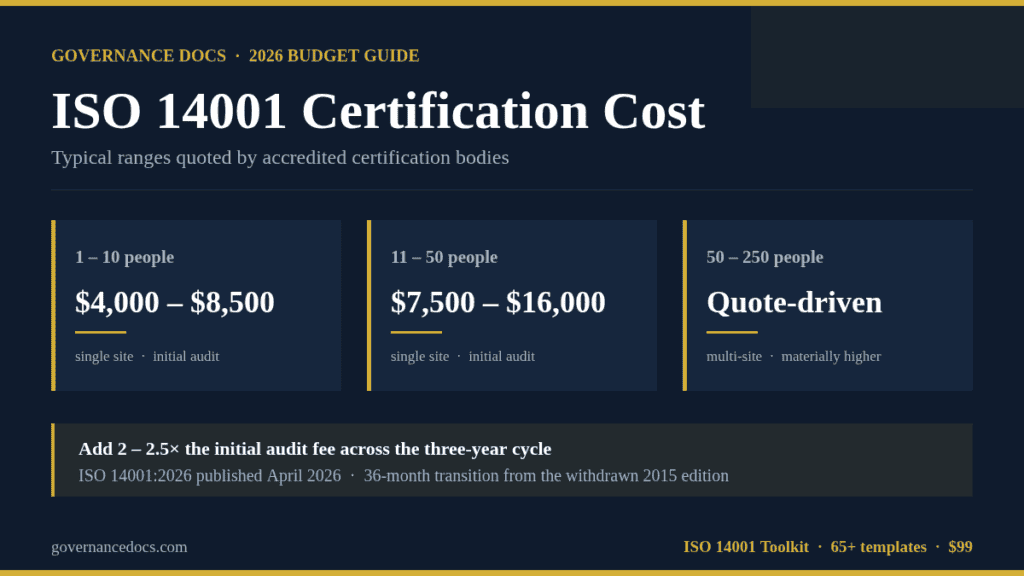
ISO 14001 certification cost by company size in 2026
These are typical ranges drawn from published 2026 guidance by accredited certification bodies. Treat them as a budgeting starting point, not a quote — pricing varies significantly by country, sector and registrar.
Scope size
Certification audit (Stage 1 + Stage 2)
Annual surveillance audit
Consultant, if used
1–10 people, single site
$4,000 – $8,500
$2,000 – $4,000
$5,000 – $10,000
11–50 people, single site
$7,500 – $16,000
$3,000 – $6,000
$8,000 – $15,000
50–250 people, multi-site
Quote-driven, materially higher
$5,000 – $8,000+
$15,000 – $20,000+
For a company of 10 to 25 people, a realistic all-in first-year figure — standard, implementation effort, training and the certification audit — is $9,000 to $20,000. If a quote comes in dramatically under that for an accredited certificate, ask which accreditation body the registrar holds and verify it on that body’s public register before you sign.
The costs that never appear on the registrar’s invoice
Most people budget the audit and are then surprised by everything around it. These are the parts of ISO 14001 certification cost that get missed:
The standard itself. ISO 14001:2026 is CHF 196 from the ISO Store, about US$240 at current rates. National standards bodies resell it, sometimes bundled.
Internal time. Almost always the largest real cost and almost never on a spreadsheet. Someone has to identify environmental aspects, build the compliance obligations register, and chase evidence.
Documentation. Policies, procedures, registers and records. This is the part a template set compresses most directly.
Training. An internal auditor course for at least one person, plus awareness training across the workforce.
Monitoring and calibration. A genuine cost where you measure emissions, discharges or waste volumes. Clause 9.1 expects the equipment to be fit for purpose.
Remediation. If Stage 2 raises major nonconformities, you pay for a follow-up visit to close them.
The three-year cycle is the real budget
The largest mistake in budgeting ISO 14001 certification cost is treating it as a one-off. An ISO 14001 certificate lasts three years. Year one and year two bring surveillance audits; year three brings a full recertification audit priced close to your original assessment. Judging ISO 14001 certification cost on the initial audit fee alone understates it badly.
A workable planning rule: across a full three-year cycle, budget roughly two to two and a half times your initial certification body fee to cover all audits in the period. Add your internal maintenance effort on top — internal audits, management review, keeping the compliance obligations register current — and the ongoing number is steadier and more predictable than the first-year spike, but it never goes to zero.
How the ISO 14001:2026 transition changes the cost math
This is the part that dates every older cost guide. ISO 14001:2026, the fourth edition, was published in April 2026 and runs to 36 pages. ISO 14001:2015 is now withdrawn, and so is the 2024 climate change amendment that sat on top of it. Anyone holding a 2015 certificate has to transition.
The transition period is 36 months from publication. Certification bodies are currently quoting 30 April 2029 as the deadline, but published wording from accreditation bodies has varied by a couple of weeks, so confirm the exact date with your own registrar rather than working from a blog post. Ours included.
What it costs depends entirely on when you do it:
At recertification — usually no extra fee. A recertification audit is already scoped to review every clause of the standard, so auditing against the 2026 edition instead of 2015 does not necessarily change the duration.
At a surveillance audit — expect a surcharge. Surveillance visits sample a subset of clauses. Covering the whole standard means added time, typically 0.5 to 1.5 auditor days per site.
As a standalone transition audit — most expensive per certificate. Budget $3,000 to $10,000 depending on size.
The changes driving that extra time are real, not cosmetic. There is a new clause 6.3 on planning of changes that had no equivalent in 2015. Climate change is built into the context clause rather than bolted on by amendment. The life cycle perspective carries more weight, operational control now reaches externally provided processes, products and services, and management review has been restructured. Our full breakdown of what changed in ISO 14001:2026 walks through each one.
Timing your transition to coincide with a recertification audit is the single largest lever on your ISO 14001 certification cost over the next three years. Map it now.
Five ways to reduce ISO 14001 certification cost without cutting corners
Scope tightly and honestly. Scope drives effective personnel, which drives audit days, which drives the fee. Excluding a site or activity you genuinely do not control is legitimate. Gerrymandering the scope to dodge your worst environmental aspects gets found at Stage 1.
Insist on day rate times days. It makes competing quotes comparable and exposes assumptions before you commit.
Align the transition with recertification. Often worth several thousand dollars on its own.
Do not write documentation from scratch. Drafting an EMS manual, an aspects and impacts register and a full procedure set consumes weeks of senior time at full salary cost.
Run a genuine internal audit before Stage 2. A major nonconformity means a return visit you pay for. Finding it yourself costs a day; the auditor finding it costs a day plus a fee plus a delayed certificate. Start from the mandatory documents and records list and work outward.
On the fourth point: our ISO 14001 Toolkit is a 65+ template document set written to the 2026 edition, for $99. Against a consultant engagement in the $5,000 to $20,000 range, or against the internal hours the same paperwork costs you, it is the cheapest variable in the whole budget. It does not replace the audit, and nothing does.
ISO 14001 certification cost FAQ
Is ISO 14001 certification worth the cost?
It depends on whether someone is asking for it. More than 676,000 organizations held ISO 14001 certificates worldwide according to the ISO Survey 2024, and a large share of them certified because a customer, a tender or a supply chain requirement made it a condition of doing business. If that is your situation, the return is obvious. If nobody is asking, an uncertified EMS built to the same standard delivers most of the operational benefit at a fraction of the price.
Can I get certified without a consultant?
Yes, and plenty of small organizations do. What you need is someone internal with time and the standard in front of them. The consultant line is the most compressible part of ISO 14001 certification cost, provided you replace it with something — a template set, a trained internal auditor, or both — rather than with optimism.
Does ISO 14001 cost more than ISO 9001?
Usually a little more for the same headcount. IAF MD 5 applies an environmental complexity category on top of personnel numbers, so a manufacturer with real emissions and waste streams draws more audit days for an EMS than for a QMS. If you are pricing both, see our breakdown of ISO 9001 certification cost — and ask your registrar for an integrated audit quote, which is materially cheaper than two separate assessments.
I am already certified. What does the 2026 transition cost me?
Somewhere between nothing extra and about $10,000. Transitioning at your scheduled recertification audit is the cheap path because that audit already covers every clause. A standalone transition audit is the expensive one. Talk to your registrar about sequencing before your next surveillance visit.
Why are some quotes so much cheaper?
Two common reasons, and both make the headline ISO 14001 certification cost misleading. The certificate is unaccredited, meaning no accreditation body oversees the registrar and major customers may reject it. Or the quote assumes a smaller scope or fewer sites than you actually have, and the difference reappears as a variation once the audit is underway. Check the accreditation, then check the scope statement on the quote.
The short version
Budget $9,000 to $20,000 for the first year if you are a small single-site organization, expect two to two and a half times the initial audit fee across the three-year cycle, and add a transition line if you are still on the 2015 edition. Then reduce the parts you control — scope, documentation, readiness — and accept that the audit itself is a fixed cost of a credible certificate. If you want the process end to end before you commit budget, start with how ISO 14001 certification actually works.