Notified body fees are the one line in an EU MDR budget that manufacturers most often get wrong, and the reason is simple: nobody looks at the published price lists. Article 50 of Regulation (EU) 2017/745 obliges every designated notified body to publish its standard fees, and the European Commission now maintains a consolidated list of links to those price lists covering 52 MDR notified bodies. This guide reads the 2026 price lists of three of them, explains what each fee item pays for, and works a first-year estimate for a class IIb device so you can see where the money goes.
One caveat before the numbers. A price list tells you the rate; it does not tell you the effort. The same class IIb file can take four assessment days at one notified body and twelve at another, and most of that gap is the quality of the file you submit, not the notified body’s hourly rate.
Free gap assessment
How much of ISO 13485 could you evidence today?
Score clauses 4 to 8, free, with the FDA QMSR and EU MDR duties kept separate so you can see what is the standard and what is the regulator.
The obligation is short. Article 50 MDR says notified bodies “shall establish lists of their standard fees for the conformity assessment activities that they carry out and shall make those lists publicly available.” Annex VII, section 1.2.8 adds that their terms must be “consistent, fair and reasonable” and must take account of the interests of small and medium-sized enterprises as defined in Recommendation 2003/361/EC.
Because the Regulation never defined “standard fees,” the Medical Device Coordination Group issued MDCG 2023-2 in January 2023. It sets three practical rules. The list must be reachable on the notified body’s own NANDO-registered website without registering or handing over contact details. Each item should say whether it is a flat fee or a time-based fee. And “duly justified external costs” (travel, external laboratories, expert consultations) may be claimed as expenditure on top of the listed fees. MDCG 2023-2 also gives a template, which is why the 2026 price lists from different notified bodies now share the same headings: administrative charges, auditing, documentation review, product testing and reporting.
The Commission’s consolidated list is published on its notified bodies page. It links the fee list of each designated body, so you never need to rely on a consultant’s summary.
Notified body fees line by line: the 2026 price lists
The table below is read from three published price lists in euros: BSI Group The Netherlands (NB 2797, effective 1 January 2026), DQS Medizinprodukte (NB 0297, valid from 1 January 2026) and NSAI (NB 0050, effective 11 November 2024, the list the Commission links as current). Figures are the listed standard rates; travel time and expenses are extra at all three.
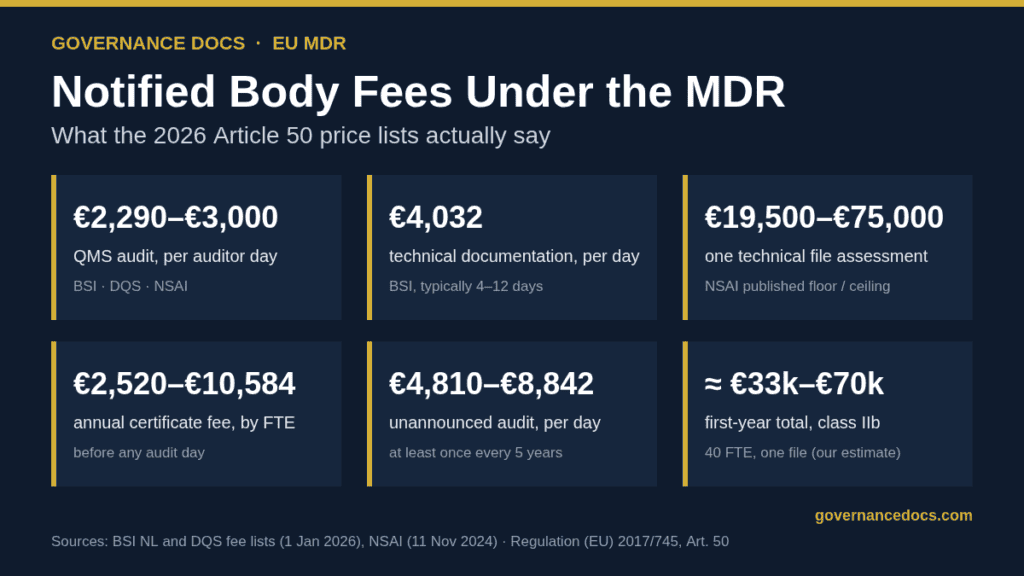
Three things stand out in these notified body fees. First, technical documentation review is where the totals diverge: NSAI publishes a floor of €19,500 and a ceiling of €75,000 for one file, and BSI’s four-to-twelve-day band works out to €16,128–€48,384. Second, audit day rates cluster tightly at €2,290–€3,000. Third, the annual fee is not a token charge; at the largest FTE band it reaches €10,584 a year at BSI before a single audit day is booked.
What actually drives the total
The price lists name their own drivers in a column headed “factors influencing the calculation of fee.” They repeat across notified bodies:
Device class and route. Article 52 sets the sampling. For class IIb, the notified body assesses the technical documentation of at least one representative device per generic device group; for class IIa, at least one per category of devices. For class III, and for class IIb implantables outside the Article 52(4) exemption list (sutures, staples, screws, plates and the like), every device’s file is assessed. More files, more assessment days.
Completeness and quality of the submission. Every list cites it. A file that triggers two rounds of questions doubles the review time at the same daily rate.
Number of FTEs and sites. Audit duration is set from IAF MD 9 (ISO 13485 audits) and IAF MD 5, both driven by headcount. BSI and NSAI also scale the annual fee to FTEs.
Clinical consultations. Class III implantables and class IIb active devices that administer or remove a medicinal product (Rule 12) go through the Article 54 clinical evaluation consultation with an expert panel. BSI lists expert panel consultation at €504 per hour; DQS lists it as effort-based.
Special procedures. Devices incorporating a medicinal substance, human tissue or animal tissue need a competent-authority consultation. BSI lists two to three review days at €4,032 each, plus the authority’s own fee.
A worked first-year estimate for a class IIb device
Take a manufacturer with 40 employees, one site, one generic device group, a non-implantable class IIb device, applying under Annex IX (quality management system plus technical documentation assessment). Using the rates above, this is a typical range for first-year notified body fees; it is an estimate built from the published lists, not a quote.
Component
Basis
Typical range
Application fee
Flat
€2,760–€3,500
Initial QMS audit
4–6 auditor days at €2,290–€3,000
€9,200–€18,000
Technical documentation assessment
4–8 days at €3,250–€4,032
€13,000–€32,300
Clinical evaluation assessment
0.5–1.5 days at €4,032–€4,050
€2,000–€6,100
Certificate decision and issue
Flat, where listed
€500–€760
Annual maintenance fee
11–49 FTE band
€2,520–€4,000
Travel time (not expenses)
2–3 days
€3,500–€5,300
First-year total
≈ €33,000–€70,000
The spread in these notified body fees is deliberate. The low end assumes a clean file reviewed in four days and a compact audit; the high end assumes eight assessment days and a second round of questions. A class IIa device with one representative file will usually land below this band. A class III implant with several files, an Article 54 expert panel consultation and a medicinal-substance consultation will land well above it, and NSAI’s €75,000 ceiling for a single technical documentation assessment shows how far the review component alone can stretch.
Recurring notified body fees after the certificate
The certificate is valid for the period it states, capped at five years under Article 56(2). Between issue and renewal, the Regulation fixes a rhythm that turns into recurring notified body fees:
Surveillance audit every 12 months (Annex IX, section 3.3), typically 2–3 auditor days plus travel: €4,600–€9,000 a year at 2026 day rates.
Unannounced audit at least once every five years (Annex IX, section 3.4), which the notified body plans but does not disclose: €4,810–€8,842 per day, and it may combine it with a surveillance visit or add it.
PSUR review. Article 86 requires class IIb and III manufacturers to update the PSUR at least annually and class IIa at least every two years; the notified body’s review is billed at 1–2 days.
Change assessments at €345–€685 per hour, or a daily rate for larger design changes.
Annual maintenance fee every year, sized by headcount.
Over a five-year certificate, a mid-sized class IIb manufacturer should expect the recurring fees to exceed the initial certification fees. Budget them as an operating cost, not a one-off project.
What the price lists do not cover
Notified body fees are only the conformity assessment. Three other buckets sit outside every Article 50 list:
Preparation. Building the technical documentation, the clinical evaluation and a quality management system that already meets ISO 13485. Most of the assessment-day variance in the table above is decided here. See our ISO 13485 certification cost breakdown for the QMS side.
Testing. Electrical safety, biocompatibility, usability and software verification are bought from laboratories, and MDCG 2023-2 allows the notified body to pass external costs through as expenditure.
Regulatory infrastructure. EUDAMED registration, UDI assignment, the authorised representative if you are outside the EU, and the person responsible for regulatory compliance. None of these appear on a notified body invoice, but all of them are audited.
How to keep notified body fees down
Notified bodies price effort, so the levers are all on your side of the table.
Submit a complete technical file the first time. Every list names “completeness and quality of the submitted file” as the driver of assessment days. Run the Annex II and III checklist before submission, not after the first deficiency letter.
Group devices sensibly. Sampling under Article 52 is per generic device group (IIb) or per category (IIa). A rational portfolio structure reduces the number of files assessed.
Claim the SME terms. NSAI discounts audit-related activities by 10% for small and 20% for micro enterprises; BSI and DQS scale annual fees to headcount. Ask for the notified body’s SME policy in writing; MDCG 2023-2 expects them to have one.
Combine audits. ISO 13485, MDSAP and MDR audits at one notified body can share days; DQS lists a combined system assessment rate of €2,920 a day.
Time your transition. Legacy devices under the extended Article 120 deadlines still need an MDR application lodged and a written agreement in place. If you missed those conditions, read EU MDR transition deadlines and the conditions that closed before you budget anything.
For the regulatory background to every article cited here, start with our pillar guide, EU MDR: Regulation (EU) 2017/745 explained. The consolidated text of the Regulation, including Article 50, is free on EUR-Lex.
If the technical file is the part you are least sure of, the EU MDR Toolkit (68 templates, $99) includes the Technical Documentation Completeness Matrix, the Notified Body Application and Interaction Procedure, the Notified Body Audit Evidence Pack and the Notified Body and Certificate Log, which are the four documents that most directly shorten assessment days.
Notified body fees FAQ
Are notified body fees the same as the cost of CE marking?
No. Notified body fees cover the conformity assessment only. CE marking also costs you the technical documentation, clinical evaluation, testing, EUDAMED and UDI set-up, and the QMS, most of which you pay for before the notified body sees anything.
Do class I devices pay notified body fees?
Only class I sterile, measuring or reusable surgical instrument devices (Is, Im, Ir) need a notified body, and only for the aspects concerned. Other class I devices self-declare under Article 52(7) and pay nothing to a notified body.
Why do quotes from two notified bodies differ so much for the same device?
Usually because they estimated different assessment days, not because their rates differ. Ask each to state the assumed technical documentation days and audit days; that is the number to compare.
Can a notified body charge more than its published list?
The list is the standard rate. MDCG 2023-2 lets notified bodies add duly justified external costs such as travel, laboratories and expert consultations, and every list reserves extra time for incomplete submissions.
Is there an SME discount?
There is no fixed EU-wide discount, but Annex VII 1.2.8 requires notified bodies to take SME interests into account, and MDCG 2023-2 expects each list to describe how. NSAI’s 10% and 20% reductions are one published example.
Figures read from the BSI, DQS and NSAI standard fee lists linked from the European Commission’s notified bodies page, the consolidated text of Regulation (EU) 2017/745 and MDCG 2023-2, on 19 September 2026. Rates change each January; check the current list before you sign.