
CART
No products in the cart.
ISO Compliance Insights & Best Practices
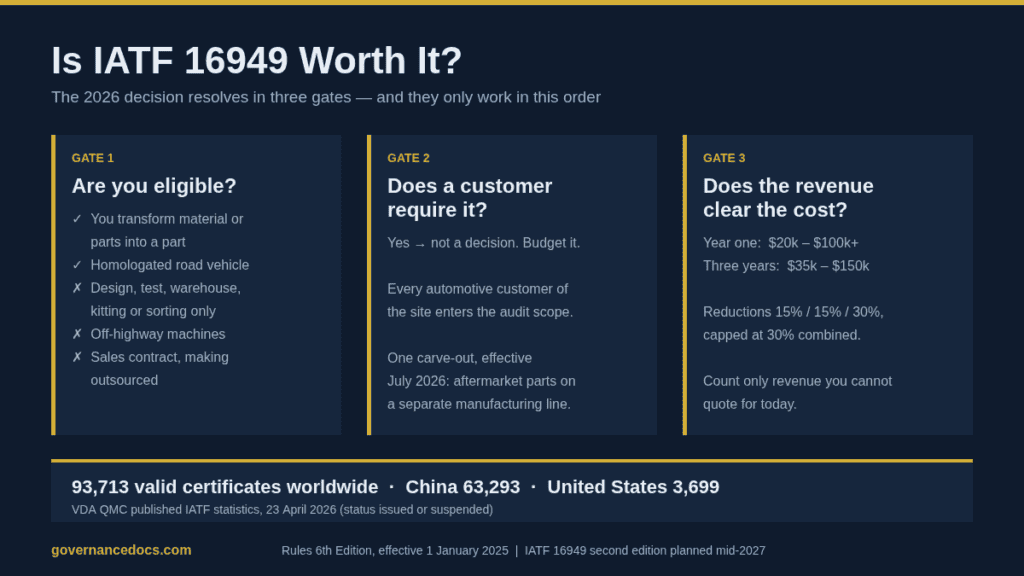
Is IATF 16949 worth it? For most automotive suppliers the honest answer starts somewhere unexpected: with whether the certificate is available to you at all. The International Automotive Task Force decides who may be certified, and since the Rules 6th Edition took effect on 1 January 2025 that answer has changed for a large slice of the industry. Aftermarket, service and remanufactured part makers are now eligible. Companies that only design, test, kit or warehouse are not, however much automotive work they do.
So this guide treats the question in three parts. First, eligibility, because a cost-benefit case is pointless if the scheme is closed to you. Second, the return, priced against what the certificate actually unlocks rather than the usual list of quality benefits. Third, the cost of ownership, which in IATF’s case includes clocks and consequences no other management system standard imposes. Figures are US dollars, labelled as typical ranges, and current as of September 2026.
Free gap assessment
Where do you stand on the automotive supplemental requirements?
Score only what IATF adds to ISO 9001, free, including customer-specific requirements, product safety and the core tools.
Run the free IATF 16949 gap assessment → or View premium report sample
There is no single verdict, because four different companies asking the same question are in four different positions. Find yours.
| Your situation | Verdict | Why |
|---|---|---|
| An IATF OEM or a tier-1 customer requires third-party certification | Not a decision — budget it | The certificate is a condition of quoting. Section 1.0 also pulls every automotive customer of that site into the audit scope, so the bill is bigger than the one customer that asked |
| You make replacement, aftermarket, remanufactured or accessory parts and nobody has demanded it | A genuine choice — run the numbers | Rules 6th Edition made you eligible. With no mandate, the certificate has to earn its keep commercially |
| Your customers ask only for ISO 9001 | Usually not yet | IATF 16949 clause 8.4.2.3 sets ISO 9001 certification as the supplier floor and IATF certification as the eventual objective, unless the customer authorizes otherwise |
| You only design, test, sort, kit, package or warehouse | Not available | None of those meet the Rules definition of manufacturing |
| Your parts go on off-highway machines | Not available | Eligibility is limited to homologated vehicles intended for public roads |
| You hold the sales contract but outsource the making of the part | Not available | The Rules exclude what used to be called the fabless model |
Two of those six rows are verdicts nobody can sell you out of, which is the first reason to read the eligibility section before the price list.
Rules 6th Edition Section 1.0 states that only organizations that manufacture and, where applicable, design and develop automotive products and vehicles are eligible for IATF 16949 certification. IATF Global Oversight walked through that section paragraph by paragraph in a published certification body briefing, and the worked examples are unusually blunt.
Manufacturing is defined as a process including at least one value-added activity that further transforms the input material or part into a semi-complete or complete state. Assembly, casting, extrusion, heat treatment, machining, molding, plating, painting and soldering all qualify. Sorting, kitting, testing, inspection, packaging and warehousing do not. An automotive vehicle means a homologated vehicle intended to be driven on public roads, which takes in cars, trucks, buses, motorcycles, campers and specialty vehicles such as ambulances and school buses, and in some countries trailers, scooters and auto rickshaws. If it cannot be licensed for a public road, the parts on it are outside the scheme.
| Eligible | Not eligible |
|---|---|
| Production parts and processed materials made to a customer’s specification | Raw material extraction with no transforming process — ore, sand, crude oil, hides |
| Accessory parts made to OEM specification and released by the OEM, fitted at the dealership | Sites whose only activities are design, testing or warehousing |
| Service, aftermarket and remanufactured replacement parts, including sales direct to repair shops and parts retailers | Aftermarket products with no equivalent part released by an OEM |
| EV charging units, wall boxes and charging cables, including public and municipal stations | The electrical supply or source feeding a charging unit |
| Processed materials such as sheet, rod, pellets, lubricants, sealants and brake fluid | Parts for vehicles that are not homologated for public roads |
The aftermarket expansion is the commercially interesting part. IATF confirmed in the same briefing that a manufacturer can be certified for aftermarket replacement parts without holding any OEM supply chain purchase order, and that auto repair shops, body shops and parts retail stores count as automotive customers. Ten years ago that company had no route to a certificate. Today it has one, which is precisely why is IATF 16949 worth it has become a live question for a whole segment that used to be told not to bother.
The audit half of the budget is more predictable than most schemes because IATF fixes minimum audit days by site headcount in Rules Table 5.2, and every recognized certification body must apply them. Two registrars quoting the same plant should land on the same number of days and differ only on day rate. Stage 1 readiness assessment adds 1.5 to 3.0 days on site, at least 20 calendar days before stage 2, and audit preparation time sits outside the audit duration, so it appears on the invoice separately.
Realistic first-year totals run from roughly $20,000 for a small make-to-print shop that already holds ISO 9001 to $100,000 or more for a design-responsible tier-1 plant building its system from scratch, with surveillance at roughly a third to a half of that every year after. Our IATF 16949 certification cost breakdown prices three typical plants line by line and reproduces the audit-day brackets.
Three reductions are worth knowing before you ask for quotes: 15% where the site has no design responsibility, 15% for a corporate scheme with a centrally controlled system across two or more sites, and 30% on the stage 2 audit when you are upgrading from an existing ISO 9001 certificate. Combined reductions are capped at 30%, and results round up to the nearest half day. A 40-person make-to-print shop with an ISO 9001 certificate can therefore take a stage 2 audit from 4.5 days to 3.5 — real money, but rarely the figure that settles whether is IATF 16949 worth it comes out yes or no.
For most suppliers asking is IATF 16949 worth it, this is the whole return. Where a customer requires the certificate, no amount of demonstrated quality substitutes for it; you are simply not on the bid list. That makes the calculation a contract-value question rather than a payback-on-quality-savings question. If one program you cannot currently quote is worth more over three years than the fully loaded cost above, the answer is yes and the rest of the analysis is decoration.
A certified site with clean scorecards spends markedly less time hosting second-party audits than an uncertified one, because customers lean on the certificate and their own performance data instead. Suppliers who track audit-hosting hours usually find this is the largest recurring saving, and it is the one benefit that scales with the number of automotive customers you serve.
The five core tools — APQP, control plan, PPAP, FMEA, and MSA with SPC — are the common language of automotive quality, and building them properly is most of the implementation work. Our guide to the IATF 16949 core tools covers the chain and where it usually breaks. Suppliers who were already running APQP and PPAP for customers find the gap to certification much smaller than the headline cost suggests.
For a remanufacturer or aftermarket producer with no mandate, the certificate is a differentiator rather than a ticket, because so few of your competitors hold one. That is a weaker argument than a contractual gate, but it is a real one, and the scope statement is explicit about it: certificates covering these products carry the words aftermarket, service or remanufactured.
Keep the market context in view. VDA QMC, one of the five IATF member associations, put the worldwide population at 93,713 valid IATF 16949 certificates as of 23 April 2026, of which China holds 63,293 and the United States 3,699, with Germany on 2,681 and Mexico on 2,369. Two things follow. Globally the certificate is a ticket, not a badge — ninety thousand companies have one. In North America the population is small enough that it functions as a gate to a specific set of customers rather than as broad market recognition. Note also that VDA QMC counts certificates with the status issued or suspended, so the headline slightly overstates how many are trading normally today.
Work it as a threshold, not a return. Take the 40-person shop above: year one lands around $20,000 to $35,000 all in once you include audits, training, documentation time and a modest gap assessment, with $5,000 to $10,000 a year in surveillance and internal upkeep after that. Call the three-year cost $35,000 to $55,000.
Against that, put only the revenue you cannot access today. A single tier-1 program at a few hundred thousand dollars a year clears the threshold several times over, which is the ordinary case and the reason small suppliers certify. What does not clear it is a hope of general quality improvement: if your customers are content with ISO 9001 and nobody is holding a program back, the same $40,000 spent on measurement systems, gauges or a capable quality engineer will do more for your defect rate than the certificate will.
The trap at this size is section 1.0’s scope rule. Supply one customer who requires certification and all automotive customers of that site come into the audit scope — you cannot certify the one line that needs it and leave the rest outside. Since July 2026 there is exactly one exception, discussed below.
Any serious answer to is IATF 16949 worth it has to price the upkeep, and this is where an IATF certificate differs from ISO 9001 — and where suppliers get caught. The scheme runs on fixed clocks with automatic consequences, and the certification body has no discretion to be generous.
| Clock | What it requires | What happens if you miss it |
|---|---|---|
| 15 calendar days from the closing meeting | Initial response to a major nonconformity | Audit result failed; existing certificate withdrawn |
| 60 calendar days | Evidence of implemented corrective action and its effectiveness | Same — the audit is invalidated |
| 90 calendar days | A one-time onsite special audit to verify systemic corrective action for a major nonconformity | An extra paid audit visit you did not budget for |
| 15 calendar days after a decertification process starts | Technical reviewer decides on suspension — mandatory where a major nonconformity is confirmed | Certificate suspended while you fix it |
| Surveillance every 12 months, −3/+3 months | Audit conducted inside the window | Loss of certification; late audits can force a fresh initial certification audit |
| 90 calendar days before the due date | Audit dates confirmed with the certification body | A transfer to a new registrar converts into a full initial audit |
Two more mechanisms deserve a line in any honest cost case. Under Rules clause 5.2 q, if the site is missing the quality or delivery targets on an IATF OEM scorecard, the certification body shall add audit time to verify the corrective actions, and where that time will not fit into the planned audit it must run a special audit within 60 calendar days. Poor customer scorecards therefore raise your audit bill directly. And a sanctioned interpretation to clause 5.12 now requires the registrar to notify its IATF oversight office, with justification, if it does not write a major nonconformity where OEM performance targets are being missed — soft-grading is being actively policed, so budget for a real audit rather than a comfortable one.
Three situations where the disciplined answer is no, or not yet.
Your customers only require ISO 9001. Clause 8.4.2.3 requires organizations to have their automotive suppliers develop a system certified to ISO 9001 unless the customer authorizes otherwise, with progression toward IATF certification as the objective. Many tier-2 and tier-3 suppliers sit legitimately at the ISO 9001 step, often with the AIAG minimum automotive requirements layered on at a customer’s request. Ask your customers in writing where they expect you to be in two years, then decide.
Your aftermarket work can stay out of scope. In June 2026 IATF issued a sanctioned interpretation to section 1.0, effective July 2026, creating the only exception to the all-customers rule: aftermarket replacement parts manufactured on a separate manufacturing line from production or service parts may be excluded from the audit scope where that aftermarket customer does not require certification. If you were about to certify a plant whose aftermarket volume would have dragged a second product family into the audit, that is a genuine and current saving — check whether your line layout already qualifies.
You are ineligible. Design-only centers, test houses, warehouses, kitting operations, off-highway suppliers and outsourced-manufacturing sales companies cannot hold a certificate, whatever a consultant tells you. ISO 9001, plus whatever customer-specific requirements apply, is the ceiling and there is no shame in it.
Timing is the one question that has an easy answer this year. IATF 16949:2016 remains the standard you are certified against, and certification bodies are clear that the 2016 standard paired with ISO 9001:2015 is the certifiable combination until the second edition arrives. IATF’s own stakeholder communiqué puts publication in mid-2027 with the end of the transition period aligned to the end of the ISO 9001 transition, and our guide to the IATF 16949 second edition tracks the five priority topics behind it. Certify now and you meet the new edition at a recertification you were paying for anyway. Waiting for mid-2027 costs you eighteen months of business access to save a transition you will pay for either way.
Five levers that move the is IATF 16949 worth it arithmetic in your favor, all of them inside the Rules rather than in a consultant’s pitch.
Claim the reductions you qualify for. Ask the registrar in writing which of the 15% no-design, 15% corporate scheme and 30% ISO 9001 upgrade reductions it has applied, and check the arithmetic against the 30% cap. Quotes that ignore them are common.
Separate your aftermarket line. As above, the July 2026 interpretation rewards a physical line separation with a smaller audit scope.
Get the site structure right before you apply. An extended manufacturing site must be within 10 miles and 60 minutes’ driving distance of the main site, under the same legal entity, sharing one system — same owner but a different legal entity will not do, and the sites become separate certifications with separate audits.
Plan the audit around production. At least 30% of audit time is spent on the manufacturing floor, and the Rules require the certification body to delay the audit if automotive processes will not be running. A delay can cost you the certificate, so schedule around the build plan rather than the quality manager’s calendar.
Fix the scorecards first. Because clause 5.2 q converts missed OEM targets into extra audit days, closing performance issues before the audit window opens is a direct saving, not just good practice.
Usually yes, but price it properly. That one customer’s requirement brings every automotive customer of the site into the audit scope, so compare the certificate’s cost against the whole relationship, not the single program. If the program is small and the customer will accept ISO 9001 with documented progression, negotiate that instead and get the authorization in writing.
Yes. Under Rules 6th Edition a manufacturer of aftermarket replacement parts is eligible without any OEM purchase order, and the customers can be repair shops, body shops or parts retailers. The certificate scope statement will say aftermarket, service or remanufactured as applicable.
It can be, and eligibility is no longer in doubt — remanufactured parts rebuilt to original specification are explicitly in scope. With no customer mandate, treat it as a marketing and tender-qualification investment and test it the cheap way first: ask three target customers whether a certificate would change their sourcing decision.
No. IATF 16949:2016 references ISO 9001:2015 and certification continues against that pairing until the IATF second edition publishes, currently planned for mid-2027. Nothing about the September 2026 ISO 9001 edition requires action on your IATF certificate today.
Look it up rather than guess: minimum days come from Rules Table 5.2 by site headcount, and the free audit-day calculator published by the Americas oversight office applies the same brackets. Then add stage 1, preparation time and any additional time for missed OEM targets.
Settle eligibility, get three quotes from IATF-recognized registrars with the reductions itemized, and price the revenue you cannot currently reach. If that revenue clears a three-year cost in the $35,000 to $150,000 band depending on site size, the decision makes itself. Our pillar guide to IATF 16949 for automotive suppliers covers what the system has to contain once you commit.
If you do commit, the documentation is the longest pole. The IATF 16949 Toolkit gives you 250+ editable templates covering the automotive quality system, the core tools and the records an auditor will ask for — a faster and cheaper start than drafting a manual from a blank page. Is IATF 16949 worth it for your site? Answer it with your own numbers rather than a registrar’s brochure.

October 19, 2026
October 19, 2026
October 18, 2026
October 18, 2026
October 15, 2026
