A HITRUST readiness assessment is the rehearsal that decides whether your formal assessment will be a clean pass or an expensive surprise. HITRUST certification is demanding, evidence-heavy and priced by the effort the external assessor has to spend, so finding your gaps before that work starts saves both money and calendar time.
This guide explains what a readiness assessment is, how it differs from a validated assessment, how to scope and score it in the MyCSF portal and what to do with the results. It is written for security and compliance leads at healthcare, SaaS and service organizations whose customers have asked for HITRUST. Timelines and costs are typical ranges; HITRUST and your assessor set the real rules, so confirm current requirements before committing to a schedule.
Free gap assessment
Could you evidence your HIPAA safeguards today?
Score every standard and implementation specification, free, including the addressable ones that still need a decision on file.
HITRUST is a framework and assurance program built around the HITRUST CSF. Organizations complete assessments in the MyCSF portal, and depending on the assessment type the result can be a certification report valid for one or two years. The available assessment types include e1, i1 and r2, which differ in depth and validity.
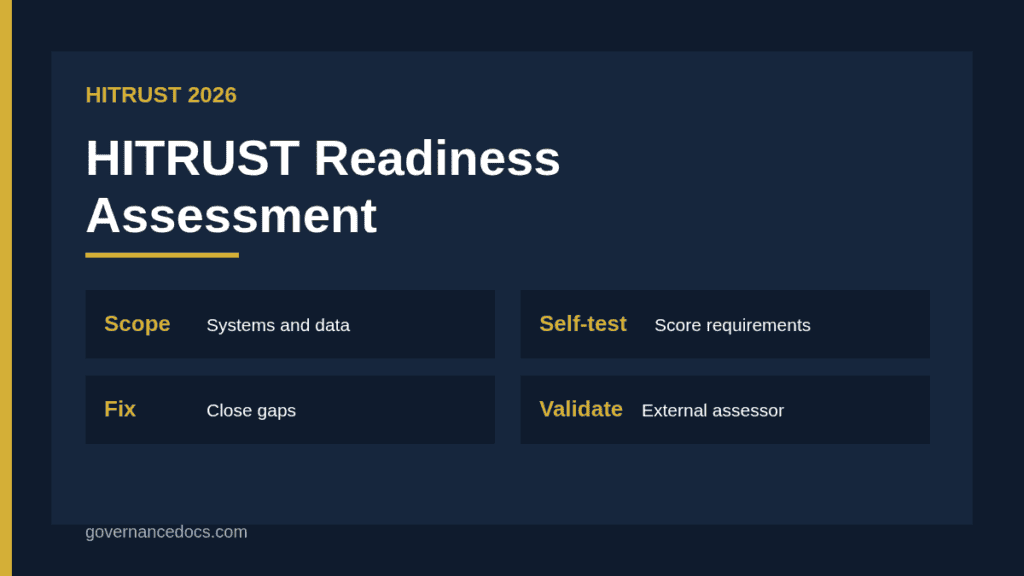
A HITRUST readiness assessment is the self-assessment stage before validation. You scope the environment, answer each requirement, score your implementation and record the evidence you believe supports it. It is not certification, and it does not replace independent testing, but it tells you which requirements you would likely fail. The practical guides available from assessors describe it as a step to complete before validated testing begins, and we agree with that order.
Validated assessments involve an external assessor, testing and a quality assurance review by HITRUST. Discovering weak controls during that process means rework, delays and extra fees. A readiness assessment moves that discovery earlier, when fixes are cheaper.
It also builds the evidence habit. Most failures are not missing controls but missing proof: a policy with no approval date, a review with no record, a scan report that cannot be tied to the scope. Readiness forces the team to collect evidence before anyone outside is watching. The exercise also helps you choose the right assessment level for customer needs; compare with HITRUST vs ISO 27001 and HITRUST vs SOC 2 if you are deciding among frameworks.
How to scope your HITRUST readiness assessment
Scope is the single biggest driver of effort. Define the systems, locations, business units and data types in scope, and be precise about boundaries. A smaller, well-defined scope is easier to assess and easier to defend. If a customer requires a specific product or platform, scope to that and expand later.
Consider inheritance from cloud providers and other service organizations. When a provider already holds a HITRUST report, some requirements can be inherited, reducing your testing. Read HITRUST inheritance for how that works and what you still must demonstrate.
Document the scope in writing and get your assessor to agree to it early, because changing scope mid-project is expensive.
Aspect
Readiness assessment
Validated assessment
Purpose
Find and fix gaps
Obtain a HITRUST report and certification decision
Who performs it
Your team, often with an advisor
An authorized external assessor
Testing
Self-scored against requirements
Independent testing of evidence
Submitted to HITRUST
Not for certification
Yes, for quality assurance review
Output
Gap list and remediation plan
Validated report, certification if criteria are met
Best timing
Months before validation
After gaps are closed
Scoring requirements in the HITRUST readiness assessment
HITRUST evaluates requirements across maturity levels covering policy, procedure, implementation, measurement and management. For more rigorous assessments, the scoring model matters because the results must meet thresholds. Our explainer on HITRUST scoring goes through the method.
In readiness, score honestly. The temptation is to give full credit for anything that exists. A better habit is to ask what an assessor would test, then check that the evidence exists today: the approved policy, the procedure that staff actually follow, the samples that prove operation and the metrics that show you review performance.
A step-by-step HITRUST readiness assessment plan
The following plan fits most mid-sized organizations. Adjust durations to your size and complexity.
Weeks 1 to 2: confirm the customer requirement, assessment type and scope
Weeks 2 to 4: pick an assessor or advisor and open the MyCSF assessment
Weeks 3 to 8: answer and score requirements, assigning an owner to each
Weeks 6 to 10: collect evidence and mark missing items as gaps
Weeks 8 to 16: remediate gaps by priority, updating policies and procedures
Weeks 14 to 18: run a mock review of evidence samples
Then: freeze scope and start the validated assessment
Evidence to collect during readiness
Keep a structured evidence library. Organize by control domain, and name each item so it can be found quickly. For every requirement, store the policy, the procedure, at least one dated sample of operation and the owner. Include screenshots only when they show identifying details such as system name and timestamp.
Typical items include access review logs, vulnerability scan results, patch reports, training records, incident response test results, vendor assessments, backup restore tests and change tickets. Review the same sample periods your assessor will use, because evidence outside the testing window does not help.
Working with an assessor and the portal
HITRUST validated assessments are performed by an authorized external assessor. Interview several and ask about experience in your sector, their approach to readiness and how they handle quality assurance comments. See HITRUST external assessor for selection advice.
The MyCSF portal is where you scope, score and submit. Our page on MyCSF explains the workflow. For a two-year certification there is also an interim assessment at the one-year mark; read HITRUST interim assessment so you plan for it from the start. For budgeting, use HITRUST certification cost.
Using templates for the HITRUST readiness assessment
Most gaps found in readiness are documentation gaps: missing policies, procedures and forms. The HITRUST CSF Toolkit provides editable templates covering the control areas HITRUST assesses, so you can close documentation gaps quickly and focus engineering time on real control gaps.
Templates do not produce evidence of operation; only running the control does. For background on the program, see the A-LIGN HITRUST certification guide. If your drivers are healthcare laws rather than a customer request, compare with HITRUST vs HIPAA first.
Turning readiness results into a remediation plan
Sort every gap by effect on your pass result and by effort to fix. Requirements that are missing entirely, such as an absent policy or an untested incident response plan, come first because they can be closed in days. Operating gaps, such as access reviews that were never performed, need a few cycles to generate evidence, so start them early. Technical gaps, such as missing multi-factor authentication on a system in scope, need engineering time and change control, so schedule them with realistic buffers.
Give each gap an owner, a due date and a definition of done that names the evidence you will collect. Review progress weekly with the project sponsor and keep a dated log of the changes. Re-score the affected requirements as they close, and compare your scores with the pass criteria for the assessment type you plan to pursue. Organizations that do this find the validated assessment becomes a confirmation of work already done, not a discovery exercise.
Timing your HITRUST readiness assessment against customer deadlines
Work backward from the date your customer needs the report. Allow time for the validated testing, the quality assurance review by HITRUST and any comments the reviewer raises. Then add the remediation time from your readiness results, and a buffer for scope changes. If the calendar does not fit, talk to your customer early; some will accept a signed plan with milestones while you complete the process, but only if you ask before the deadline rather than after it. Keep your assessor informed so they can reserve testing time, since good assessors book up quickly during busy periods. These durations are illustrative, so get a written schedule from your assessor.
Keeping evidence fresh until validation starts
Evidence ages. A policy approved two years ago, a scan from last spring or an access review that stopped after the first quarter will all draw questions. Set a calendar of recurring tasks for the months between readiness and validation, assign each to a named person and store the output in the evidence library on the day it is produced. A short weekly check of the library, looking for empty folders and stale dates, catches most problems before the assessor does.
Common mistakes in a HITRUST readiness assessment
Organizations often scope too broadly, score too generously, skip evidence collection and start validation before gaps are closed. Another mistake is treating readiness as one-time; controls drift, so refresh evidence before the validated assessment begins. Finally, teams forget to involve business owners. Controls such as access reviews and vendor management need owners in the business, not only in IT.
HITRUST Readiness Assessment FAQ
What is a HITRUST readiness assessment?
It is a self-assessment completed before validated testing. You scope the environment, score requirements, collect evidence and fix gaps, but it does not itself produce certification.
Is readiness required before a validated assessment?
Check current HITRUST rules, but it is widely recommended by assessors because it reveals gaps early and reduces rework.
How long does readiness take?
Typically a few months for a mid-sized organization, depending on scope, evidence readiness and the number of gaps.
Who performs it?
Your internal team, often supported by an advisor or the authorized assessor who will later perform validation.
How long is HITRUST certification valid?
Commonly one year for e1 and i1, and two years for r2 with an interim assessment at one year. Confirm current terms with HITRUST.