CART
HITRUST scoring is what separates a HITRUST assessment from a control checklist. Each requirement is not marked present or absent — it is scored across maturity levels, and a control you perform reliably but never measure will still cost you points.
This guide covers the five maturity levels, how they are weighted, what the domain threshold means for certification, and where scores are lost.
Free gap assessment
Could you evidence your HIPAA safeguards today?
Score every standard and implementation specification, free, including the addressable ones that still need a decision on file.
Run the free HIPAA gap assessment → or View premium report sample
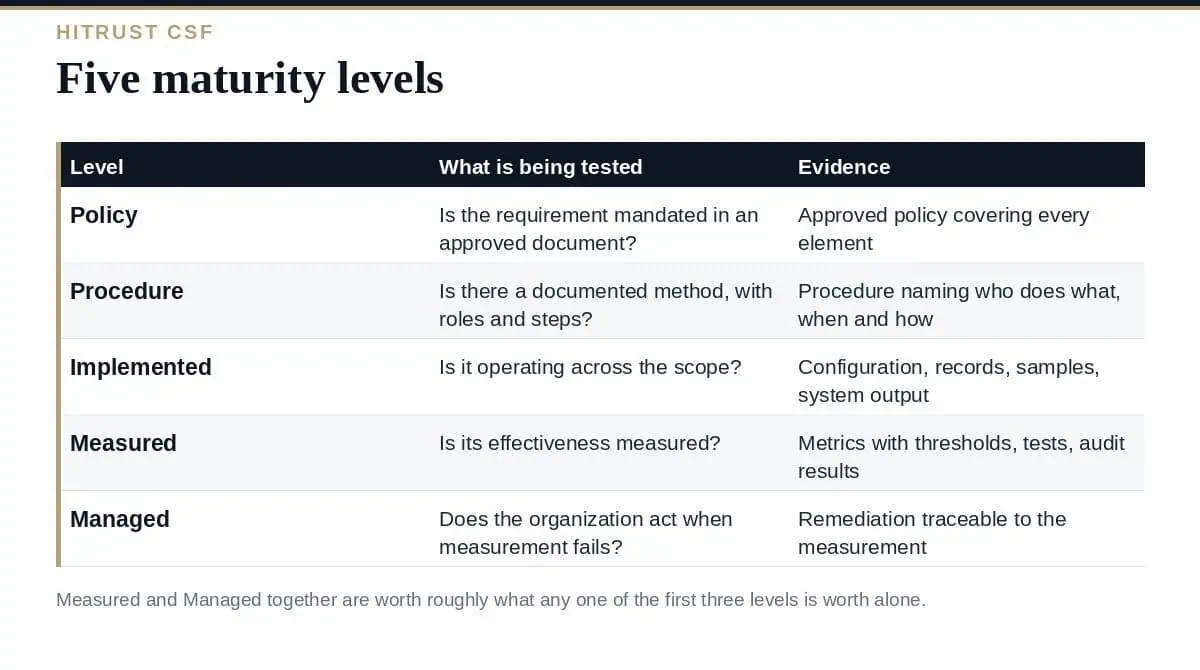
HITRUST uses a maturity model derived from PRISMA. Every requirement statement is evaluated at each level:
| Level | What is being tested | Evidence |
|---|---|---|
| Policy | Is the requirement mandated in an approved document? | Approved policy covering every element of the requirement |
| Procedure | Is there a documented method, with roles and steps? | Procedure naming who does what, when and how |
| Implemented | Is it actually operating across the scope? | Configuration, records, samples, system output |
| Measured | Is its effectiveness measured, not just its existence? | Metrics, tests, audit results with thresholds |
| Managed | Does the organization act when measurement shows a problem? | Remediation records traceable to the measurement |
Each level is scored on how completely the requirement’s elements are covered — coverage — and how rigorously the maturity criteria are met — strength. The two combine into the level score, and the level scores combine into the requirement score.
In HITRUST scoring the first three levels carry most of the weight. Measured and Managed together are worth roughly what any one of Policy, Procedure or Implemented is worth on its own. That design is deliberate: it stops an organization with excellent documentation and no operation from scoring well, while still rewarding the continuous monitoring that distinguishes a live control from an implemented-and-forgotten one.
The practical read: you cannot certify on documentation, and you cannot reach a strong score without measuring something. Most organizations arrive with the first three levels solid and lose their margin entirely at Measured.
Requirement statements are distributed across assessment domains, and the certification test is applied by domain: each domain needs an average maturity score at or above the required level. A single weak requirement rarely fails you — a domain where nothing is measured will.
That has a direct consequence for remediation planning. Sort your gaps by domain, not by severity. Three small improvements inside a failing domain are worth more than one large improvement in a domain already comfortably above the line. Our guide to the e1, i1 and r2 assessments covers which assessment type applies before you get to the scoring at all.
Free ISO 27001 risk assessment
Which of your risks sit above your appetite line?
Set your own risk criteria, pick from 61 information security risk scenarios, rate likelihood and impact, and decide how to treat each one. You get a heat map, a process score and the findings an auditor would raise, free.
Run the free risk assessment → or View premium report sample
Policy that does not cover every element. Requirement statements often contain several distinct obligations. A policy covering three of four elements does not score three-quarters by accident — it scores on the assessor’s coverage judgement, and partial coverage is expensive.
Procedure written as policy. The two levels test different things. A restatement of the policy in the procedure document scores at Policy and adds nothing at Procedure.
Implementation demonstrated in one place. Scope coverage matters. Evidence from one system, when the requirement applies to twelve, is partial implementation.
Metrics without thresholds. A number with no target is not measurement. Measured needs a defined threshold and a comparison against it.
No trace from measurement to action. Managed is about what happened when the measurement was bad. If nothing was ever bad, the more likely explanation is that nothing was ever measured properly.
What are the HITRUST maturity levels?
Policy, Procedure, Implemented, Measured and Managed. Each requirement is scored at every level, and the level scores roll up into the requirement score.
What score is needed to certify?
Certification turns on domain averages meeting the required maturity level across the assessment domains, rather than on any single requirement passing.
Do all five levels apply to every assessment?
The maturity model applies to the validated assessments; the lighter assessment types work against a smaller requirement set. Check which model applies to the assessment you are pursuing.
Can we certify without measuring anything?
Not comfortably. Measured and Managed carry less weight than the first three levels, but a domain that scores zero on both will usually fall below the threshold.
How is HITRUST scoring different from a SOC 2 opinion?
SOC 2 produces an auditor’s opinion with exceptions described in narrative. HITRUST scoring produces a number per requirement and per domain, which is why customers can compare two HITRUST reports in a way they cannot compare two SOC 2 reports.
Treat HITRUST scoring as five separate tests per requirement, not one. Write policies that cover every element of the requirement statement, keep procedures genuinely procedural, and demonstrate implementation across the whole scope rather than one representative system. Then invest early in measurement with real thresholds and a record of what you did when a threshold was missed — that is where the margin between passing and failing a domain actually lives.
Policy sets, procedure templates and an evidence matrix are in the HITRUST CSF v11 Toolkit (re-baselined to CSF v11.8.0, September 2026), or start with the free ISO templates.


October 13, 2026
October 12, 2026
October 12, 2026

October 12, 2026

October 12, 2026

