

HITRUST Certification Validity: The Complete 2026 Guide to e1, i1 and r2
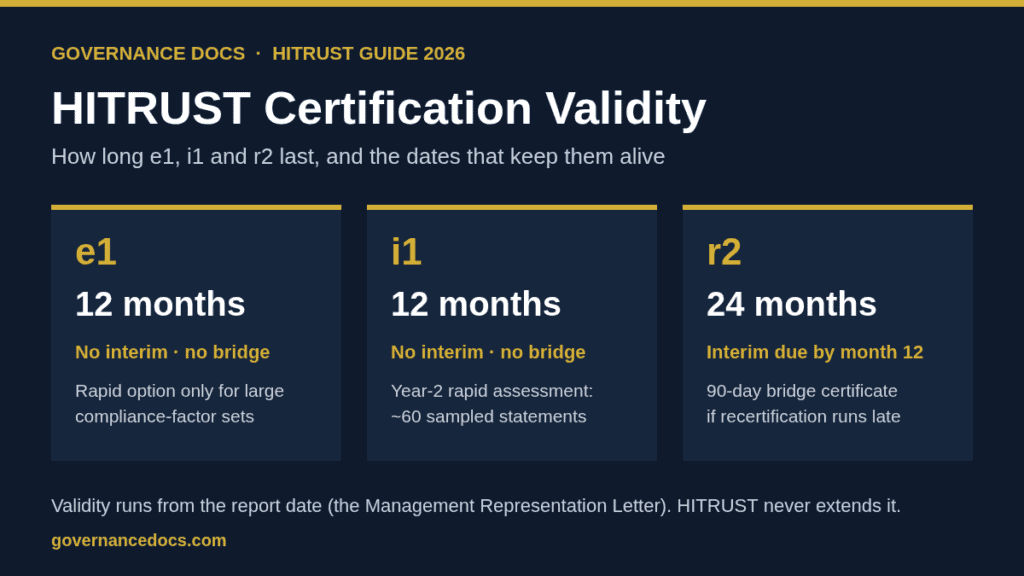
HITRUST certification validity is shorter and stricter than most first-time buyers expect: an e1 or i1 certificate lasts 12 months, an r2 lasts 24 months only if you pass an interim assessment at the one-year mark, and HITRUST will not extend any of them. Customers and health plans check those dates, so a missed deadline shows up as a gap on your security questionnaire, not as a quiet administrative slip.
This guide sets out the HITRUST certification validity rules from the HITRUST Assessment Handbook (chapter 15), what each date is counted from, and how to plan the next assessment so the certificate never lapses. If you are still choosing between the three assessment types, start with our guide to HITRUST e1, i1 and r2 assessments and come back here once you know which one you are buying.
Free gap assessment
Could you evidence your HIPAA safeguards today?
Score every standard and implementation specification, free, including the addressable ones that still need a decision on file.
Run the free HIPAA gap assessment → or View premium report sample
HITRUST certification validity at a glance
The handbook sets one validity period per assessment type. Every add-on certification travels with its parent: an ai1 inside an i1 lasts 12 months, and an ai2 or NIST CSF add-on inside an r2 lasts 24 months.
| Assessment | Validity | Counted from | Mid-cycle check | Lighter renewal option | Bridge if late? |
|---|---|---|---|---|---|
| e1 (Essentials, 1-year) | 12 months | Date of the report | None | e1 rapid assessment, only for large compliance-factor sets | No |
| i1 (Implemented, 1-year) | 12 months | Date of the report | None | i1 rapid assessment in year 2 | No |
| r2 (Risk-based, 2-year) | 24 months | Date of the report | Interim assessment at month 12 | None; a full r2 every two years | Yes, 90-day bridge certificate |
The “date of the report” has a precise meaning. The handbook says the report date is the same as the date on the Management Representation Letter your organization signs at the end of the assessment. That letter, not the end of fieldwork and not the day you submit in MyCSF, starts the clock.
e1 and i1: 12 months, no extensions
For the one-year assessments, HITRUST certification validity is simple. Both one-year certifications expire 12 months after the report date. There is no interim assessment, and there is no grace period: the handbook states plainly that e1 and i1 certifications cannot be extended past the one-year expiration, and bridge certificates are not available for either.
That makes the renewal date a hard deadline. To avoid a gap, the Management Representation Letter for the next assessment has to be signed on or before the day the current certificate expires. Work backwards from that date: the External Assessor’s testing, your remediation of anything they find, and the letter all have to land inside the 12 months.
The rapid assessment option in year 2
HITRUST offers a lighter renewal for one-year certificates, called a rapid assessment. It does not change HITRUST certification validity or lengthen the certificate; it reduces the testing needed to earn the next one. HITRUST’s i1 page describes year two focusing on about 60 core requirements rather than the full set of 182.
The handbook rules for eligibility are specific:
- You hold an active e1 or i1 certificate earned through a full validated assessment on CSF v11 or later.
- The scope is the same as the prior assessment.
- The control environment has not materially degraded, and there have been no significant changes to policies, processes, controls, hosting locations or technologies since the last certification date.
- Only sets of more than 60 requirement statements can be sampled. The e1 core set never qualifies, so an e1 rapid assessment only helps when a compliance factor added more than 60 statements.
- Your MyCSF subscription must include rapid assessments.
For each eligible set, the assessor tests a sample of 60 previously scored requirement statements plus every statement marked N/A last time. The i1 core sample always includes every statement that required a corrective action plan (CAP). The remaining scores roll forward. The result is the same i1 or e1 report and certificate as a full assessment, valid for one year.
Timing matters here too. HITRUST sends the eligibility questionnaire 180 days before expiration, and the rapid assessment object is generated no more than 120 days before expiration. If you plan to use it, answer the questionnaire early rather than discovering in month 11 that a hosting change made you ineligible.
r2: 24 months, if the interim passes
The r2 is the only two-year certificate, and HITRUST certification validity for an r2 depends on what happens at month 12. The handbook requires an interim assessment to keep the second year. Skip it, and the handbook says non-submission by the deadline results in suspension or revocation of the certification.
When the interim is due
The External Assessor must submit the interim assessment to HITRUST on, or within the 90 days before, the one-year anniversary of the r2 certification date. MyCSF generates the interim object automatically 90 days before the due date for annual subscribers, who can also create it manually up to 120 days ahead. Organizations without a subscription receive a notice 90 days out and request access from HITRUST Support; that access lasts 60 days.
What the interim tests
The interim is not a repeat of the r2. It covers one randomly selected requirement statement from each assessment domain, plus every requirement statement that produced a required CAP. Add-on certifications get their own sample. HITRUST then checks four things:
- No significant changes to the certified scope.
- No security events in the certified environment that had to be reported to a federal or state agency.
- No degradation of the control posture, meaning no lowered maturity scores in the sampled statements.
- Sufficient CAP progress, which the handbook defines, barring extenuating circumstances, as 50% or more of required CAPs started or complete.
The CAP test is the one that catches organizations out. Corrective action plans written during the r2 tend to sit untouched for eleven months, and the interim then finds most of them not started. Assign an owner and a date to every CAP the week the r2 report arrives.
If scores drop, the assessor decides whether the change reflects real degradation and may widen testing. Depending on severity, HITRUST can suspend the certification while you remediate or revoke it, in which case a new validated assessment is needed. For a fuller walkthrough of the year-two check, see our HITRUST interim assessment guide.
What happens when HITRUST certification validity runs out
The handbook is blunt: HITRUST does not, under any circumstances, extend the expiration date of a certification. If re-assessment fieldwork is not finished with a signed Management Representation Letter by the last day of the certification period, you have a certification gap. During that gap you are not considered HITRUST certified, and the gap runs until the re-certification date.
For a vendor selling into health systems or payers, a gap usually means a stalled renewal, an extra security questionnaire, or a contract clause triggered. It is cheaper to start the next assessment early than to explain the gap.
The r2 bridge certificate
r2 holders have one safety net that e1 and i1 holders do not. A bridge assessment produces a bridge certificate valid for 90 days from the expiration of the prior r2. It is a separate certificate that accompanies the expired report; it does not extend the r2, and HITRUST says it does not give equivalent assurance.
To qualify, all of the following must hold:
- You currently hold an active r2 validated report with certification.
- You have not missed the recertification date by more than 30 days.
- No reportable breaches and no significant changes in the scoped environment since certification (otherwise, contact HITRUST Support to ask whether you can still proceed).
- You intend to complete the full r2 before the bridge certificate expires.
Your HITRUST Customer Success Manager has to approve the bridge object, which can be created and submitted no more than 60 days before and up to 30 days after the r2 expiration date. The External Assessor tests 19 requirement statements picked at random by MyCSF, across all maturity levels the next r2 will include. Those results can carry into the full r2 without retesting.
There is a cost to using it. The completed r2 must reach HITRUST no later than 90 days after the old certificate expired, and those 90 days are deducted from the new certificate’s 24 months. The new r2 is dated from the original re-certification date, so the bridge buys time to finish, not extra validity. Check with your customers first: HITRUST advises that some relying parties may not accept a bridge certificate.
Planning renewals around HITRUST certification validity
The rules above translate into a simple calendar. The lead times below are typical planning ranges, not HITRUST requirements; your assessor’s availability and the size of your scope will move them.
| When | e1 / i1 holder | r2 holder |
|---|---|---|
| Report date | Certificate starts; diary the 12-month expiry | Certificate starts; diary month 12 and month 24 |
| Weeks 1–4 | Assign owners to any CAPs | Assign owners and dates to every CAP |
| Month 6 (180 days before expiry) | Answer the rapid assessment eligibility questionnaire | Confirm assessor availability for the interim |
| Months 8–9 | Book the External Assessor and confirm scope | Interim window opens 90 days before the anniversary |
| Month 12 | Management Representation Letter signed on or before expiry | Interim submitted on or before the anniversary |
| Months 16–20 | (Next cycle) | Start the full r2 re-assessment |
| Month 24 | (Next cycle) | Fieldwork done and letter signed, or request a bridge |
Three habits keep HITRUST certification validity continuous:
- Keep the evidence live. Policies, procedures and the records that prove they operate should be updated through the year, not rebuilt before each assessment. Stale evidence is what turns a sampled statement into a lowered score.
- Log significant changes as they happen. A new hosting region or a major platform swap can make you ineligible for a rapid assessment or a bridge. Talk to your assessor before the change, not after.
- Budget for the full cycle. An r2 is a two-year commitment with a paid interim in the middle. Our HITRUST certification cost breakdown covers what each stage typically costs.
If your policy set is the weak point, the HITRUST CSF Toolkit gives you editable policy and procedure templates aligned to HITRUST CSF v11, so the documentation side of each renewal starts from a maintained baseline rather than a blank page.
Frequently asked questions
How long is HITRUST certification valid before recertification?
An e1 or i1 certificate is valid for 12 months from the report date. An r2 certificate is valid for 24 months from the report date, provided you pass the interim assessment due at the one-year anniversary. After that, you need a new validated assessment.
Can HITRUST extend a certificate if our assessment runs late?
No. The Assessment Handbook says HITRUST does not extend expiration dates under any circumstances. r2 holders can request a 90-day bridge certificate if they meet the eligibility criteria; e1 and i1 holders have no equivalent and will have a certification gap.
What date does HITRUST certification validity start from?
The date of the report, which the handbook defines as the date of the Management Representation Letter you sign at the end of the assessment. It is not the date fieldwork finished or the date you submitted in MyCSF.
Do we lose the r2 if the interim finds problems?
Not automatically. If sampled scores drop, the assessor judges whether the controls have degraded and may test further. HITRUST can then suspend the certificate while you remediate, or revoke it if the degradation is serious. Missing the interim deadline altogether leads to suspension or revocation.
The dates in this guide come from the HITRUST Assessment Handbook, chapter 15.7 Re-certification and the linked interim, bridge and rapid assessment sections, read in November 2026. HITRUST updates the handbook regularly, so confirm the current version with your External Assessor before you commit to a timeline.
When a standard changes, know first
One email a month: edition changes, new deadlines, and what they mean for documentation you already have. No sales sequence.

Governance Docs
Governance Docs LLC
Recent Posts
November 25, 2026
November 24, 2026
November 23, 2026

November 22, 2026

November 21, 2026