A health and safety policy template helps you put your commitment to safe work in writing, name who is responsible for what, and set out the practical arrangements that make it happen. This guide gives you a fill-in template, explains the legal position for small businesses in the UK and the US, and shows what ISO 45001 adds if you want certification.
The rules differ sharply by country, so each section below says which jurisdiction it covers. Check local law if you operate elsewhere.
The Three-Part Structure the UK HSE Recommends
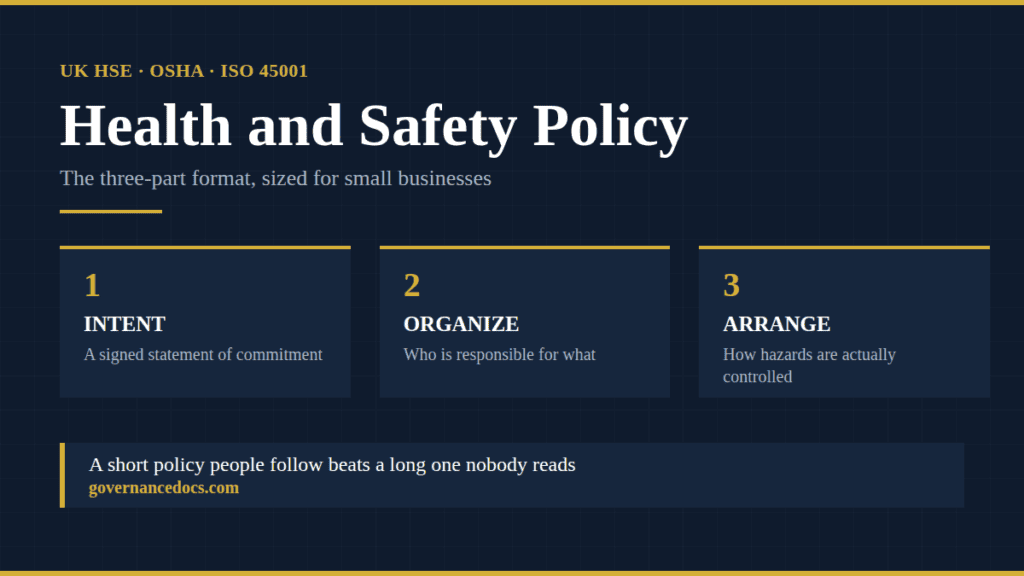
Britain’s Health and Safety Executive (HSE) suggests a policy in three parts. Most UK templates, and many international ones, follow this structure because it maps neatly onto what the law asks for.
Statement of intent: your general policy, commitment and aims, signed by the employer or most senior person.
Responsibilities: the names, positions and roles of people with specific health and safety duties.
Arrangements: the practical steps you take to meet your aims, such as risk assessments, training, and safety signs or equipment.
This mirrors section 2(3) of the Health and Safety at Work etc. Act 1974, which requires a written statement of the employer’s general policy and “the organisation and arrangements” for carrying it out, brought to the notice of all employees.
Health and Safety Policy Template (Fill-In)
Replace the bracketed text. This health and safety policy template follows the three-part structure and adds the commitments ISO 45001 expects, so one document can serve both purposes.
Part 1: Statement of intent
“[Company] is committed to providing safe and healthy working conditions to prevent work-related injury and ill health for our employees, contractors and visitors. We will comply with all applicable legal requirements, eliminate hazards and reduce risks where we can, consult and involve our workers on health and safety matters, provide the information, training and equipment people need, and continually improve our health and safety performance. We will set objectives each year and review progress at [management meetings]. This policy is reviewed at least annually.”
Approves the policy, provides resources, chairs the annual review
Day-to-day responsibility
[Operations Manager]
Ensures arrangements in Part 3 are carried out and records kept
Competent person / H&S advisor
[Name or external provider]
Advises on risk assessments, law and training
Supervisors and team leaders
[Names]
Brief staff, check safe systems of work, report incidents
First aiders
[Names]
Provide first aid and maintain kits
Fire wardens
[Names]
Run evacuations and check escape routes
All workers
Everyone
Follow instructions, use equipment correctly, report hazards and near misses
Part 3: Arrangements
Arrangement
What to write
Example wording
Risk assessment
Who, how often, where recorded
“[Operations Manager] completes risk assessments for all work activities, reviews them [annually] or after change, and shares findings with staff.”
Consultation
How workers are involved
“Health and safety is a standing item at [monthly team meetings]. Worker representatives sit on the [safety committee].”
Training
Induction and refresher
“All new starters receive health and safety induction on day one. Job-specific training is recorded in the training register.”
Equipment and maintenance
Inspection regime
“Work equipment is inspected [before use / at set intervals] and faults are reported to [name].”
Hazardous substances
Controls and data sheets
“Safety data sheets are kept at [location]. Substances are assessed before first use.”
Accidents and incidents
Reporting and investigation
“All accidents, near misses and work-related ill health are reported to [name] the same day and recorded in the incident log.”
Emergencies
Fire and evacuation
“Fire drills take place [every six months]. Assembly point: [location].”
Contractors
Selection and control
“Contractors provide risk assessments and method statements before starting work.”
Monitoring
Checks and review
“[Name] carries out [monthly] workplace inspections and reports results to management.”
Keep Part 3 honest. Every arrangement in your health and safety policy template should point to a real record, such as an inspection log, a training register or an incident form. If you can’t produce the record, either start keeping it or remove the promise.
If you are combining safety with quality and environment, see our QHSE policy guide for an integrated version of the statement of intent.
Health and Safety Policy for Small Businesses
United Kingdom (Great Britain)
HSE says every business must have a policy for managing health and safety, but the duty to write it down applies once you have five or more employees. HSE’s guidance says businesses with fewer than five employees don’t have to write it down, though doing so is useful. You must share the policy, and any changes, with your employees.
For a small business, the health and safety policy template above can fit on two or three pages. Drop arrangements that don’t apply, such as hazardous substances in a pure office setting, rather than leaving them blank. HSE says the policy should make clear who does what, when and how. That matters more than length.
United States
Federal OSHA has no general rule requiring every employer to publish a single health and safety policy statement. Instead, many OSHA standards require specific written programs when the hazard is present. Two examples:
Hazard Communication (29 CFR 1910.1200, paragraph (e)(1)): employers whose workers are exposed to hazardous chemicals must develop, implement and maintain a written hazard communication program at each workplace.
Emergency action plans (29 CFR 1910.38): where an OSHA standard requires one, the plan must be written, but an employer with 10 or fewer employees may communicate it orally.
Some states go further. California, for example, requires every employer to maintain a written Injury and Illness Prevention Program under Title 8, section 3203. A US health and safety policy for small businesses is therefore best written as a short umbrella statement that points to each required written program.
What ISO 45001 Adds to a Health and Safety Policy
ISO 45001:2018 is the current occupational health and safety management system standard. Its 2024 amendment added climate change text that already applies to certified organizations. A revision is in progress, which ISO expects to publish as ISO 45001:2027, but no transition arrangements have been announced yet, so keep building to the 2018 edition.
Clause 5.2 requires top management to establish an OH&S policy that includes:
A commitment to provide safe and healthy working conditions for the prevention of work-related injury and ill health, appropriate to the organization’s purpose, size, context and risks.
A framework for setting OH&S objectives.
A commitment to fulfil legal requirements and other requirements.
A commitment to eliminate hazards and reduce OH&S risks.
A commitment to continual improvement of the OH&S management system.
A commitment to consultation and participation of workers and, where they exist, workers’ representatives.
The policy must also be available as documented information, communicated within the organization, available to interested parties as appropriate, and kept relevant. The statement of intent in our health and safety policy template covers all six commitments. For the rest of the required documents, see our list of ISO 45001 mandatory documents.
UK Law vs OSHA vs ISO 45001 Compared
Aspect
UK (HSWA 1974)
US federal OSHA
ISO 45001:2018
Nature
Legal duty
Legal duties, standard by standard
Voluntary, certifiable standard
Written policy required?
Yes, with five or more employees
No single general policy rule; specific written programs where standards apply
Yes, as documented information
Required content
General policy, organization and arrangements
Depends on the standard, e.g. hazard communication program
Six commitments listed in clause 5.2
Communication
Brought to the notice of all employees
Varies; training and access rules per standard
Communicated internally; available to interested parties
Review
Revise as often as appropriate
Per standard
Kept relevant and appropriate; reviewed through management review
Who checks
HSE and local authority inspectors
OSHA compliance officers (or state plans)
Accredited certification body auditors
Mistakes to Avoid With Any Health and Safety Policy
Names missing from Part 2. “Management” is not a person. Inspectors and auditors want named roles.
Arrangements that don’t happen. If the policy promises monthly inspections, keep the records.
No worker involvement. ISO 45001 makes consultation and participation an explicit commitment. Show how it works.
Never reviewed. Date it, sign it, and put the next review in the calendar.
Do I need a written health and safety policy with fewer than five employees?
In Great Britain, no. HSE says businesses with fewer than five employees don’t have to write it down, though it is still useful. You still need to manage risks and meet every other duty.
Who should sign the health and safety policy?
The employer or most senior person, such as the managing director or CEO, signs the statement of intent in Part 1 of the health and safety policy template. Their signature shows top management owns the commitments, which is also what ISO 45001 expects.
Can one health and safety policy template cover several countries?
Yes for the statement of intent, which can be global. Responsibilities and arrangements usually need a local annex per country, because legal duties, reporting routes and required written programs differ.
Will ISO 45001:2027 make my policy obsolete?
Unlikely. The policy commitments are expected to stay similar, and no transition timetable exists yet. Review your policy when the new edition is published and transition rules are announced.
Our ISO 45001 Toolkit provides 50+ editable templates for an occupational health and safety management system — including an OH&S policy, a hazard, risk and opportunity procedure and a legal register — for $99.
When a standard changes, know first
One email a month: edition changes, new deadlines, and what they mean for documentation you already have. No sales sequence.