A FOD prevention program is the set of controls that stops tools, hardware, debris and personal items from ending up inside aerospace products, and it is one of the most practical, hands-on parts of an AS9100 quality system. A single dropped rivet in a fuel tank or a rag left in an engine intake can ground an aircraft, so customers take foreign object damage seriously, and auditors expect to see FOD controls working on the shop floor rather than in a binder.
This guide covers what AS9100D requires, what the dedicated FOD standard AS9146 adds, and how to build a FOD prevention program that is proportionate to your work.
Key FOD Terms
The industry distinguishes three related ideas, and using them precisely helps investigations:
Foreign object (FO): any substance or article alien to the product that could get into it, such as tools, consumables, hardware, protective caps, personal items or process debris like swarf and sealant.
Foreign object debris (FOd): a foreign object that has actually entered or migrated into or onto the product and could cause damage if not found and removed.
Foreign object damage (FOD): the damage itself, measurable in physical or economic terms, that may degrade safety or performance.
In everyday use, “FOD” covers all three. A good program targets the first stage: keep foreign objects from ever becoming debris.
What AS9100D Requires for FOD
AS9100 Rev D does not contain a separate FOD clause, but clause 8.5.1, control of production and service provision, requires controlled conditions that include the prevention, detection and removal of foreign objects. Auditors therefore expect a defined approach wherever FOD is a credible risk to your product.
Related requirements reinforce it:
8.1.1 Operational risk management: FOD risk should be assessed for operations where it applies.
8.5.4 Preservation: protection of product during processing, storage and delivery, including covers, caps and clean handling.
7.1.4 Environment for the operation of processes: housekeeping and work area conditions.
8.7 and 10.2: FOD incidents are nonconformities that need investigation and corrective action.
As of October 2026, AS9100D remains the certifiable revision; its successor, IA9100, has not yet been published.
AS9146: The Dedicated FOD Prevention Program Standard
AS9146 is not a certification standard in its own right, but customers increasingly invoke it in contracts. Its requirements are complementary to customer and regulatory requirements, not a substitute for them.
The program elements it covers, as described in IAQG guidance material, include:
Program management, with top management commitment and a designated program representative
FOD risk assessment and area designation
Operations controls: design for FOD prevention, protective measures, process sequencing, identifying critical openings, cleaning and inspection
Training and controlled access for personnel and visitors
Product protection
Housekeeping and clean-as-you-go
Control of consumables, hardware and personal items
Tool accountability and control
Handling FOD nonconformities and evaluating program effectiveness
Designating FOD Areas
Not every area needs the same controls. A FOD prevention program should designate areas based on a risk analysis and apply controls that match. IAQG guidance describes a tiered approach, commonly along these lines:
Final assembly, open engine or fuel system work, flight hardware integration
Restricted access, tool and hardware inventories at entry and exit, personal item restrictions, inspection before closing
Mark boundaries clearly on the floor and at entry points so anyone walking in knows which rules apply.
The Seven Controls Every FOD Prevention Program Needs
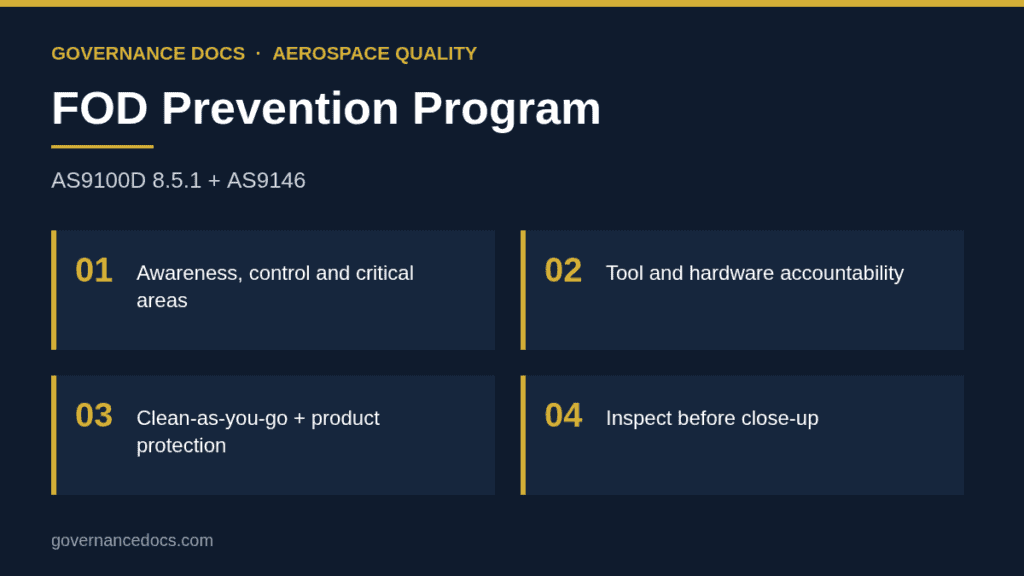
Tool control. Shadow boards or foam-cut tool boxes, tool marking, check-out and check-in, and an immediate stop-and-search procedure when a tool or part of a tool is missing.
Consumables and hardware accountability. Kit only what the job needs, count it out and back, and control items such as rags, tie wraps and safety wire.
Personal items policy. Pens, badges, jewelry, phones and loose items in critical areas are a classic source of FO.
Housekeeping and clean-as-you-go. Clean the immediate work area at each step, not just at shift end.
Product protection. Caps, plugs and covers on openings, ports and tubes, with control so the protective items themselves are not left behind.
Inspection before close-up. A formal FOD inspection, often with independent verification, before panels, cavities or assemblies are closed.
Training and access. Initial and recurring FOD training, records, and escort or briefing rules for visitors and contractors.
Investigating FOD Incidents
Treat every FOD event and every lost tool as a nonconformity. Investigations should establish where the object came from, which control failed and whether other products could be affected. Because many FOD causes are behavioral, consider human factors in the root cause analysis as AS9100D clause 10.2.1 requires. Our AS9100 human factors guide shows how to go beyond “operator error.”
Useful program metrics include:
FOD incidents found internally versus escapes found by the customer
Lost tool reports and recovery rate
FOD walk or sweep findings by area
Training completion for personnel in FOD control and critical areas
Report the trend at management review and use it to adjust area designations and controls.
Scaling a FOD Prevention Program to Your Business
A small machine shop making brackets does not need the same program as an engine assembly line. For a low-risk shop, a short procedure covering housekeeping, deburring and cleaning, protective packaging and tool control may be enough. For organizations working on open assemblies, flight hardware or engines, a full AS9146-aligned program with area designations, inventories and formal close-up inspections is normal and often contractually required.
The key is a documented risk assessment that justifies the level of control you chose. Auditors accept a lighter program when the reasoning is sound and the floor matches the paperwork.
Getting Started
The AS 9100 Toolkit includes FOD prevention content among its 38 editable templates, alongside production control, nonconformance and corrective action documents aligned to AS9100D. For how FOD sits within the wider aerospace quality framework, see our overview of aerospace quality management, and for product protection at receiving, see our counterfeit parts prevention guide.
Auditing Your FOD Prevention Program
Build regular FOD checks into your internal audit program and add short, frequent floor walks led by supervisors. A practical audit of a FOD prevention program looks at:
Whether area designations and boundaries match the current layout
Tool boards and boxes: complete, marked, and with lost tool reports filed
Consumable and hardware accountability in kitting and assembly
Product protection on open ports and assemblies
Close-up inspection records on recently completed work
Training records for people working in control and critical areas
A FOD prevention program only works when everyone knows their part. Define roles in the procedure:
Top management: commits resources, sets expectations and reviews FOD performance
FOD program representative: owns the procedure, area designations, training content and metrics
Supervisors: run daily floor walks, enforce tool control and stop work when a tool or item is missing
Operators and technicians: follow clean-as-you-go, account for tools and hardware, and report FOD findings without fear of blame
Inspectors: perform close-up and final FOD inspections and record results
Purchasing and receiving: flow down FOD requirements to suppliers and check incoming product protection
Clear ownership turns a FOD prevention program from a poster campaign into a working control.
Frequently Asked Questions
Is a FOD prevention program mandatory for AS9100?
AS9100D clause 8.5.1 requires controlled conditions that include preventing, detecting and removing foreign objects. A formal program is not named, but you need a defined approach wherever FOD is a credible risk, and many customers contractually require one.
Is AS9146 certifiable?
No. AS9146 sets requirements for a FOD prevention program that customers can invoke. Compliance is typically assessed through customer audits or as part of AS9100 audits where the contract applies.
What should happen when a tool goes missing?
Stop work in the affected area, search the product and area, and do not close up or release the product until the item is found or a documented investigation and disposition is completed.
Who should run a FOD prevention program?
Assign a named program representative with authority to set area rules and stop work, supported by top management. In small organizations this is often the quality manager or production manager.
How often should FOD training be repeated?
AS9146 expects initial and recurring training but leaves the interval to the organization and its customers. Annual refreshers are common, with additional briefings after incidents, process changes or new area designations, and before visitors or contractors enter FOD critical areas.