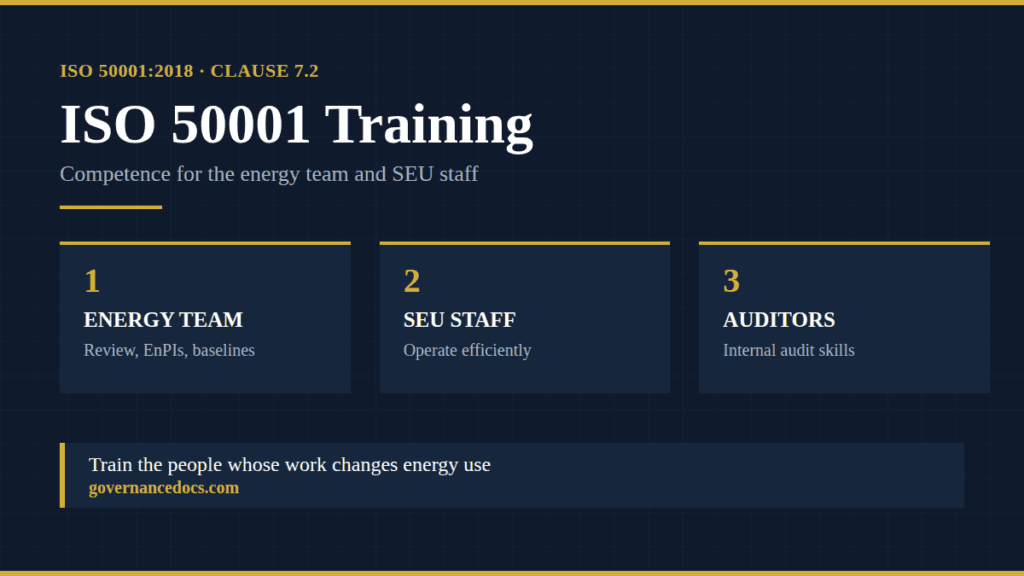
ISO 50001 training is how you show that the people who run, use and audit your energy management system know what they are doing. The standard never tells you to send anyone on a course. It asks for competence and awareness, and it asks you to keep evidence of both.
This guide covers what ISO 50001:2018 actually requires, who needs which training, how to choose between internal auditor and lead auditor courses, and a training matrix you can adapt today. For the wider picture, start with our overview of ISO 50001 and how the standard has held still.
Free gap assessment
Are you ready for the 2026 edition of ISO 14001?
Score every clause of the new edition, free, including the aspects, life cycle and compliance evaluation work that carries most of the findings.
Two clauses carry most of the load: clause 7.2 on competence and clause 7.3 on awareness. Clause 6.3 adds a link that many teams miss. The energy review has to identify the people whose work influences or affects each significant energy use.
Clause
What it asks for
Evidence an auditor looks for
5.3 Roles and authorities
Top management assigns responsibility to an energy management team
Appointment letters, team terms of reference
6.3 Energy review
For each significant energy use, identify the people doing work under your control who influence or affect it
SEU register with named roles
7.2 Competence
Decide the competence needed by people whose work affects energy performance and the EnMS, make sure they have it through education, training, skills or experience, close gaps and check the action worked
Competence requirements by role, training records, effectiveness checks
7.3 Awareness
People know the energy policy, their contribution to the EnMS and to energy performance, the effect of their activities or behavior on energy performance, and what happens if they do not conform
Induction content, toolbox talk records, answers in interviews
9.2 Internal audit
Auditors are selected so audits stay objective and impartial
Auditor competence records, audit program
Clause 7.2 also requires you to retain documented information as evidence of competence. Auditors sample this record first.
ISO 50001:2018 is still the current edition. ISO last reviewed and confirmed it in 2024, as the ISO 50001:2018 catalog page shows. Its Amendment 1:2024 (climate action changes) added climate-change text to the context clauses, not to the competence clauses. Give it one line in your energy team briefing so people can explain whether climate change is relevant to your EnMS.
There is no mandatory ISO 50001 training certificate
ISO 50001 does not require an external course, a certificate or an accredited trainer for your staff. Competence can come from education, training, skills or experience, and the standard accepts all four.
A maintenance technician with ten years on your compressors may already be competent for that significant energy use. You still need to define the competence, check the person against it and record the result.
Who needs ISO 50001 training
Five groups cover most organizations.
Top management
Leaders need a short briefing on their clause 5.1 duties: the energy policy, objectives, resources, the energy management team and management review. Certification auditors interview top management, so the briefing should prepare them to explain the system in their own words.
This is where structured energy management training pays off. A team that cannot explain why a baseline was adjusted will struggle at the stage 2 audit.
People who influence significant energy uses
This is the group the standard focuses on most. Operators, maintenance staff and on-site contractors who run or service your SEUs need to know the operational controls, the set points and the deviations that matter.
Use your significant energy uses register as the source list. Every SEU should name the roles that affect it, and every one of those roles should appear in the training matrix.
Purchasing and engineering staff
Clause 8.2 covers design and clause 8.3 covers procurement. Buyers and engineers need to know when energy performance must be considered, and how to record that they did it.
Everyone else in scope
Awareness covers all people doing work under your control, including contractors on site. A short induction session usually covers the energy policy, how to report energy waste and what goes wrong when a procedure is ignored.
ISO 50001 internal auditor and lead auditor options
Clause 9.2 needs internal auditors who are competent and impartial. The standard does not prescribe a course, so most organizations choose one of three routes. The lengths below are typical ranges, not rules.
Option
Who it suits
Typical length
What it gives you
In-house training by an experienced auditor
Sites that already run ISO 9001 or ISO 14001 audits
One day or less
Auditors who know your SEUs and your data
ISO 50001 internal auditor course
Staff new to auditing or new to energy
Often one to two days
A structured method and a course record
ISO 50001 lead auditor course
Energy managers, consultants, people who will audit suppliers or work for a certification body
Often four to five days, with an exam
The skills to lead third-party audits
Whatever route you pick, base the audit method on ISO 19011:2026, the current guideline for auditing management systems.
An ISO 9001 or ISO 14001 auditor can usually audit an EnMS after an energy-specific top-up. The gap is technical: reading metering data, checking how EnPIs are normalized and testing whether the baseline is still valid.
The DOE-backed 50001 Ready Navigator guidance on competence and training is a useful free reference when you plan this. It suggests ISO 50001 training for the energy team, general awareness for all staff, and EnMS-specific training for internal auditors.
Build your ISO 50001 training matrix
A training matrix turns clause 7.2 into something you can audit.
Role
Topics
When
Evidence
Top management
Energy policy, objectives, resources, management review duties
On appointment; when the EnMS changes
Briefing record, management review minutes
Energy management team
Energy review, SEUs, relevant variables, EnPIs, baselines, data collection, action plans
On appointment; after major changes
Course records, worked energy review, CPD log
SEU operators and maintenance
Operational controls, set points, deviations, who to tell
Before working on the SEU; after control changes
Task training record, supervisor sign-off
Purchasing and engineering
Energy criteria in procurement (8.3) and design (8.2)
On appointment; when criteria change
Briefing record, sample purchase evaluation
Internal auditors
ISO 50001 requirements, ISO 19011 method, EnPI and data checks
Before the first audit; periodic refresher
Course record, witnessed audit, audit reports
All staff and on-site contractors
Energy policy, their contribution, reporting energy waste, consequences of not following procedures
Induction; periodic refresher
Induction attendance, toolbox talk sign-off
Records that prove ISO 50001 competence
A good competence record answers five questions. Keep it per person, not only per course.
Which role the person holds and the competence requirement for that role
What was delivered, by whom, when and for how long
How effectiveness was checked: observation, test, supervisor sign-off or audit result
When the next review or refresher is due
For contractors, the contract clause or site induction record that covers energy controls
Attendance alone does not prove ISO 50001 competence. Clause 7.2 asks you to evaluate whether the action worked. A sign-off from the supervisor who watched an operator run the SEU is stronger evidence than a sheet of signatures.
How auditors test ISO 50001 training
Certification auditors rarely start with your matrix. They walk to an SEU and ask the operator what the set point is, what a deviation looks like and who they would tell.
Then they trace back. Is this person named against the SEU, is their training on file, and was effectiveness checked? A gap anywhere in that chain becomes a finding.
Expect questions to the energy team on how the baseline is adjusted, and to top management on why the energy policy matters. Practice those answers before the audit, not during it.
Set up ISO 50001 training in six steps
List every SEU from your energy review and name the roles that influence each one.
Write competence requirements for each role: knowledge, skills and any qualifications.
Assess current staff against those requirements and record the gaps.
Close gaps with training, mentoring, reassignment or hiring, and set dates.
Check effectiveness and file the evidence against the person.
Review the matrix after each energy review, new SEU or change to operational controls.
ISO 50001 training FAQ
Is ISO 50001 training mandatory?
Clause 7.2 requires competence and clause 7.3 requires awareness, so some training is almost always needed. The standard does not require a specific course or certificate. Experience and on-the-job instruction count if you can show the result.
Do internal auditors need a certified course?
No. ISO 50001 asks for auditors who are competent, objective and impartial, not for a certificate. A recognized course helps you prove competence, especially for staff new to auditing.
How often should ISO 50001 training be refreshed?
The standard sets no interval. Many organizations refresh awareness yearly and retrain SEU staff whenever controls, equipment or set points change. Tying refreshers to the energy review cycle keeps them relevant.
Can ISO 50001 training be delivered online?
Yes, for awareness and theory. Operational training on SEUs works better on the floor, where a supervisor can watch the task and sign off competence.
Our ISO 50001 Toolkit provides 53 editable templates for building and running your energy management system, including the energy policy, energy review, significant energy uses, EnPIs and baselines, internal audit and management review records, for $99.
When a standard changes, know first
One email a month: edition changes, new deadlines, and what they mean for documentation you already have. No sales sequence.