

ISO 45001 Certificate Validity: The Complete 2026 Guide
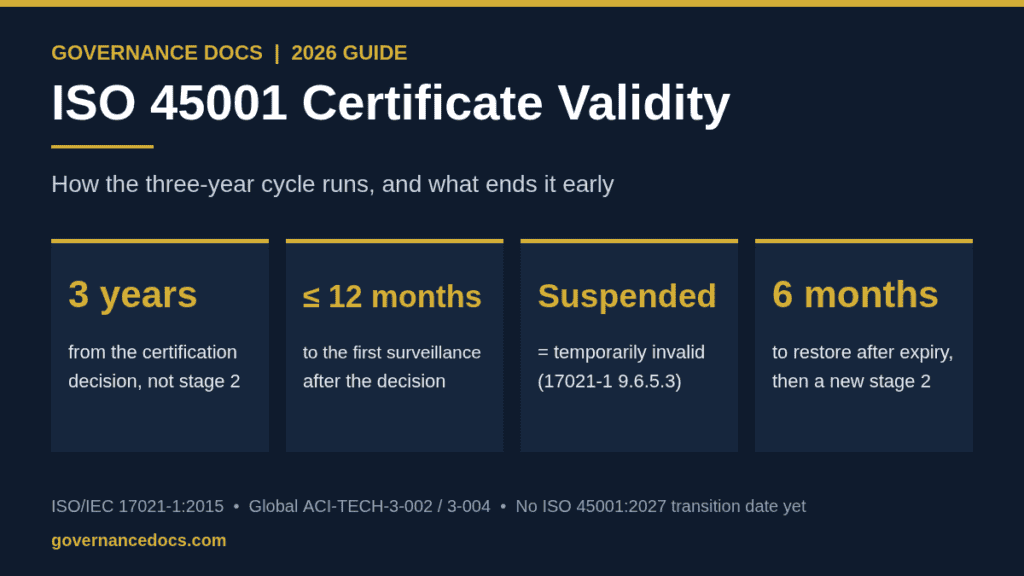
ISO 45001 certificate validity is three years, counted from the certification body’s decision to certify you, not from the day the auditor leaves site, and those three years only hold if every surveillance audit in between happens on time. That is the short answer. The longer answer matters because a certificate can stop being valid well before the date printed on it, and because the occupational health and safety rules contain three restrictions that quality and environmental certificates do not have.
This guide walks through how the cycle runs, what keeps the certificate alive between audits, what suspension and withdrawal mean in practice, what happens on the expiry date, how the coming ISO 45001:2027 revision affects a certificate you hold today, and how to check a supplier’s certificate before you rely on it. It is written for the person who owns the certificate, or who has to decide whether a contractor’s certificate can be trusted. If you are still working toward certification, start with our ISO 45001 certification guide first.
Free gap assessment
Could you prove workers take part in safety decisions?
Score every clause of ISO 45001, free, including the consultation and participation evidence that fails more audits than any other requirement.
Run the free ISO 45001 gap assessment → or View premium report sample
How ISO 45001 Certificate Validity Works: The Three-Year Cycle
ISO 45001 itself says nothing about certificates. The rules come from ISO/IEC 17021-1:2015, the standard every accredited certification body must follow, plus the Global ACI mandatory documents that replaced the old IAF MDs in 2026. Clause 9.1.3.2 of 17021-1 sets the shape of the cycle: a two-stage initial audit, surveillance audits in the first and second years after the certification decision, and a recertification audit in the third year, before the certificate expires. The first three-year cycle starts with the certification decision; every later cycle starts with the recertification decision.
Two timing rules in clause 9.1.3.3 decide whether ISO 45001 certificate validity survives the cycle:
- Surveillance audits must happen at least once a calendar year, except in recertification years.
- The first surveillance audit must take place no more than 12 months after the certification decision date. Not the stage 2 date. Organizations that plan the first surveillance from the stage 2 anniversary are usually late by the weeks it took the certification body to make its decision.
| Point in the cycle | What happens | Rule |
|---|---|---|
| Stage 1 and stage 2 | Initial certification audit | ISO/IEC 17021-1 9.3.1 |
| Certification decision | Cycle starts; certificate issued with an expiry date about three years out | 9.1.3.2 |
| Year 1 | First surveillance, no later than 12 months after the decision | 9.1.3.3 |
| Year 2 | Second surveillance, in the next calendar year | 9.1.3.3 |
| Year 3 | Recertification audit, completed before the expiry date | 9.6.3 |
| Recertification decision | New three-year cycle starts | 9.1.3.2, 9.6.3.2.3 |
One major nonconformity at the initial audit can also delay the start of validity. Under clause 9.5.3.2, if the certification body cannot verify the correction and corrective action for a major nonconformity within six months of the last day of stage 2, it has to run another stage 2 before it can recommend certification.
What an ISO 45001 Certificate Must Show
Clause 8.2.2 of 17021-1 lists what every accredited certificate has to carry. These are the fields to read when you check ISO 45001 certificate validity, whether it is yours or a supplier’s.
| Required field | What to look for |
|---|---|
| Name and location of the certified client | The legal entity you are dealing with, and every site covered for a multi-site certificate |
| Effective date | Not earlier than the certification decision it relates to |
| Expiry or recertification due date | Consistent with the three-year cycle |
| Unique identification code | The number you quote when you ask the certification body to confirm status |
| Standard and issue status | ISO 45001:2018; a certificate that still names OHSAS 18001 is not valid |
| Scope | The activities, products and services at each site, written without ambiguity |
| Certification body name, address and mark | An accreditation symbol may appear alongside, but must not mislead |
| Means to tell revisions apart | Reissued certificates must be distinguishable from obsolete versions |
A note in the same clause allows the certification body to keep the original certification date on the certificate after a lapse, provided the current cycle start and expiry dates and the last cycle’s expiry date are clearly shown. So an “originally certified” date from years ago does not by itself prove continuous certification. Read the current cycle dates.
ISO 45001 Certificate Validity Between Audits: Surveillance
Between issue and expiry, ISO 45001 certificate validity depends on surveillance. Under clause 9.6.2.2, surveillance audits are on-site audits but not necessarily full system audits. Each one covers internal audits and management review, the review of actions on earlier nonconformities, complaints handling, progress toward objectives, continuing operational control, changes, and use of marks and references to certification.
Global ACI-TECH-3-004 (formerly IAF MD 5), the audit-time document for quality, environmental and OH&S systems, adds three rules that apply to occupational health and safety and nowhere else:
- Remote auditing is capped. Clause 4.5 limits remote activity for OH&S to reviewing documents and records and interviewing staff and workers, and states that process control and OH&S risk control cannot be audited remotely. A fully remote ISO 45001 surveillance audit cannot keep a certificate valid.
- No individualized surveillance programme. Clause 7 allows quality and environmental certificates in their second and later cycles to use a tailored programme. For OH&S those requirements are stated as not applicable.
- Fewer audit-time reductions. Reductions for temporary unskilled staff, high automation, off-location workers and low-risk activities are either not applicable or allowed only by exception for OH&S.
Surveillance time is set at about one third of the initial audit time each year, with an update of your organizational data at each visit (clause 5). If your headcount, sites or hazards have grown, expect the audit-day quote to grow too. Our ISO 45001 surveillance audit guide covers what auditors sample at each visit.
When ISO 45001 Certificate Validity Ends Early: Suspension and Withdrawal
ISO 45001 certificate validity can end before the printed expiry date. Clause 9.6.5.2 says the certification body shall suspend certification when, for example, the client fails to meet certification requirements, does not allow surveillance or recertification audits at the required frequency, or asks for suspension itself.
Clause 9.6.5.3 is the one buyers should know: under suspension, the management system certification is temporarily invalid. The paper certificate still exists and still shows a future expiry date, but it is not valid while suspended. Under 9.6.5.4 the certification body restores certification once the issue is resolved; if it is not resolved, the result is withdrawal or a reduction in scope. A note to that clause says suspension would in most cases not exceed six months.
Scope reduction under 9.6.5.5 is the quieter outcome. The certificate stays valid, but only for the parts that still meet the requirements. If a supplier closed a site or dropped an activity, the reissued certificate should say so.
A common myth is that 17021-1 gives you 90 days to close a nonconformity. It does not. The standard requires each certification body to have a documented procedure for suspension and withdrawal (9.6.5.1), and the closure deadlines you work to come from that procedure and your contract. Read your certification body’s rules, not a generic article.
ISO 45001 Certificate Validity at the Expiry Date
The expiry date is where most ISO 45001 certificate validity problems surface. Recertification has to be planned so the certificate can be renewed before it expires (9.6.3.1.1). The recertification audit includes an on-site audit (9.6.3.2.1), and for any major nonconformity the time limits for correction and corrective action must be defined and met before expiry (9.6.3.2.2).
Audit time for recertification is normally about two thirds of the time a fresh initial audit would take at the time of recertification, based on your updated data, not two thirds of what the original audit took (TECH-3-004 clause 6). Our ISO 45001 recertification audit guide covers planning in detail.
| Situation at expiry | Result | 17021-1 clause |
|---|---|---|
| Recertification completed and decided before expiry | New certificate; expiry can be based on the existing expiry date, so no days are lost | 9.6.3.2.3 |
| Recertification not completed, or majors still open, at expiry | Recertification not recommended; certification not extended; client informed | 9.6.3.2.4 |
| Outstanding recertification activities finished within six months after expiry | Certification body can restore certification; expiry date stays on the prior cycle | 9.6.3.2.5 |
| More than six months after expiry | At least a stage 2 audit is required | 9.6.3.2.5 |
The restoration route is not a grace period. Between the expiry date and restoration, you hold no valid certificate, and the restored certificate’s effective date cannot be earlier than the recertification decision. If a contract or tender requires continuous certification, that gap shows.
ISO 45001 Certificate Validity and the ISO 45001:2027 Revision
ISO 45001:2018 is still the current edition. As checked on iso.org on 18 November 2026, the standard page shows it at stage 90.92, “to be revised”, with ISO/DIS 45001 listed as the draft that will replace it. ISO’s own page refers to the coming edition as ISO 45001:2027. Nothing has been published yet.
More important for ISO 45001 certificate validity: no transition arrangements exist. Global ACI has not issued a transition schedule for ISO 45001, so there is no last date for 2018-edition audits and no date when 2018 certificates stop being valid. Any page that gives you a firm ISO 45001 transition deadline today is guessing. Compare ISO 9001:2026 and ISO 14001:2026, where Global ACI did publish dated transition periods. A three-year transition is a reasonable planning assumption based on those precedents, but it is an assumption until the document appears.
Two points are settled. First, the 2024 climate action amendment to ISO 45001:2018 already applies to current certificates, and the amendment is free from ISO. Second, the last migration ended long ago: certificates to OHSAS 18001:2007 stopped being valid after 30 September 2021, the extended end of the migration period. An OHSAS 18001 certificate offered by a supplier today is void, whatever date it shows. For what the revision is expected to change, see our ISO 45001 revision guide.
How to Check ISO 45001 Certificate Validity for a Supplier
A PDF certificate proves little about ISO 45001 certificate validity on its own, because it cannot show suspension. Use this sequence:
- Read the 8.2.2 fields: legal name, sites, scope, standard edition, current cycle dates and certificate number.
- Check that the scope actually covers the work you are buying. A certificate for a head office does not cover a field-service subsidiary.
- Confirm current status with the certification body that issued it, quoting the certificate number. Many certification bodies run an online register; where one does not, ask in writing.
- Check the certification body is accredited for ISO 45001 by an accreditation body that is a signatory to the international arrangements, now run by Global ACI.
- Recheck before renewal dates and after any incident you hear about, since a suspension can happen at any time.
If a certification body is not accredited, the certificate may still be genuine, but it carries less weight with most buyers and regulators. Our guide to choosing an ISO 45001 certification body explains how to tell the difference.
Changing Certification Body Without Losing ISO 45001 Certificate Validity
Switching certification body does not have to reset your cycle or interrupt ISO 45001 certificate validity. Global ACI-TECH-3-002 (formerly IAF MD 2), in force since 28 August 2026, sets the rules:
- Only valid accredited certification can be transferred; a certificate known to be suspended cannot be accepted (2.1.2).
- If your current certification body has stopped trading or lost its accreditation, the transfer must be completed within six months or by certificate expiry, whichever is sooner (2.1.3).
- If audit reports are not made available, or a surveillance or recertification audit was not completed as programmed, you are treated as a new client and start again with an initial audit (2.2.4.5).
- Major nonconformities must be verified as corrected, and minor nonconformities need an accepted action plan, before the new certificate is issued (2.3.1).
- If the pre-transfer review finds no problems, the certification cycle continues from the previous one (2.3.4).
The practical lesson: move between surveillance audits, with every audit on your current programme completed and its reports in hand.
Keeping Your Evidence Ready for Every Audit
Most problems with ISO 45001 certificate validity trace back to the same causes: a surveillance audit pushed past the calendar-year limit, nonconformities left open, or records that cannot show the system is still running. Each audit samples the same evidence: internal audit reports, management review minutes, hazard identification and risk assessments, incident investigations, legal compliance evaluations and corrective action records.
If your records are scattered, the ISO 45001 Toolkit gives you 50+ editable templates covering those records, from the OH&S policy and risk register to the internal audit and management review packs, for $99. Having them in one structured set makes surveillance and recertification evidence much easier to produce on the day.
FAQ: ISO 45001 Certificate Validity
How long is an ISO 45001 certificate valid?
ISO 45001 certificate validity is three years from the certification decision, provided surveillance audits take place at least once a calendar year and the first one falls within 12 months of the decision. A recertification audit in year three renews it for another three years.
Is an ISO 45001:2018 certificate still valid in 2026?
Yes. ISO 45001:2018 is the current edition. The 2027 revision has not been published and no transition deadline has been set, so a 2018 certificate is valid until its own expiry date, subject to surveillance.
What happens if my ISO 45001 certificate expires before recertification?
The certificate is not valid from the expiry date. The certification body can restore it if outstanding recertification activities are completed within six months; after that, at least a stage 2 audit is needed. The expiry date stays tied to the previous cycle.
Can a suspended ISO 45001 certificate still be valid?
No. Under ISO/IEC 17021-1 clause 9.6.5.3, a suspended certification is temporarily invalid, even though the certificate document still shows a future expiry date. Confirm status with the certification body before relying on it.
Can an ISO 45001 surveillance audit be done fully remotely?
No. Global ACI-TECH-3-004 limits remote activity for OH&S to document and record review and interviews, and states that process control and OH&S risk control cannot be audited remotely. Some on-site time is always needed.
Sources: ISO 45001:2018 on iso.org; Global ACI-TECH-3-004 (M) v1.0; Global ACI-TECH-3-002 (M) v1.0.

Governance Docs
Governance Docs LLC
Recent Posts

November 18, 2026

November 18, 2026
November 18, 2026

November 18, 2026

November 18, 2026