AS9100 human factors requirements ask a simple question that many quality systems still avoid: when a person makes a mistake, did the system make that mistake easy to make? AS9100 Rev D does not have a single “human factors” clause. Instead, the idea is threaded through awareness, production control and corrective action, and auditors increasingly test it by reading your root cause analyses.
This guide explains where AS9100 human factors requirements appear in AS9100D, what auditors expect to see, and how to build a practical approach that goes beyond writing “operator error, retrained” on a corrective action form. AS9100D (revised September 2016) is the certifiable revision as of October 2026; its planned successor, IA9100, has not been published yet.
Free gap assessment
Are you ready for the 2026 edition of ISO 9001?
Score yourself against the new edition, free, including the risk and opportunity split and the clause 10 renumbering that breaks converted checklists.
Human factors is the study of how people interact with their work: the tasks, tools, environment, procedures, schedules and organization around them. In aerospace manufacturing and maintenance, it is grounded in decades of accident and incident investigation showing that most human errors are predictable outcomes of conditions such as fatigue, time pressure, poor communication, ambiguous instructions and inadequate tooling.
For a quality system, the practical point is this: you cannot train away an error that the process design keeps inviting. A missed inspection step on a crowded traveler, a torque value that differs between two revisions of a work instruction, a kit with look-alike fasteners in adjacent bins. These are system problems that show up as human mistakes.
Where AS9100 Human Factors Requirements Appear
Clause
Topic
Human factors angle
7.1.4
Environment for the operation of processes
Social, psychological and physical factors such as stress, fatigue, lighting and noise
7.2
Competence
Training, qualification and evaluation of effectiveness
7.3
Awareness
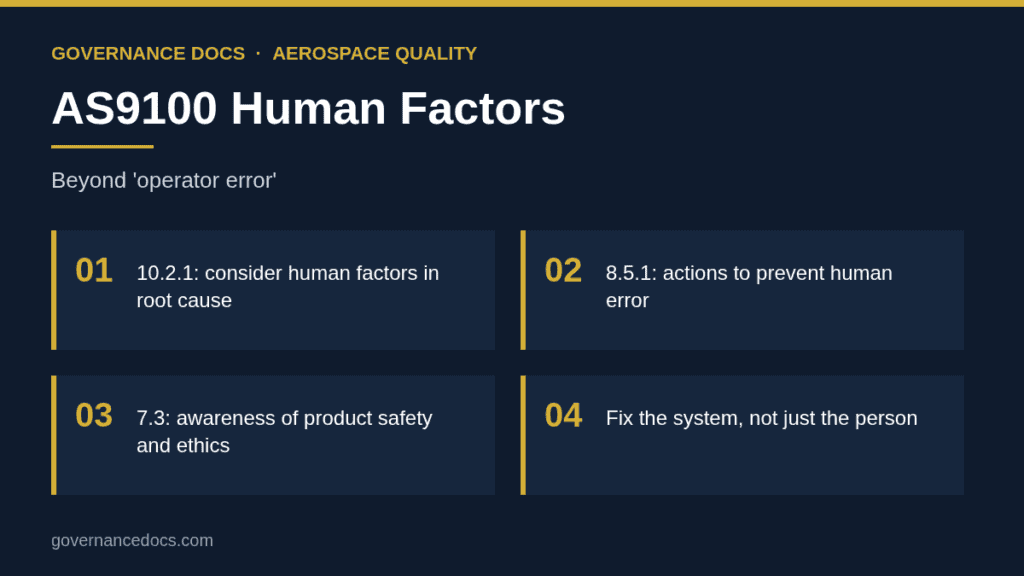
People must be aware of their contribution to product conformity and product safety, and of the importance of ethical behavior
8.5.1
Control of production and service provision
Actions to prevent human error are part of controlled conditions
10.2.1
Nonconformity and corrective action
Root cause analysis must consider human factors, as applicable
Clause 10.2.1 is the one that drives audit findings. AS9100D requires that when evaluating the need for action to eliminate the causes of a nonconformity, the organization determines the causes, including, as applicable, those related to human factors. In practice, that means an auditor will pick a sample of corrective actions and check whether the investigation went past the individual to the conditions around them.
Why “Operator Error” Is Not a Root Cause
“Operator error” describes what happened, not why. Auditors treat it as an incomplete investigation, and so do most aerospace primes reviewing supplier corrective action responses. The follow-up questions you need to answer are:
Was the instruction clear, current and available at the point of work?
Was the person trained and qualified for that specific task, and was the training effective?
Were the tools, fixtures and gauges suitable, and could the error be detected before the part moved on?
Was there time pressure, fatigue, distraction or an unusual shift pattern?
Did the layout, labeling or kitting make the wrong choice easy?
Has the same error happened elsewhere, which would point to a systemic cause?
If the answer to all of these is genuinely “no issue,” then the cause may well be an individual lapse, and coaching may be the right action. But that conclusion must come from the analysis, not replace it.
Common Human Factors Categories Used in Investigations
Many aerospace organizations borrow from maintenance human factors training, which popularized a list of twelve common preconditions for error often called the “Dirty Dozen”: lack of communication, complacency, lack of knowledge, distraction, lack of teamwork, fatigue, lack of resources, pressure, lack of assertiveness, stress, lack of awareness and norms. The list is not part of AS9100, but it gives investigators a structured prompt so they do not stop at the first answer.
Another useful lens separates error types:
Slips and lapses: the person knew what to do but did something else or forgot a step. Fixes focus on process design, checklists, mistake-proofing and interruptions.
Mistakes: the person did what they intended, but the intention was wrong because of a misunderstanding or bad information. Fixes focus on instructions, training and communication.
Violations: a deliberate deviation from a rule, often because the rule was impractical or “everyone does it.” Fixes focus on culture, supervision and whether the rule itself is workable.
Classifying the error first makes the corrective action far more targeted.
Building AS9100 Human Factors Into Corrective Action
The simplest way to meet the requirement is to change your corrective action form. Add a mandatory human factors section that the investigator completes for every nonconformity involving human performance. A practical structure:
Describe the event factually, without blame.
Classify the error as slip, lapse, mistake or violation.
Check contributing conditions using a prompt list covering instructions, training, tools, environment, workload, communication and supervision.
Identify the system cause that, if changed, would prevent recurrence for anyone doing that task.
Choose controls in order of strength: eliminate the opportunity (design or fixture change), detect it automatically, simplify the task, then improve instructions and training.
Verify effectiveness with data over a defined period.
Retraining should rarely be the only action. It is the weakest control because it relies on the same person remembering the same thing under the same conditions.
Preventing Human Error in Production (Clause 8.5.1)
Corrective action reacts to errors; clause 8.5.1 expects you to prevent them as part of controlled production conditions. Typical measures that auditors recognize:
Mistake-proofing on fixtures and kits, such as asymmetric locators or shadow boards
Travelers that require sign-off at each critical step, including inspection points
Visual work instructions at the point of use, controlled under configuration management
Independent verification for safety-critical or key characteristics
Tool control and FOD controls in assembly areas
Shift handover records for work that spans shifts
Limits on overtime for critical operations
Awareness and Culture (Clause 7.3)
AS9100D expands ISO 9001’s awareness requirement. People must understand their contribution to product or service conformity, their contribution to product safety, and the importance of ethical behavior. That last point links directly to human factors: a culture where people report errors and near misses without fear produces better data and fewer repeat problems.
Auditors test awareness through interviews. They will ask a machinist or inspector what happens if the part they make is wrong, and who might be affected. A clear, specific answer is strong evidence; a blank look is a likely finding. Our AS9100 product safety guide covers the related clause 8.1.3 in detail.
Evidence Auditors Expect for AS9100 Human Factors
A corrective action procedure that explicitly requires human factors consideration
Completed investigations showing analysis beyond the individual
Trend data on human-performance-related nonconformities
Awareness training content covering product safety, counterfeit parts and ethics
Evidence of error-prevention measures in production planning
Management review inputs that discuss recurring human performance issues
The AS 9100 Toolkit includes editable nonconformance and corrective action templates and awareness material aligned to AS9100D, which you can extend with a human factors section in minutes.
Auditors increasingly ask not only whether you consider AS9100 human factors but whether doing so has reduced errors. Useful measures include:
Repeat nonconformities on the same part, process or task after corrective action
Share of corrective actions closed with retraining only, which should fall as investigations improve
Error-proofing actions implemented per quarter
Near-miss and self-reported error rates, which often rise at first as reporting culture improves
Escapes to customers attributed to human performance
Present these at management review. A rising self-reporting rate alongside falling escapes is a strong sign that your approach to AS9100 human factors is working.
Training Supervisors and Investigators
The people who run investigations decide whether AS9100 human factors requirements are met in practice. Give supervisors and quality engineers short, practical training on error types, interviewing without blame, and choosing strong controls. Include a few worked examples from your own nonconformance history; real cases from your own shop floor are far more persuasive than generic material. Record the training as competence evidence under clause 7.2.
Frequently Asked Questions
Does AS9100 require a human factors program?
Not a separately named program. AS9100D requires human factors to be considered in root cause analysis (10.2.1), actions to prevent human error in production (8.5.1) and expanded awareness (7.3). Many organizations bundle these into a short human factors procedure because it makes the evidence easier to show.
Is retraining an acceptable corrective action?
It can be part of one, but auditors and primes usually reject retraining as the only action because it does not change the conditions that allowed the error. Pair it with a process, tooling or instruction change.
How is human factors different in AS9110?
Maintenance organizations certified to AS9110 operate closer to aviation authority requirements, where human factors training for maintenance staff is commonly required by regulation. The quality system principles are the same, but the regulatory overlay is stronger.
How do auditors check AS9100 human factors?
Usually by sampling closed corrective actions involving human performance and checking whether the root cause analysis considered conditions such as instructions, tools, workload and environment, and whether the actions changed those conditions.