CART
Product safety entered AS9100 as a clause of its own in Revision D: 8.1.3 requires the organisation to “plan, implement, and control the processes needed to assure product safety during the entire product life cycle, as appropriate to the organization and the product”. The standard defines product safety as the state in which a product is able to perform to its designed or intended purpose without causing unacceptable risk of harm to persons or damage to property — a definition that reaches from the design office to the scrap bin — and its NOTE lists what the process should cover: assessment of hazards and management of the associated risks, management of safety-critical items, analysis and reporting of occurred events affecting safety, and communication of those events and training of persons. The IAQG’s published key changes for IA9100 turn those NOTE items into requirements and expand the clause with linkages to safety management systems, which makes a Rev D process built on the NOTE the right investment now. This guide sets out what 8.1.3 requires and where the topic appears elsewhere in AS9100, the five elements of the process with the evidence for each, how safety-critical items are identified and managed, how safety events are analysed and reported, and the design errors that leave an organisation with a policy and no process.
Free gap assessment
Are you ready for the 2026 edition of ISO 9001?
Score yourself against the new edition, free, including the risk and opportunity split and the clause 10 renumbering that breaks converted checklists.
Run the free ISO 9001 gap assessment → or View premium report sample
| Clause | Requirement | Safety content |
|---|---|---|
| 3 Terms | Definition | Product safety: the state in which a product is able to perform to its designed or intended purpose without causing unacceptable risk of harm to persons or damage to property |
| 7.3 Awareness | Persons doing work under the organisation’s control are aware of their contribution to product safety, and of the importance of ethical behaviour | Awareness evidence for every role that touches the product |
| 8.1.3 Product safety | Plan, implement and control the processes needed to assure product safety during the entire product life cycle; NOTE items: hazards and risks, safety-critical items, event analysis and reporting, communication and training | The process itself |
| 8.4 External providers | External providers are made aware of their contribution to product safety; requirements are flowed down | Supplier awareness and flow-down of safety-critical characteristics |
| 8.5.1 Production | Special requirements, critical items and key characteristics identified and controlled | The manufacturing controls for safety-critical items |
| 8.7 Nonconforming outputs | Customer and authority notification where nonconforming product is delivered; disposition authority | Safety events reported outward |
| 10.2 Corrective action | Human factors considered; flow-down to external providers | Safety-event root cause |
| IA9100 (pending) | Per the IAQG key changes: NOTE items become requirements — identification of hazards, safety risks, change impact from safety risk, safety process effectiveness, training, communication and awareness, and reporting events; expanded linkage to Safety Management Systems | The process, formalised |
| Element | What it involves | Evidence an auditor asks for |
|---|---|---|
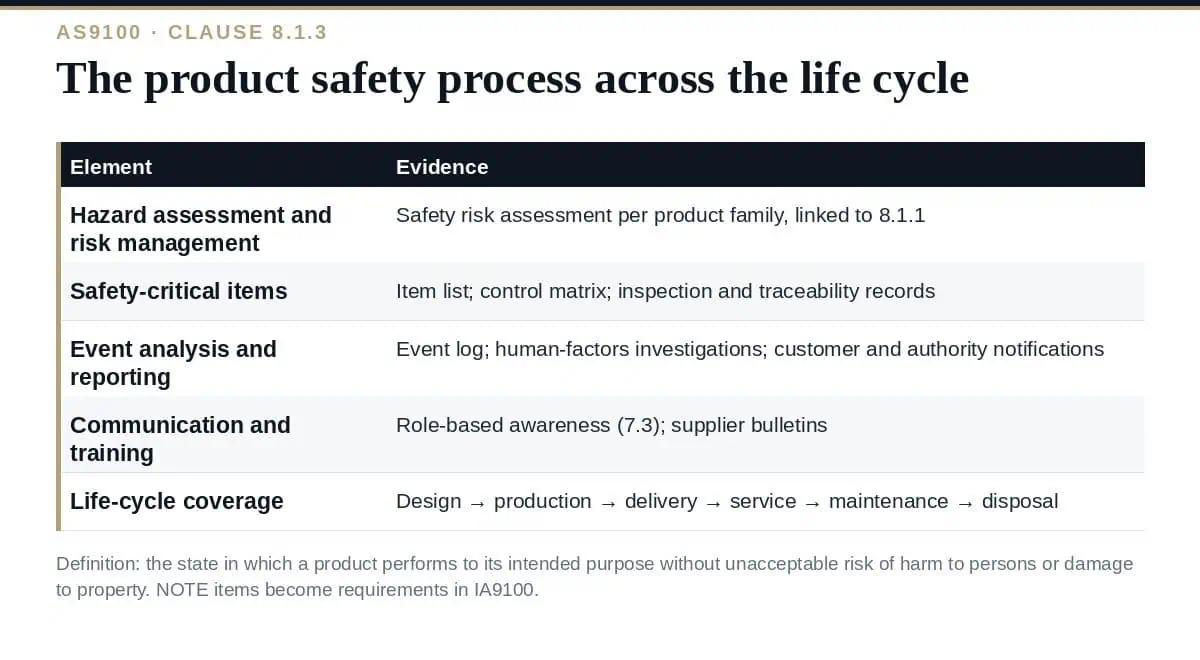
| 1. Hazard assessment and risk management | Identify what the product could do to people and property if it fails or is misused, across design, production, use, maintenance and disposal; assess the risk; decide controls; feed the operational risk process under 8.1.1 | A safety risk assessment per product family, linked to the risk register and to design FMEAs where design is in scope |
| 2. Safety-critical items | Identify the items — parts, characteristics, processes — whose failure would produce the hazards; designate them as critical items or key characteristics; control them with tighter inspection, traceability, process validation and supplier flow-down | A safety-critical item list; drawings and routings that mark them; inspection and traceability records that prove the extra control |
| 3. Analysis and reporting of safety events | Capture events — in service, in production, in the supply chain — that affected or could have affected safety; analyse root cause with human factors; report to customers and authorities as 8.7 and regulation require | An event log; investigation reports; customer and authority notifications; trend analysis |
| 4. Communication and training | Communicate safety events and lessons internally and to external providers; train persons on their contribution to safety (7.3) | Training records by role; safety communications; supplier bulletins |
| 5. Life-cycle coverage | The process applies from concept and design through manufacture, delivery, operation, maintenance and disposal — including obsolescence and end-of-life | Process scope statement; evidence at each life-cycle stage the organisation controls |
The item list is where the process becomes concrete. For a design organisation it derives from the system safety assessment — the functional hazard assessment and the failure modes whose severity is catastrophic or hazardous — and from the customer’s designated critical items. For a build-to-print manufacturer it derives from the customer’s drawings, specifications and purchase order: critical items, key characteristics and special requirements flowed down under 8.4.3. For a distributor or maintenance organisation it derives from the parts and tasks whose failure the regulator or customer classifies as safety-related. Once identified, each item carries a defined set of extra controls — validated special processes, 100% or enhanced inspection, full traceability, first article inspection, supplier approval restricted to qualified sources — and the controls are recorded against the item so an auditor can follow one part number from the list to the evidence. Our guide to first article inspection covers the verification step; counterfeit parts prevention covers the supply-side control that safety-critical items make non-negotiable.
Our guide to AS9100 vs ISO 9001 covers where the clause sits among the aerospace additions.
What does AS9100 require for product safety?
Clause 8.1.3: the organisation plans, implements and controls the processes needed to assure safety across the whole product life cycle. Its NOTE — hazard assessment and risk management, safety-critical items, analysis and reporting of safety events, communication and training — describes the process, and the IAQG says those items become requirements in IA9100.
How does AS9100 define product safety?
The state in which a product is able to perform to its designed or intended purpose without causing unacceptable risk of harm to persons or damage to property.
Does 8.1.3 apply to build-to-print suppliers and distributors?
Yes, ‘as appropriate to the organization and the product’. A build-to-print supplier’s process centres on the customer’s critical items and on escapes; a distributor’s on traceability and counterfeit prevention for safety-related parts; a maintenance organisation’s on release and human factors under AS9110.
What is a safety-critical item?
A part, characteristic or process whose failure or nonconformance would create a hazard to persons or property — derived from the system safety assessment, the customer’s designated critical items and key characteristics, or the regulator’s classification — and controlled with tighter inspection, traceability, process validation and supplier restriction.
What changes in IA9100?
Per the IAQG’s key-change summary, the NOTE items become requirements — hazard identification, safety risks, change impact from safety risk, safety process effectiveness, training, communication and awareness, and reporting of events — and the clause links to safety management systems. A Rev D process built on the NOTE already meets it.
Build the process as five things an auditor can follow: a hazard and risk assessment per product family, a safety-critical item list with its control matrix, an event log with human-factors investigations and notifications, awareness and training that name safety, and a scope that runs to disposal. AS9100 Rev D asks you to consider them; IA9100 will require them; the customer whose aircraft carries your part already assumes them.
The Product Safety Procedure, the hazard and risk assessment template, the safety-critical item register and control matrix, the safety event log and investigation form and the safety awareness training record are in the AS 9100/9110/9120 Aerospace QMS Toolkit, or start with the free templates.

October 11, 2026
October 11, 2026
October 11, 2026
October 11, 2026
October 11, 2026

