A HACCP corrective action is the predefined response you take when monitoring shows that a critical control point has drifted outside its critical limit. It is the fifth of the seven HACCP principles, and it is where a food safety plan proves it can protect consumers on a bad day, not just a good one. Auditors read corrective action records closely because they show whether the team understands its hazards.
This guide explains what the Codex text expects, what a complete HACCP corrective action contains, how to write procedures that staff can follow under pressure, and the mistakes that turn a simple deviation into a recall.
Free gap assessment
Would your HACCP plan survive an inspection?
Score the whole of the Codex text, free - the good hygiene practices as well as the seven principles, with the US and EU overlays on top.
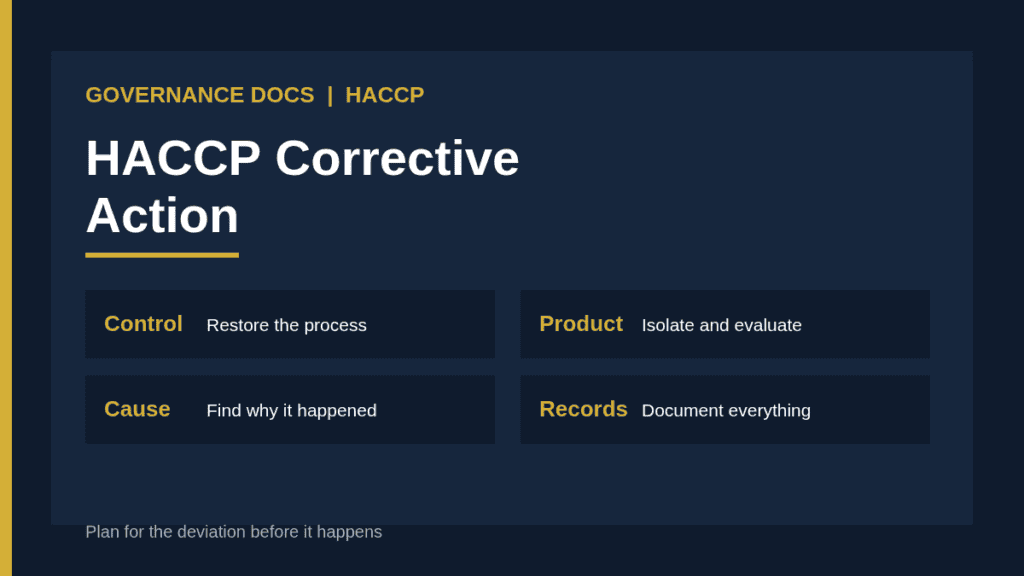
The General Principles of Food Hygiene (CXC 1-1969), most recently revised in 2022, set the international reference for HACCP. Principle 5 says corrective actions are needed when monitoring indicates that a deviation from a critical limit at a critical control point has occurred. The text expects the response to do four things: bring the process back under control, isolate any affected product and evaluate its safety and suitability, identify why the deviation happened, and take steps to prevent it happening again. Everything must be documented and the records retained. You can find the text on the Codex Alimentarius codes of practice page. Your national food law may add requirements of its own, so check the rules where you operate.
Element
Question it answers
Typical evidence
Restore control
How is the process brought back within limits?
Adjustment made, time, person
Product disposition
What happened to product made since the last good check?
Hold tag, quantity, decision
Root cause
Why did the limit fail?
Investigation notes, equipment check
Prevention
What stops it happening again?
Maintenance, retraining, changed limit or step
Records
Can we prove all of the above?
Signed, dated corrective action form
Where corrective action sits in your HACCP plan
The principles run in order. The hazard analysis identifies significant hazards, the team selects control points, critical limits set the boundary between safe and unsafe, monitoring checks the boundary, and the HACCP corrective action defines what happens when monitoring finds a breach. Each critical control point in your plan should therefore carry its own corrective action, written before production starts. If you are still building the plan, our overview of the HACCP plan shows how the parts fit together.
A generic sentence such as “take corrective action” does not meet the intent. The action for a cooking step that missed its core temperature is different from the action for a metal detector that failed its test piece, and the people on shift need to know which one applies without calling a manager.
Writing a HACCP corrective action procedure
1. Define the trigger
State exactly what counts as a deviation: a temperature reading below the limit, a missed monitoring check, a failed detector test, a supplier certificate not received. A missed check is a deviation too, because you no longer know the state of the product.
2. Give immediate steps to the operator
The first job is to stop the problem growing. Typical immediate steps are to stop the line, correct the process parameter, and segregate product produced since the last acceptable check. Keep this list short and physical so that it is followed under time pressure.
3. Set product disposition rules
Decide in advance who may release, rework, reprocess, downgrade or destroy affected product, and on what evidence. For example, product that missed a cooking limit might be re-cooked if the process allows and the quality is acceptable, or destroyed if not. Where safety cannot be shown, product should not be released. Link this to your product recall procedure and your traceability system, because disposition depends on knowing exactly which lots are affected.
4. Investigate the cause
Ask why the deviation happened, and keep asking until you reach something you can fix: a worn seal, an uncalibrated probe, a rushed changeover, an unclear instruction. Stopping at “operator error” rarely prevents a repeat. Ask what made the error easy to make.
5. Prevent recurrence and close out
Decide the preventive step, give it an owner and date, and check later that it worked. Then close the record with a signature from someone independent of the operator, usually the food safety team leader or a supervisor.
A worked example
The following is an illustrative example, not taken from a real site. A cooked chicken product has a critical limit for core temperature. At the routine check, the probe reads below the limit on one tray.
Restore control: The operator stops the oven line and raises the setpoint after confirming the probe is calibrated.
Isolate product: All trays since the last good check are tagged and moved to a hold area, and the quantity is recorded.
Decide disposition: The team leader has the held trays re-cooked in line with the written procedure, then re-tests core temperature on each.
Find the cause: Maintenance finds that a fan belt was slipping, which reduced heat circulation.
Prevent recurrence: The belt is replaced and added to the weekly maintenance checklist. The team reviews whether monitoring frequency is enough.
Record and verify: The form is completed and signed, and the deviation is listed for the next verification review.
Common HACCP corrective action mistakes
Treating the reading as the problem. Re-measuring until a pass appears hides the deviation. Record the failed reading and act on it.
Forgetting the product made since the last good check. The affected product is everything produced back to the last verified acceptable reading, not just the last unit.
No authority to stop the line. If the operator must wait for a manager to approve a hold, product will keep moving. Give the authority in writing.
Repeated deviations with no root cause. The same CCP failing every week signals a design problem, so review the limit, the equipment or the step itself.
Incomplete records. Forms with missing signatures, dates or quantities weaken your position in an audit or a complaint investigation.
Training operators to act on a deviation
A written procedure only works if the person at the line can use it. Train operators on the corrective actions for the CCPs they monitor, using realistic scenarios rather than a slide deck: what do you do if the reading is low, who do you call, where does held product go, what do you write down. Repeat the training when the plan changes, when someone new joins the shift and after any serious deviation. Short drills, run on the floor with the actual forms, reveal gaps such as an unlabeled hold area or a missing pen far better than a written test does.
Keep the form simple
The corrective action form should fit on one page and capture the date and time, the CCP, the reading and the limit, the immediate action, the product affected with lot numbers and quantities, the disposition decision, the root cause, the preventive step, and the signatures. If the form is long, staff will skip fields when the line is busy, and a half-completed record helps nobody.
Verification and trend review
Corrective action records are useful beyond the single incident. At verification, review them for patterns: which CCPs deviate most, on which shift, on which line, after which maintenance event. A rising trend can justify a change to the process, tighter monitoring or new training. Our note on HACCP validation versus verification explains how this review differs from validating that your limits are effective in the first place. If your system is certified, the same records support the internal audit and management review of a wider food safety system such as ISO 22000.
Getting the forms and procedures ready
The HACCP Toolkit provides ready-to-adapt templates for the plan, monitoring records and the documents that support a HACCP corrective action. Whichever format you use, tailor each corrective action to the CCP it belongs to, and rehearse it with operators before you need it.
HACCP corrective action FAQ
Is a corrective action required for every deviation?
Every deviation from a critical limit at a critical control point needs a documented response. Deviations at other steps, such as prerequisite programme checks, still need action, though the record may be lighter.
Can we reprocess product after a deviation?
Sometimes, if your procedure allows it and reprocessing brings the product to a safe state that can be shown by evidence. Where safety cannot be demonstrated, the product should not be released.
Who should sign off a corrective action?
The person who reviews the record should be independent of the operator and trained in your HACCP plan, typically the food safety team leader.
What is the difference between a correction and a corrective action?
A correction fixes the immediate problem, such as re-cooking a batch. A corrective action removes the cause so that it does not recur. In HACCP, both are expected and both should appear in the record.
How long should we keep corrective action records?
Keep them for at least the shelf life of the product, and longer where your customers, certification scheme or food law require it. Confirm the specific period with your regulator or scheme owner.