CART
ISO 21001 vs ISO 9001 is the choice every school, college, university and training provider faces once it decides to certify a management system, and the standards themselves settle most of it. ISO 21001:2025 describes itself as “a stand-alone management system standard, aligned with ISO 9001”, built on the same harmonized structure with the same clauses 4 to 10, and then rewrites the operational core around learners and other beneficiaries rather than customers: requirements for educational products and services, design and development of programmes, delivery, release and nonconforming educational outputs.
ISO 9001 is generic and certifiable by any organisation; ISO 21001 applies to any organisation that “uses a curriculum to support the development of competence through teaching, learning, training or research”, including a training department inside a company whose business is not education. This guide compares the two standards clause by clause, sets out the seven differences that decide the choice, explains the edition position of both — ISO 21001:2025 published July 2025 and ISO 9001:2026 published September 2026 — and shows when the right answer is to run both as one system.
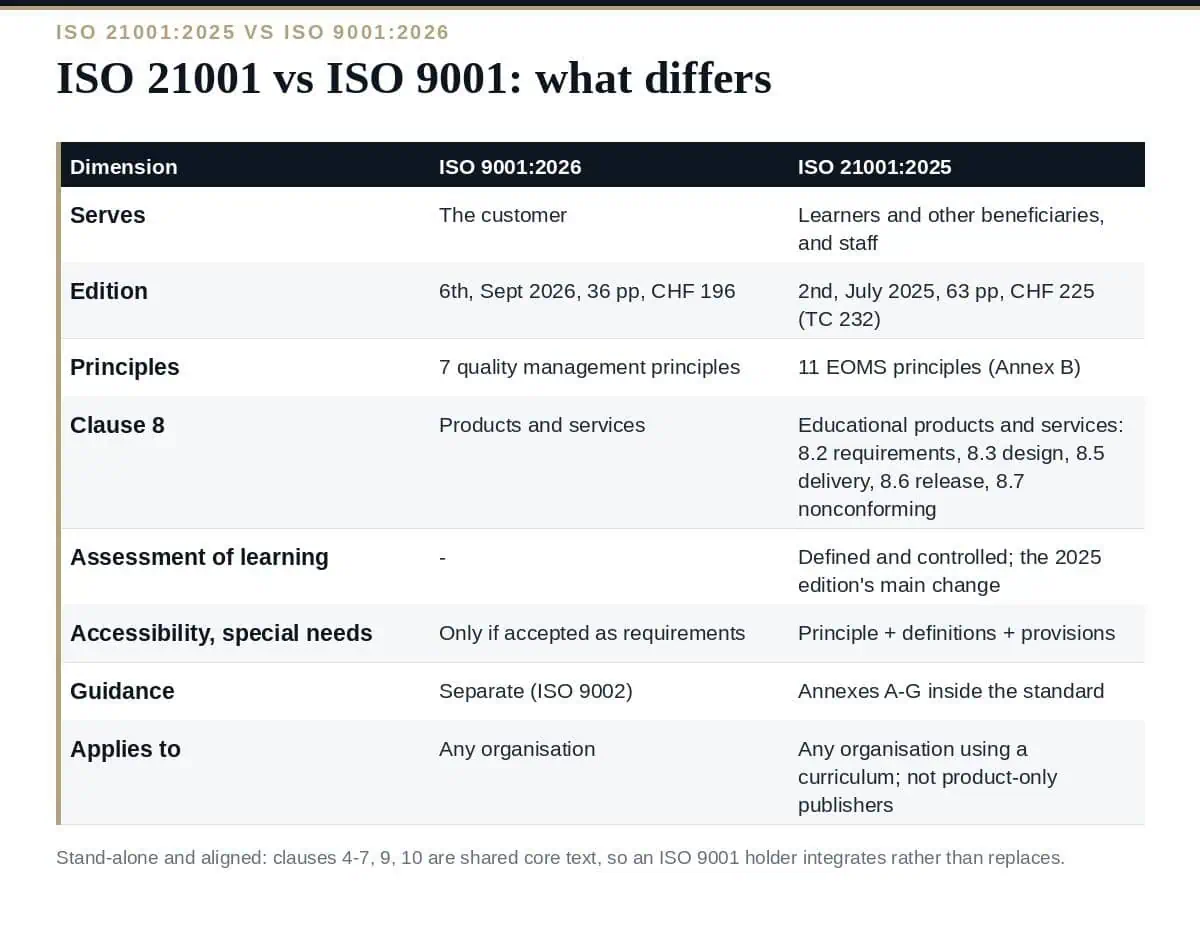
| Dimension | ISO 9001:2026 | ISO 21001:2025 |
|---|---|---|
| What it is | Quality management system requirements; generic, any organisation | Educational organization management system (EOMS) requirements with guidance; organisations that use a curriculum |
| Edition | Sixth edition, September 2026 (replacing 2015); 36 pages; CHF 196; IAF transition period (three years is customary) | Second edition, July 2025 (replacing 2018 and its Amd 1:2024); ISO/TC 232; 63 pages; CHF 225 |
| Who it serves | The customer | Learners and other beneficiaries — separately defined, and staff |
| Principles | Seven quality management principles (ISO 9000) | Eleven EOMS principles, detailed in Annex B |
| Structure | Harmonized structure, clauses 4–10 | Same; 0.3 states it “conforms to ISO’s requirements for management system standards” |
| Clause 8 | Operational planning; requirements for products and services; design and development; external providers; production and service provision; release; nonconforming outputs | Same skeleton, rewritten as educational products and services: 8.2 requirements, 8.3 design and development, 8.5 delivery, 8.6 release, 8.7 control of educational nonconforming outputs |
| Guidance inside the standard | Requirements only (guidance in ISO 9002) | Requirements with guidance; Annexes A–G (early childhood, principles, interested parties, communication, processes and tools, EQAVET mapping, health and safety) |
| Stand-alone? | Yes | Yes — no ISO 9001 certificate required first |
On ISO 21001 vs ISO 9001 the shared ground is large. Clauses 4 to 7, 9 and 10 are the harmonized core text with educational wording: context, interested parties, scope, leadership, policy, roles, risks and opportunities, objectives, planning of changes, resources, competence, awareness, communication, documented information, monitoring, internal audit, management review, nonconformity and corrective action, continual improvement.
ISO 21001 states in 0.3 that the identical core text and common terms are there “to benefit users implementing multiple ISO management system standards”, and an organisation certified to ISO 9001 will find its policy, objectives, audit programme and management review reusable with the beneficiary language added. The process approach, PDCA and risk-based thinking sections of the introduction (0.5) are the ISO 9001 text applied to an EOMS. Our guides to ISO 9001:2026 and ISO 21001:2025 cover each standard’s current edition.
| Situation | Recommendation | Why |
|---|---|---|
| School, college, university, vocational or online provider | ISO 21001 | The whole organisation delivers a curriculum; ISO 9001 would leave design, assessment, accessibility and learner satisfaction outside the certified system |
| Corporate training function inside a non-education company | ISO 21001 for the function, alongside the parent’s ISO 9001 | The scope note in clause 1 covers “professional training departments” explicitly; the parent’s QMS carries the shared clauses |
| Awarding body or exam provider | ISO 21001 (assessment is its strength); consider ISO/IEC 17024 where certification of persons is the product | The revised assessment text is the 2025 edition’s main change |
| Publisher of educational products only | ISO 9001 | Clause 1: ISO 21001 “does not apply to organizations that only produce or manufacture educational products” |
| Education provider already certified to ISO 9001 | Add ISO 21001 as an integrated system; keep one audit | Clauses 4–7, 9, 10 overlap; the addition is clause 8, the beneficiary analysis and the three-group satisfaction measurement |
| Provider whose funder or regulator names ISO 9001 | ISO 9001 now, ISO 21001 as the second stage — the ISO 21001 vs ISO 9001 question is then one of timing | Meet the contractual requirement first; the EOMS adds the educational depth |
Is ISO 21001 a replacement for ISO 9001 in education?
For the educational offering, yes — it covers everything ISO 9001 covers and adds the learner-specific requirements. ISO 21001:2025 is a stand-alone standard aligned with ISO 9001; an organisation does not need ISO 9001 first.
Can we hold both certificates?
Yes, and integrated certification is the efficient route: clauses 4–7, 9 and 10 are shared core text, so one audit covers both with clause 8 assessed against each standard’s version.
Which edition of each applies in 2026?
ISO 21001:2025 (second edition, July 2025; the 2018 edition and its 2024 amendment are withdrawn) and ISO 9001:2026 (published September 2026, with a transition from 2015).
Does ISO 21001 apply to a company’s internal training department?
Yes. Clause 1 states it can be applied to educational organisations within larger organisations whose core business is not education, such as professional training departments.
What did ISO 21001:2025 change?
The foreword names one main change: assessment-related text revised to reflect current best practice in educational assessment. The eleven principles, the harmonized structure and the annexes A–G continue.
Decide ISO 21001 vs ISO 9001 on one question: do you deliver a curriculum? If yes, ISO 21001:2025 is the standard written for you, and ISO 9001 is at most the shared core you already hold. If you only make educational products, ISO 9001 is the one that applies. If you hold ISO 9001 and deliver education, integrate rather than replace — the core is identical, and the work is clause 8, the beneficiary analysis and measuring satisfaction for learners, other beneficiaries and staff.
The EOMS manual and policy, the beneficiary and interested-party analysis, the educational design and assessment procedures and the cross-mapping matrix to ISO 9001 are in the ISO 21001 Educational Management Toolkit, or start with the free templates.

September 20, 2026
September 19, 2026
September 19, 2026

September 19, 2026

September 19, 2026

