CART
HITRUST vs SOC 2 is the comparison a vendor to healthcare, insurance or financial services makes when a customer’s security questionnaire accepts either — and the two are not the same kind of thing. SOC 2 is an attestation: a CPA firm examines controls the organisation itself defined against the AICPA’s Trust Services Criteria and issues a report with an opinion and, in a Type II, the exceptions found. HITRUST is a certification: a prescribed, scored control set — 43 requirements at e1, 182 at i1, a tailored set at r2 — tested by an authorised External Assessor, quality-assured centrally by HITRUST, and issued as a certificate with a fixed validity.
HITRUST’s own description of the distinction, on its i1 page, is blunt: SOC 2 is “an attestation with flexible criteria and no third-party validation” while i1 is “a certification with a defined control set, external assessor testing, and centralized HITRUST quality assurance”. This guide sets out the seven differences that decide which one a buyer actually wants, where the two overlap and reuse each other, the cost and timeline comparison, and when a vendor needs both.
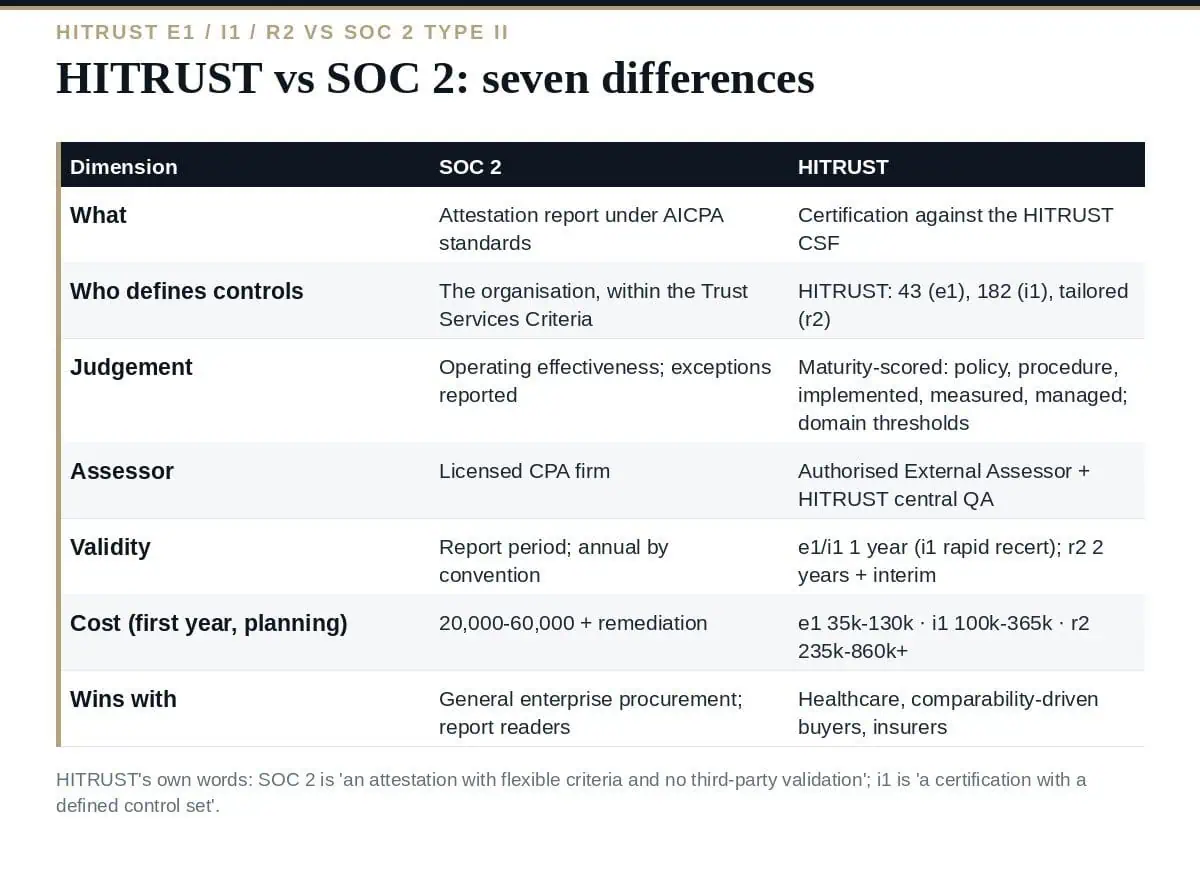
| Dimension | SOC 2 | HITRUST (e1 / i1 / r2) |
|---|---|---|
| What it is | An attestation report under AICPA standards on controls relevant to the Trust Services Criteria — security, availability, processing integrity, confidentiality, privacy | A certification against the HITRUST CSF, a harmonised framework mapped across 60-plus authoritative sources |
| Who defines the controls | The organisation, within the criteria; two SOC 2 reports can test very different control sets | HITRUST: 43 controls at e1, 182 at i1, a risk-tailored set at r2 |
| How controls are judged | Operating effectiveness over a period (Type II) or design at a point in time (Type I); exceptions reported | Scored on maturity — policy, procedure, implemented, measured, managed — with domain thresholds for certification |
| Who assesses | A licensed CPA firm | An authorised HITRUST External Assessor Organisation, with HITRUST’s central quality assurance of the result |
| Output | A report with the auditor’s opinion, system description and test results; not public | A certification report and letter; results shared through MyCSF |
| Validity | The report covers its period; customers typically expect a new report annually | e1 and i1 one year (i1 with rapid recertification); r2 two years with an interim assessment |
| Market | North American procurement generally; SaaS and technology vendors | Healthcare and adjacent regulated sectors above all; increasingly finance and insurance |
Under SOC 2 the organisation writes its own control list to meet the Trust Services Criteria, and the auditor tests that list. Two vendors can both hold clean SOC 2 Type II reports with very different security postures, which is why a careful buyer reads the report rather than the logo. HITRUST prescribes the requirements: at e1 and i1 the set is fixed, at r2 it is generated from the organisation’s risk factors, and the buyer knows what a certificate at each level means without reading the report. That is the core of HITRUST vs SOC 2 — flexibility for the vendor against comparability for the buyer.
The second HITRUST vs SOC 2 difference is the verdict. A SOC 2 test result is a finding: the control operated, or an exception is noted. A HITRUST requirement is scored across five maturity levels, and the certification test is applied by domain, so an organisation can pass every control’s existence and still fail a domain where nothing is measured. Our guide to HITRUST scoring covers the weighting; the practical consequence is that HITRUST rewards measurement and management in a way SOC 2 does not test.
A SOC 2 report is the CPA firm’s opinion and nobody else’s. A HITRUST validated assessment is performed by an External Assessor and then reviewed by HITRUST before certification issues — the “centralized HITRUST quality assurance” its own page names — which is why HITRUST can publish an outcome statistic for certified environments and a SOC 2 firm cannot for its clients.
Validity is the fourth HITRUST vs SOC 2 difference. SOC 2 has no expiry; the report covers a period, and the market convention is a fresh Type II each year. HITRUST certificates carry stated validity: e1 one year, i1 one year with a rapid recertification on roughly 60 core controls in year two, r2 two years with an interim assessment after the first. Our guide to the HITRUST interim assessment covers what year two involves.
A SOC 2 customer gets the report — often under NDA — and reads the system description, the control list, the tests and the exceptions. A HITRUST customer gets a certification letter and report and, through the HITRUST Results Distribution System, the assessment results, with the assurance that the level means what HITRUST says it means. Buyers with the staff to read reports often prefer SOC 2’s detail; buyers without prefer HITRUST’s comparability.
| SOC 2 Type II | HITRUST e1 | HITRUST i1 | HITRUST r2 | |
|---|---|---|---|---|
| Typical first-year cost (planning ranges) | $20,000 to $60,000 plus remediation | $35,000 to $130,000 | $100,000 to $365,000 | $235,000 to $860,000+ |
| Timeline | 3 to 12 months including the observation period | As few as 4–6 weeks; ~30 days on average (HITRUST) | 6–12 months (HITRUST) | Set by scoping and readiness |
| Recurring | Annual report | Annual | Annual, alternating full and rapid | Two-year certificate with interim |
Our guide to HITRUST certification cost breaks the HITRUST columns into their three invoices.
| Buyer | Wants | Why |
|---|---|---|
| Health systems and payers | HITRUST, often r2 by contract | The sector’s default; the CSF harmonises HIPAA with the rest |
| North American enterprise procurement generally | SOC 2 Type II | What the security questionnaire is built around |
| Cyber insurers | HITRUST increasingly | HITRUST markets underwriting outcomes for certified environments |
| Regulated buyers needing comparability across many vendors | HITRUST | A level means the same thing for every certified vendor |
| Buyers with audit staff who read reports | SOC 2 | The exceptions and system description are the value |
The control work overlaps heavily. HITRUST publishes guidance on how e1 controls align with common SOC 2 requirements, and the CSF’s authoritative-source mappings include the Trust Services Criteria; several External Assessor firms are also CPA firms and can run a SOC 2 examination and a HITRUST assessment on shared evidence. The efficient sequence for a vendor that needs both is one control set, evidenced once in a shared repository, tested twice — and a scoping conversation with an assessor who does both before either engagement starts. Our guide to HITRUST assessments covers choosing the level.
What is the difference between HITRUST vs SOC 2?
SOC 2 is an attestation by a CPA firm on controls the organisation defined against the AICPA Trust Services Criteria, reported with an opinion and exceptions; HITRUST is a certification against a prescribed, maturity-scored control set — 43 at e1, 182 at i1, tailored at r2 — tested by an authorised External Assessor and quality-assured by HITRUST, with fixed validity periods.
Is HITRUST harder than SOC 2?
Generally, because the controls are prescribed and scored on maturity rather than defined by the organisation and tested for existence; an e1, though, is designed to be completed in weeks.
Does SOC 2 count toward HITRUST?
The evidence transfers substantially — HITRUST maps the CSF to the Trust Services Criteria and publishes e1-to-SOC 2 alignment guidance — but the assessment is separate and must be performed by an authorised External Assessor.
Which do healthcare customers want?
Usually HITRUST, and large health systems often name r2 in contracts; SOC 2 remains the general enterprise expectation.
Can one firm do both?
Often. Several HITRUST External Assessor Organisations are CPA firms and can run both on shared evidence.
Decide HITRUST vs SOC 2 by who is asking: SOC 2 for the general enterprise questionnaire, HITRUST at the level the contract names for healthcare and comparability-driven buyers, and both — on one evidence base with one firm — when the customer book spans them. The difference is not rigour alone; it is who defines the controls, who assures the result, and what the buyer can conclude without reading the report.
The HITRUST CSF Framework Overview, the Scoping Guide and Authoritative Sources Mapping, the Cross-Mapping Appendix, the Assurance Program Guide and the Third-Party Assurance Policy are in the HITRUST CSF v11 Toolkit, or start with the free templates.

September 20, 2026
September 19, 2026

September 19, 2026

September 19, 2026

September 19, 2026

