CART

The ILAAP — the internal liquidity adequacy assessment process — is where a bank states, in its own terms and on its own evidence, that it has enough liquidity and stable funding to survive, and the ECB’s guide to it is built on seven principles rather than a template. Article 86 of the Capital Requirements Directive requires institutions to have robust strategies, policies, processes and systems for identifying, measuring, managing and monitoring liquidity risk over appropriate time horizons; the ILAAP is the process that discharges that duty, the document that describes it, and the package supervisors read in the SREP. It is the liquidity twin of the ICAAP, and it is judged by the same standard: not whether the LCR and NSFR are above 100%, but whether management understands the funding of its own balance sheet under stress. This guide sets out the ECB’s seven ILAAP principles, the building blocks a package needs, the two perspectives it must run, the horizons the regulatory ratios do not cover, how it feeds the SREP, and where these documents lose credibility.
The ICAAP asks whether the bank’s capital covers its risks; this process asks whether its liquidity and funding do. In the EU the legal root is Article 86 of Directive 2013/36/EU, and the supervisory expectations are set out in the ECB’s Guide to the internal liquidity adequacy assessment process of November 2018 for the banks it supervises directly, alongside the EBA’s guidelines on ICAAP and ILAAP information collected for SREP purposes. Elsewhere the process goes by other names — the same acronym under the PRA in the UK, the US’s internal liquidity stress testing under Regulation YY — but the substance converges: an internal assessment, owned by the board, that goes beyond the regulatory ratios. Our guide to the ICAAP covers the capital side of the same architecture.
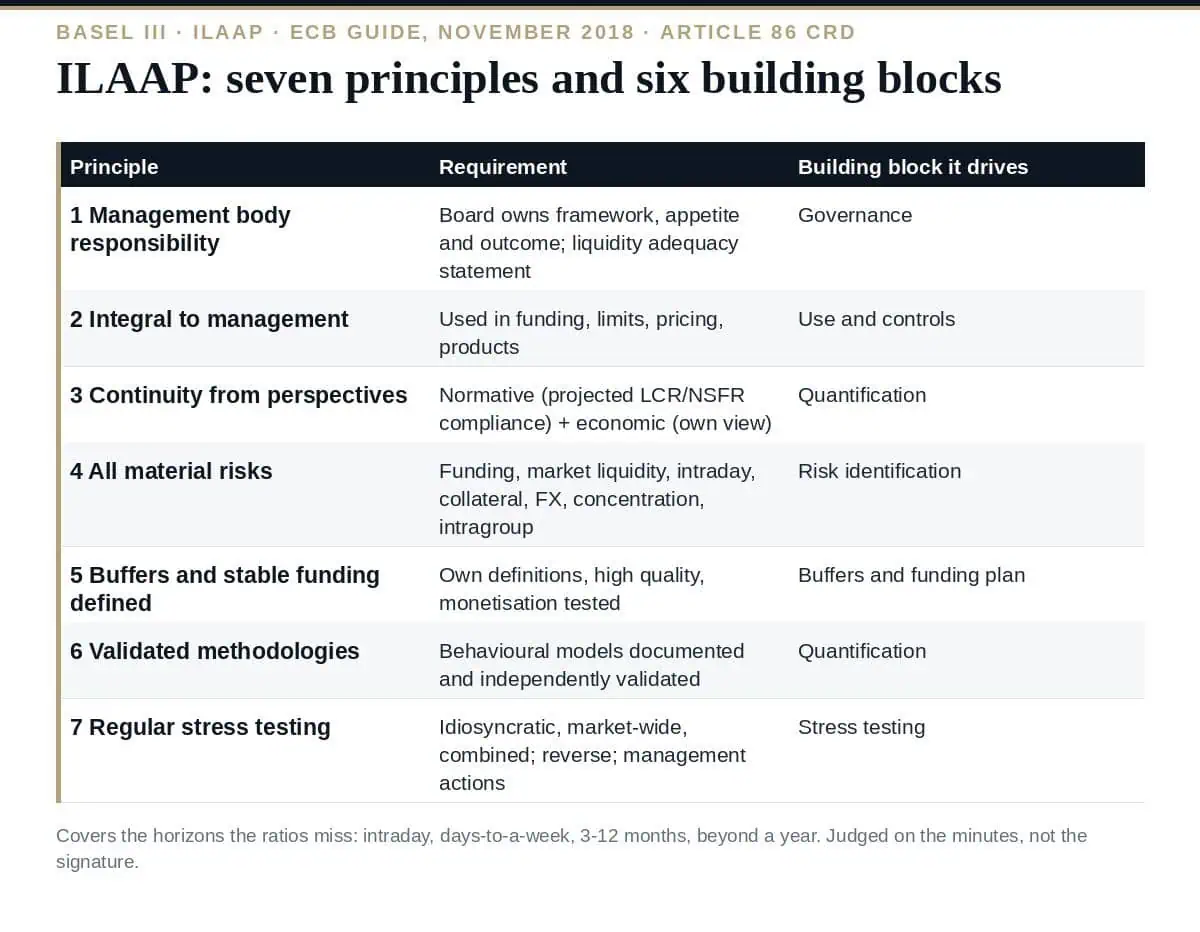
| Principle (ECB Guide, 2018) | What it requires | What supervisors look for |
|---|---|---|
| 1. The management body is responsible for the sound governance of the ILAAP | Board approval of the framework, the risk appetite and the outcome; a signed capital-adequacy-style statement for liquidity | The liquidity adequacy statement, board minutes showing challenge, not just approval |
| 2. The process is an integral part of the overall management framework | Used in decisions — funding plans, limits, pricing, new products — not produced for the supervisor | Evidence that a business decision was changed by the output |
| 3. The process contributes fundamentally to continuity by ensuring liquidity adequacy from different perspectives | Both a normative perspective (projected compliance with the LCR, NSFR and supervisory requirements over the planning horizon) and an economic perspective (the bank’s own view of liquidity and funding adequacy) | Two perspectives, reconciled, with a multi-year projection under baseline and adverse conditions |
| 4. All material risks are identified and taken into account | A risk inventory covering funding liquidity, market liquidity, intraday, collateral, FX, concentration, intragroup and off-balance-sheet risks | A documented inventory with materiality decisions, not a list of the ratios’ inputs |
| 5. The internal liquidity buffers are of high quality and clearly defined; the internal stable sources of funding are clearly defined | The bank’s own definition of the buffer and of stable funding, which may be stricter than the LCR’s HQLA and the NSFR’s ASF | Buffer composition, haircuts and monetisation testing; the funding profile by source and tenor |
| 6. Risk quantification methodologies are adequate, consistent and independently validated | Behavioural models for deposits, prepayment and drawdowns with assumptions stated and validated | Model documentation, validation reports, sensitivity to the key assumptions |
| 7. Regular stress testing is aimed at ensuring liquidity adequacy in adverse circumstances | Idiosyncratic, market-wide and combined scenarios over several horizons, including reverse stress testing, with management actions | Scenarios tied to the bank’s actual funding model; survival periods; the link to the contingency funding plan |
The LCR measures 30 days and the NSFR one year; the internal assessment has to cover what sits between and outside them. Intraday liquidity — the ability to meet payment and settlement obligations through the day — is a risk the ratios do not measure and the ECB guide names; the same is true of the days-to-a-week horizon in which a wholesale run actually happens, the three-to-twelve-month band in which a rating downgrade bites, and the beyond-one-year horizon where the funding plan lives. A package that reproduces the LCR and NSFR under a few sensitivities has not assessed liquidity adequacy; it has re-reported two ratios. Our guide to LCR vs NSFR covers what the ratios do measure.
Supervisors read the ILAAP as evidence for their own assessment of liquidity risk and of the bank’s management of it, and the outcome can be quantitative — additional liquidity requirements, a higher survival period, a larger buffer — or qualitative, from findings about governance to model-validation demands. The EBA guidelines set out the information supervisors collect: the reader’s manual, the governance, the risk identification, the quantification and stress testing, the funding plan and the internal audit’s view. A package that a supervisor can navigate to the answer of “how much and why” in a page is worth more than one that is twice as long.
What is the ILAAP?
The internal liquidity adequacy assessment process: the bank’s own, board-owned assessment of whether its liquidity buffers and funding are adequate for its risks over relevant horizons, required under Article 86 CRD and set out for ECB-supervised banks in the ECB’s 2018 guide with seven principles. It is the liquidity counterpart of the ICAAP and a core input to the SREP.
How does it differ from the LCR and NSFR?
The ratios are regulatory minimums over 30 days and one year; the ILAAP is the bank’s own assessment across all horizons — intraday, short-term, medium-term and structural — from a normative perspective (projected ratio compliance) and an economic perspective (the bank’s own view), with its own buffer and stable-funding definitions.
What are the seven principles?
Management body responsibility; integration into the management framework; continuity from different perspectives; identification of all material risks; clearly defined high-quality buffers and stable funding; adequate, consistent and validated methodologies; and regular stress testing.
How often is it produced?
It is a continuous process with an annual package for the supervisor, updated when the balance sheet, funding model or risk profile changes materially.
Who signs it?
The management body, through a liquidity adequacy statement, after challenge recorded in the minutes; principle 1 is judged on that record.
Build the ILAAP as the bank’s own answer to the liquidity question: a risk inventory, an internal buffer and stable-funding definition, two perspectives from one projection, validated behavioural models, stress tests tied to the funding model with named management actions, and a board that challenged it. The LCR and NSFR are inputs; the seven principles are the test.
The ILAAP document, the Liquidity Risk Management Policy, the Contingency Funding Plan, the Stress Testing Framework and the Pillar 2 SREP Self-Assessment are in the Basel III Prudential Risk Toolkit, or start with the free templates.


September 21, 2026
September 21, 2026

September 20, 2026
September 20, 2026
September 19, 2026

