
CART
No products in the cart.
ISO Compliance Insights & Best Practices
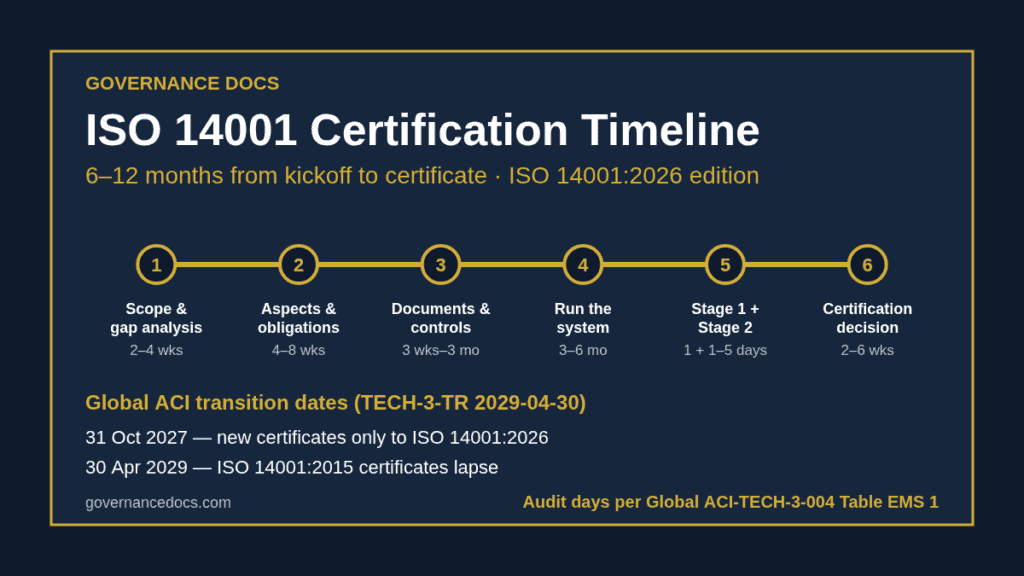
The ISO 14001 certification timeline for a single-site organization runs six to twelve months from kickoff to certificate, and the spread is not random. It comes down to four things: whether you already operate an ISO 9001 or ISO 45001 system you can build on, how long it takes to build an honest aspects-and-impacts register and compliance-obligations register, how quickly you can generate three to six months of monitoring records, and, new this month, which edition of the standard you are aiming at. ISO 14001:2026 was published in April 2026, and on 14 September 2026 Global ACI published the accreditation rules that decide when certification bodies must stop issuing certificates to the 2015 edition.
This guide walks the ISO 14001 certification timeline phase by phase, gives labelled typical durations for each step, shows the audit-day table your registrar will use to quote you, and lays out the transition dates so you do not book a Stage 2 against the wrong edition. Durations are typical ranges from implementation practice, not guarantees; the accreditation rules cited are the current published text.
Free gap assessment
Are you ready for the 2026 edition of ISO 14001?
Score every clause of the new edition, free, including the aspects, life cycle and compliance evaluation work that carries most of the findings.
Run the free ISO 14001 gap assessment → or View premium report sample
| Phase | Typical duration | What drives it |
|---|---|---|
| 1. Scope, context and gap analysis | 2–4 weeks | Number of sites and activities; existing management systems |
| 2. Aspects, impacts and compliance obligations | 4–8 weeks | How many activities you run and how many jurisdictions regulate them |
| 3. Documentation and operational controls | 3 weeks – 3 months | Templates versus writing from scratch; approval cycles |
| 4. Operating the system and building records | 3–6 months | Monitoring data, compliance evaluation, emergency drill, internal audit, management review |
| 5. Selecting and booking the certification body | 4–8 weeks lead time | Registrar capacity; runs in parallel with phase 4 |
| 6. Stage 1 and Stage 2 audits | Stage 1: 1 day · Stage 2: 1–5 days on site | Headcount and environmental complexity category |
| 7. Nonconformity closure and certification decision | 2–6 weeks | Number and severity of findings; registrar review queue |
| Total | 6–12 months | Shorter with an existing ISO 9001 or ISO 45001 system; longer for multi-site or high-complexity operations |
The single biggest difference between this schedule and a quality-system schedule is phase 2. An environmental management system stands or falls on whether you have identified what you actually do to the environment and which laws bind each of those activities. That work cannot be bought as a template; it can only be accelerated by one.
Fix the boundary first: which sites, which activities, which products and services. ISO 14001:2026 builds climate change into the clause 4 context analysis rather than bolting it on by amendment, so your list of internal and external issues has to say something specific about climate-related risks and opportunities, not just note that they exist. Then score every clause of the standard against what you already have. A small site with an ISO 9001 system already in place can do this in two weeks; a multi-site manufacturer starting cold needs four.
This is the phase that stretches the ISO 14001 certification timeline most. You need a documented method for deciding which environmental aspects are significant, and then you need to apply it across normal operation, abnormal operation and emergency conditions, with a life cycle perspective that the 2026 edition weights more heavily than 2015 did. In parallel, the compliance-obligations register has to name the specific permits, regulations and voluntary commitments binding each activity in each jurisdiction and say how you will evaluate compliance against each one. Budget four weeks for a single office-and-warehouse site and eight for a plant with permits for air, water and waste. This register is the most audited document in the standard, and a thin one is the most common route to a major nonconformity at Stage 2.
Environmental policy, roles and responsibilities, objectives tied to significant aspects, operational controls, and emergency preparedness and response. ISO 14001:2026 adds a clause 6.3 on planning of changes and extends operational control explicitly to externally provided processes, products and services, so contractor and supplier controls need a written home. Starting from a template set, three to five weeks is realistic. Writing from a blank page, and routing every document through a two-week approval cycle, pushes this to three months. See our ten-step ISO 14001 implementation plan for the order that works.
The phase nobody puts in the plan, and the one that decides the ISO 14001 certification timeline. Stage 2 auditors need evidence that the system runs, not that it exists: monitoring and measurement data across at least one reporting cycle, at least one documented evaluation of compliance, a tested emergency response, a completed internal audit covering every clause, and a management review that acted on the results. Three months of operation is the practical floor for a small site; six months is normal where monitoring is seasonal or where permits are reported quarterly. An organization that certifies after two months of records is either very small or has skipped something the auditor will find.
Run this in parallel with phase 4. Get quotes from two or three accredited registrars, check that each one’s accreditation covers your sector code, and confirm which edition of ISO 14001 they are accredited to audit; that question matters in 2026 for the reasons in the transition section below. Lead times of four to eight weeks for a Stage 1 date are typical, and the registrar will need your headcount, sites and activity description to calculate audit days before it can quote or schedule.
Stage 1 reviews your documentation, checks readiness for Stage 2 and confirms scope, sites and applicable legal requirements; for a single site it normally takes one day. ISO/IEC 17021-1 clause 9.3.1.2.4 sets no fixed interval between the stages: the gap depends on how many areas of concern Stage 1 raised and how long you need to resolve them, and it is commonly two to eight weeks. Stage 2 evaluates implementation and effectiveness on site, and its length comes from the audit-day table below.
Under 17021-1 clause 9.5.2, the certification body must confirm that every major nonconformity has been corrected and verified before it grants the certificate, and that minors have an accepted corrective-action plan. A clean Stage 2 with a handful of minors can be decided in two weeks; a major that needs new records before it can be verified takes longer. Clause 9.5.3.2 is the hard stop: if the registrar cannot verify closure of a major nonconformity within six months of the last day of Stage 2, it has to conduct another Stage 2 before recommending certification.
Registrars do not guess about the audit-day part of the ISO 14001 certification timeline. Initial audit time for an environmental management system comes from Global ACI-TECH-3-004 (M), the document that replaced IAF MD 5 when Global ACI took over the accreditation-forum role on 1 January 2026; its issue date is 10 July 2026 and the text is carried over without substantive change. Table EMS 1 gives the combined Stage 1 plus Stage 2 time by effective headcount and by the complexity category of your environmental aspects. The lower bands look like this:
| Effective personnel | High complexity | Medium | Low | Limited |
|---|---|---|---|---|
| 1–5 | 3 days | 2.5 | 2.5 | 2.5 |
| 6–10 | 3.5 | 3 | 3 | 3 |
| 11–15 | 4.5 | 3.5 | 3 | 3 |
| 16–25 | 5.5 | 4.5 | 3.5 | 3 |
| 26–45 | 7 | 5.5 | 4 | 3 |
| 46–65 | 8 | 6 | 4.5 | 3.5 |
| 66–85 | 9 | 7 | 5 | 3.5 |
| 86–125 | 11 | 8 | 5.5 | 4 |
Complexity is set by sector. Table EMS 2 in the same document puts mining, oil and gas, chemicals and pharmaceuticals, primary metals, cement, coal-fired generation, civil construction and demolition, and waste and effluent processing in the high category; farming, textiles, printing, glass and clay products, metal surface treatment and transport-equipment manufacturing in medium; hotels, wood products, plastics moulding, metal fabrication without surface treatment, wholesale and retail, and electronics assembly in low; and corporate head offices, telecommunications, education and general business services in limited. The registrar can lower a category where your specific activities justify it, but it must document why. A 30-person low-complexity distributor is looking at about four audit days in total; a 30-person chemical plant is looking at seven. Surveillance visits then run at roughly one third of that initial time per year.
| Profile | Typical ISO 14001 certification timeline | Where the time goes |
|---|---|---|
| Under 25 people, single site, limited or low complexity, existing ISO 9001 | 4–6 months | Aspects register and three months of records; the audit itself is 3 days |
| 25–125 people, single site, medium complexity, no existing system | 8–12 months | Compliance-obligations register, operational controls, six months of monitoring |
| 125+ people or multiple sites, high complexity | 12–18 months | Site-by-site aspects work, permit inventories, multi-site sampling under Global ACI-TECH-3-001 |
The cost side of the same decision, including audit-day pricing and the transition audit, is covered in our ISO 14001 certification cost breakdown.
ISO 14001:2026, the fourth edition, was published in April 2026 and the 2015 edition is now withdrawn on iso.org. On 14 September 2026 Global ACI published Global ACI-TECH-3-TR 2029-04-30 (M), the mandatory transition requirements, and its dates bind every accredited certification body:
| Date | Milestone | What it means for your schedule |
|---|---|---|
| 31 October 2026 | Accreditation bodies expected to be ready to assess against ISO 14001:2026 | Registrars begin their own transition assessments |
| 31 January 2027 | Certification bodies submit transition declarations | Ask your registrar whether it has filed |
| 30 April 2027 | Accreditation-body transition decisions completed | From here most registrars can issue accredited 2026 certificates |
| 31 October 2027 | New and initial accredited certifications may only be issued to ISO 14001:2026 | Any first-time Stage 2 after this date must be to the 2026 edition |
| 30 April 2029 | End of the three-year transition period | ISO 14001:2015 certificates lapse; transition may be done at a surveillance, recertification or separate transition audit |
The practical consequence for any ISO 14001 certification timeline that starts today: build to ISO 14001:2026 from the first day. A project that begins in the autumn of 2026 on the typical eight-to-twelve-month schedule would reach Stage 2 in the second half of 2027, right at the cutoff, and a 2015 certificate issued just before it would need a separate transition audit before April 2029 anyway. The clause-level changes are not large, and our ISO 14001:2026 transition guide lists them, but they touch context, planning of changes, life cycle perspective, outsourced processes and management review, which are exactly the areas Stage 2 spends its time on.
The certificate is valid for three years from the certification decision. ISO/IEC 17021-1 clause 9.1.3.3 requires the first surveillance audit within twelve months of that decision date and at least one surveillance audit in each calendar year thereafter, except in the recertification year. Surveillance time is about one third of the initial audit time per year, and it is unlikely to be less than one audit day. Recertification in year three is normally about two thirds of the time a fresh initial audit would take at that point, and clause 9.6.3.1.1 requires it to be planned early enough for the renewal decision to be made before the expiry date. Your ISO 14001 certification timeline therefore never really ends; it becomes an annual cycle with a larger audit every third year.
For the quality-system equivalent of this schedule, the ISO 9001 certification timeline follows the same Stage 1 and Stage 2 structure with a different audit-day table and its own 2026 transition dates, and our ISO 14001 environmental management guide covers what the standard requires before you plan the calendar.
Our ISO 14001 Toolkit is already written to the ISO 14001:2026 text and contains 65+ templates covering the policy, procedures, register formats and audit tools described above, for $99. It is the fastest way we know to take phase 3 from months to weeks so that the calendar is spent on the register and the records, where it belongs.
Only in a narrow case: a very small, limited-complexity organization that already holds ISO 9001 or ISO 45001 and can show three months of environmental records from day one. For everyone else, phase 4 of the ISO 14001 certification timeline alone takes three months, and a Stage 2 auditor will look for evidence of a running system rather than a written one.
2026. From 31 October 2027 accredited certification bodies may only issue new and initial certificates to ISO 14001:2026, and every 2015 certificate lapses on 30 April 2029. A first-time project starting in late 2026 would land on or after the cutoff, and a 2015 certificate issued before it would need a transition audit anyway.
Two to six weeks is typical. The registrar has to verify closure of any major nonconformities and accept your plan for minors before its independent decision-maker reviews the file. If a major cannot be verified within six months of the last day of Stage 2, 17021-1 clause 9.5.3.2 requires a repeat Stage 2.
Yes, and materially. The shared clauses are already in place, the internal audit and management review processes already exist, and an integrated audit under Global ACI-TECH-3-008 can be shorter than two separate ones. Four to six months is defensible for a single-site organization in that position; the environmental aspects and compliance-obligations work is still the part you cannot compress.
Three years from the certification decision, subject to a surveillance audit at least once each calendar year, with the first one no more than twelve months after the decision. Recertification before expiry starts the next three-year cycle.

October 12, 2026

October 12, 2026

October 12, 2026
October 12, 2026
October 12, 2026
