CART
ISO 17025 vs ISO 9001 is not a choice between two versions of the same thing. ISO 9001:2026 is a quality management system standard: it says how an organisation should run itself to deliver conforming products and services, and a certification body audits the system and issues a certificate. ISO/IEC 17025:2017 is a competence standard for testing and calibration laboratories: it says what a laboratory must demonstrate about its people, equipment, methods, traceability, uncertainty and results, and an accreditation body assesses that competence method by method and grants a schedule of accreditation.
The two overlap only in clause 8, where ISO 17025’s Option B lets a laboratory with an ISO 9001 system use it to satisfy the management system requirements — with three additions ISO 9001 does not contain. This guide sets out the seven differences that matter, how the two structures line up clause by clause, what Option B does and does not do, the effect of the 2026 edition of ISO 9001, and when a laboratory needs both.
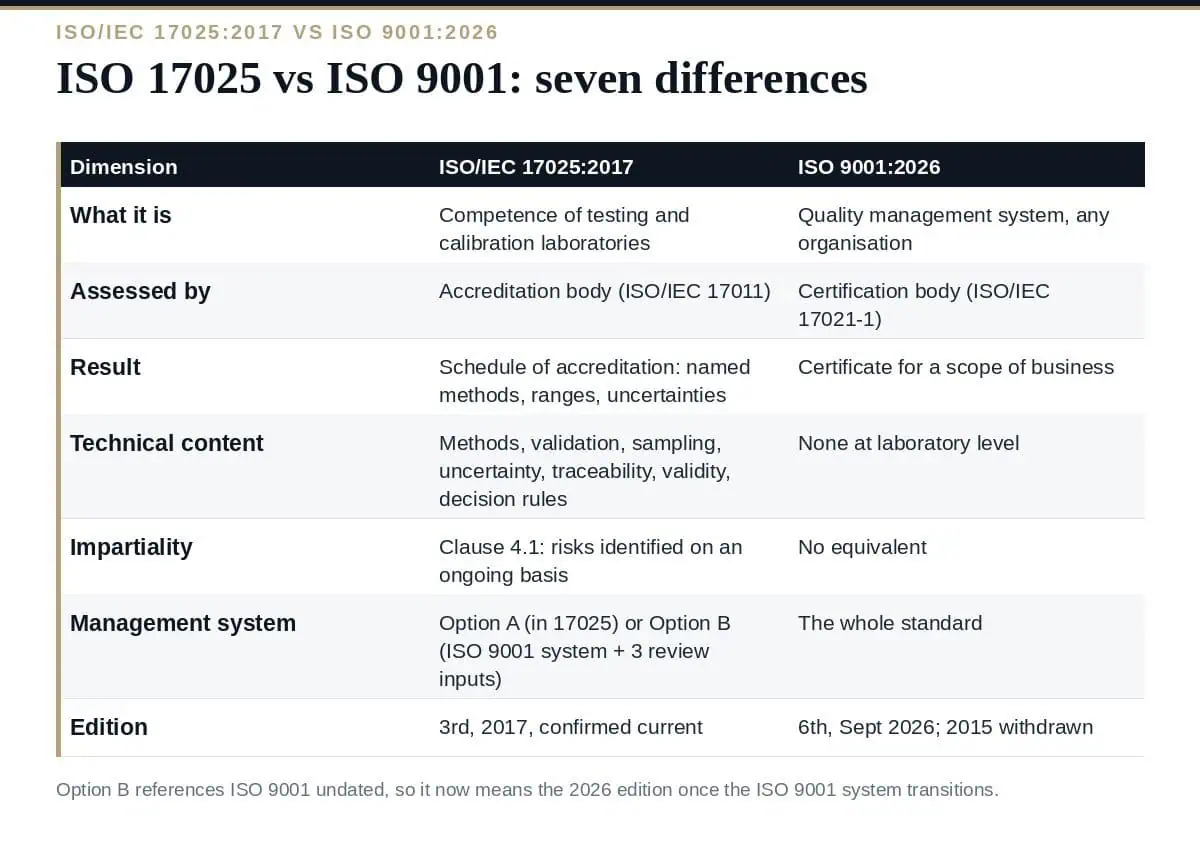
| Dimension | ISO/IEC 17025:2017 | ISO 9001:2026 |
|---|---|---|
| What it is | Requirements for the competence, impartiality and consistent operation of testing and calibration laboratories | Requirements for a quality management system for any organisation |
| Assessed by | An accreditation body operating under ISO/IEC 17011 — UKAS, A2LA, ANAB, DAkkS, NABL, SANAS | A certification body accredited under ISO/IEC 17021-1 |
| Result | Accreditation for a schedule of named tests or calibrations, measurands, ranges and uncertainties | A certificate for a defined scope of business activity |
| Structure | Clauses 4 general (impartiality, confidentiality), 5 structural, 6 resource, 7 process, 8 management system | Harmonized Structure: clauses 4 context to 10 improvement |
| Technical content | Method selection, verification and validation; sampling; measurement uncertainty; metrological traceability; ensuring validity of results; decision rules; reporting | None — process control and monitoring resources at a generic level |
| Management system | Option A (requirements in 17025) or Option B (an ISO 9001 system that supports clauses 4 to 7, plus three 17025-specific additions) | The whole standard |
| Current edition | Third edition, 2017, confirmed as current with no revision in progress | Sixth edition, September 2026, 36 pages; the 2015 edition is withdrawn, with a transition period set by the IAF |
The first ISO 17025 vs ISO 9001 difference is what is being judged. ISO 9001 asks whether the organisation has a system that produces conforming output. ISO 17025 asks whether the laboratory is competent to produce valid results for each activity on its schedule — and the assessor tests that with the method, the instrument and the analyst in front of them. A laboratory can have an excellent quality system and be incompetent at a particular calibration; ISO 9001 would pass it and ISO 17025 would not accredit that line of the schedule. Our guide to ISO 17025 covers why accreditation is granted for a schedule, not for the standard.
Certification bodies audit management systems and are themselves accredited under ISO/IEC 17021-1; accreditation bodies assess conformity assessment bodies under ISO/IEC 17011 and operate under the ILAC arrangement. A laboratory is therefore accredited, not certified, and “ISO 17025 certified” is the wrong phrase in a way that matters: work outside the schedule is not accredited work, however good the system. An ISO 9001 certificate covers everything in its scope statement; an ISO 17025 schedule covers exactly what it lists.
The technical clauses are where ISO 17025 vs ISO 9001 stops being a comparison. Clauses 6 and 7 of ISO 17025 have no counterpart in ISO 9001. Clause 6 requires competent personnel with authorisation for specific activities, controlled facilities, equipment with calibration and intermediate checks, metrological traceability to the SI, and control of externally provided products and services.
Clause 7 runs the laboratory process: review of requests and contracts including the decision rule (7.1), selection, verification and validation of methods (7.2), sampling (7.3), handling of items (7.4), technical records (7.5), evaluation of measurement uncertainty (7.6), ensuring the validity of results through quality control and interlaboratory comparison (7.7), reporting including statements of conformity (7.8), complaints (7.9), nonconforming work (7.10) and control of data (7.11). Our guides to method validation, measurement uncertainty and decision rules cover the three most examined.
ISO 17025 clause 4.1 requires the laboratory to be impartial, its management to be committed to impartiality, to identify risks to impartiality on an ongoing basis and to eliminate or minimise them. ISO 9001 has no equivalent, because a manufacturer is expected to be partial to its own products; a laboratory testing them is not. Our guide to laboratory impartiality covers clause 4.1.
ISO 17025’s clause 8 offers two routes. Option A sets out the management system requirements within the standard — documentation, control of documents and records, risks and opportunities, improvement, corrective action, internal audit and management review. Option B states that a laboratory that has established and maintains a management system “in accordance with the requirements of ISO 9001”, and that is capable of supporting and demonstrating consistent fulfilment of clauses 4 to 7, also fulfils the intent of the clause 8 management system requirements. Three readings are routinely wrong.
ISO 9001 certification is not required — a system in accordance with ISO 9001 is; certification is evidence, not the test. The system’s scope must cover the laboratory activities; a group certificate that excludes the laboratory does not support Option B. And ISO 9001 management review is not sufficient on its own: ISO 17025 clause 8.9.2 requires inputs ISO 9001 does not name — the outcome of impartiality risk identification, results of proficiency testing and interlaboratory comparisons, and changes in the volume and type of laboratory work — which an Option B laboratory must add.
ISO 9001:2026, the sixth edition, was published in September 2026 and withdrew ISO 9001:2015. ISO 17025’s Option B references ISO 9001 undated, so a laboratory relying on Option B now relies on the 2026 edition once its ISO 9001 system transitions: clause 6.1 split into determining, risks and opportunities; seven considerations under planning of changes; quality culture and ethical behaviour among the leadership commitments; clause 10 reduced to continual improvement and nonconformity and corrective action. ISO/IEC 17025:2017 itself is confirmed as current with no revision in progress, so the movement in an ISO 17025 vs ISO 9001 pairing is entirely on the 9001 side. Our guide to ISO 9001:2026 covers the changes.
An ISO 9001 certificate lets an organisation state that its quality management system is certified. An ISO 17025 schedule lets a laboratory issue reports bearing the accreditation symbol for the listed activities, and only those; a report on unlisted work must not carry it. For customers, regulators and courts the accredited report is the product, which is why the schedule is negotiated line by line and the certificate is a paragraph.
| Situation | Standard(s) | Why |
|---|---|---|
| Independent testing or calibration laboratory whose customers require accredited results | ISO 17025 | The schedule is the commercial product; ISO 9001 adds little |
| Laboratory inside a manufacturer certified to ISO 9001 | ISO 17025 with Option B | The corporate system carries clause 8; clauses 4 to 7 are the laboratory’s own |
| Contract laboratory whose customers’ supplier-approval policy names ISO 9001 | Both, or ISO 17025 with Option A plus an ISO 9001 certificate | Procurement policies often list the certificate; accreditation satisfies the technical reviewer |
| Medical laboratory | ISO 15189, not ISO 17025 | Patient-care examinations are accredited to ISO 15189; see our comparison of the two |
What is the difference between ISO 17025 vs ISO 9001?
ISO 9001 is a quality management system standard certified by a certification body for a scope of business; ISO/IEC 17025 is a competence standard for testing and calibration laboratories, assessed by an accreditation body method by method and granted as a schedule of accreditation. ISO 17025 adds technical requirements — methods, traceability, uncertainty, validity of results, decision rules — and an impartiality requirement that ISO 9001 has no equivalent for.
Does ISO 17025 include ISO 9001?
Its clause 8 Option B lets a laboratory with a management system in accordance with ISO 9001 satisfy the management system requirements, with three additions to management review. Option A provides the requirements within ISO 17025 instead. Neither makes the laboratory ISO 9001 certified.
Is ISO 17025 harder than ISO 9001?
Different rather than harder: ISO 17025 demands demonstrated technical competence, traceable calibration and uncertainty budgets that ISO 9001 never asks for, while ISO 9001 applies to the whole organisation rather than the laboratory.
Which ISO 9001 edition does Option B refer to?
ISO 9001 undated, so the current edition — ISO 9001:2026 since September 2026, with the 2015 edition withdrawn and a transition period set by the IAF.
Can a laboratory be certified to ISO 17025?
No. Laboratories are accredited to ISO/IEC 17025 for a defined schedule; there is no ISO 17025 certificate equivalent to an ISO 9001 one.
Read ISO 17025 vs ISO 9001 as competence against system: accreditation for a schedule against certification for a scope. A laboratory that must issue accredited results needs ISO 17025 whatever else it holds; a laboratory inside an ISO 9001 organisation uses Option B for clause 8 and adds the three management review inputs; and everyone relying on Option B now tracks the 2026 edition of ISO 9001, because ISO 17025 itself is not moving.
The Management System Option Determination Procedure, the Scope of Accreditation Statement and Schedule, the Impartiality Policy and the Method Validation Procedure are in the ISO 17025 Toolkit, or start with the free templates.

September 20, 2026
September 19, 2026

September 19, 2026

September 19, 2026

September 19, 2026

