CART
ISO 15189 vs ISO 17025 is a comparison between two laboratory accreditation standards that share a skeleton and differ where the work is. ISO 15189:2022 is written for medical laboratories examining human samples for the care of patients; ISO/IEC 17025:2017 is written for testing and calibration laboratories whose customer is whoever submitted the item. Both are accredited rather than certified, both follow the same five-clause structure — general, structural, resource, process and management system requirements — and the fourth edition of ISO 15189 was deliberately rebuilt on the 17025 format.
But ISO 15189 adds a clause on the patient that 17025 has no equivalent for, names a laboratory director, moves risk management into governance, and absorbs point-of-care testing; 17025 covers sampling, decision rules and calibration in a way a medical laboratory rarely needs. This guide sets out the seven differences that decide which standard a laboratory is assessed against, where the two overlap clause by clause, and the cases — including the IVDR’s in-house device exemption — where the choice is made for you.
Free gap assessment
Are you ready for the 2026 edition of ISO 9001?
Score yourself against the new edition, free, including the risk and opportunity split and the clause 10 renumbering that breaks converted checklists.
Run the free ISO 9001 gap assessment → or View premium report sample
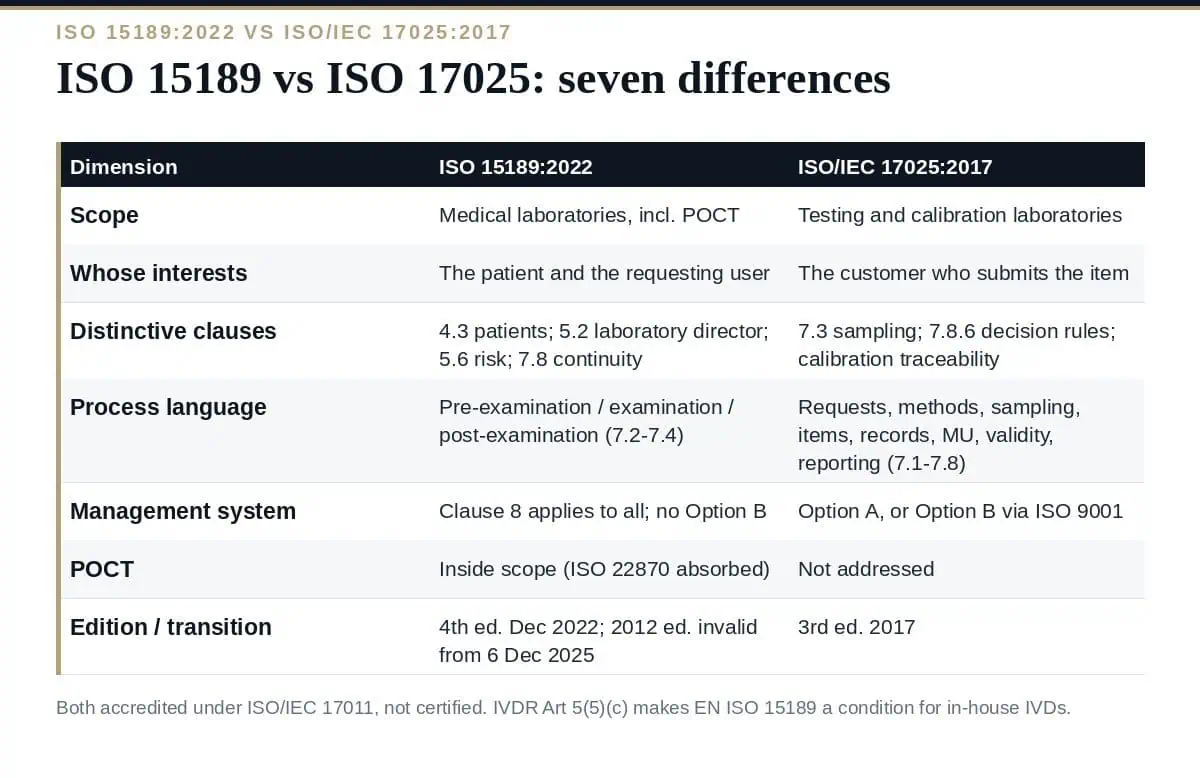
| Dimension | ISO 15189:2022 | ISO/IEC 17025:2017 |
|---|---|---|
| Scope | Medical laboratories — quality and competence in examining human samples, including point-of-care testing | Testing and calibration laboratories of any discipline |
| Whose interests | The patient, who supplies the sample and carries the risk, and the users who request and receive results | The customer who submits the item and receives the report |
| Structure | Clauses 4 general, 5 structural and governance, 6 resource, 7 process, 8 management system — the 17025 format, adopted in 2022 | Clauses 4 general, 5 structural, 6 resource, 7 process, 8 management system |
| Distinctive clauses | 4.3 requirements regarding patients; 5.2 laboratory director; 5.6 risk management; 7.8 continuity and emergency preparedness; POCT integrated (ISO 22870 withdrawn) | 7.3 sampling; 7.8.6 decision rules and statements of conformity; 6.5 metrological traceability for calibration; Option B management system via ISO 9001 |
| Process language | Pre-examination, examination, post-examination (7.2–7.4) | Review of requests, method selection and validation, sampling, handling of items, technical records, uncertainty, validity of results, reporting (7.1–7.8) |
| Assessed by | Accreditation bodies under ISO/IEC 17011; ILAC MRA scope for medical laboratories | Accreditation bodies under ISO/IEC 17011; ILAC MRA scope for testing and calibration |
| Current edition | Fourth edition, published 6 December 2022; the 2012 edition ceased to be valid on 6 December 2025 | Third edition, 2017 |
The first ISO 15189 vs ISO 17025 difference is who the work is for. In ISO 17025 the customer and the subject of the work are the same party: someone sends a sample or an instrument and gets a report. In ISO 15189 they are not. The clinician requests and receives; the patient supplies the sample and lives with the result.
That split is why ISO 15189 clause 4.3, “Requirements regarding patients”, exists and why ISO 17025 has nothing like it — information to patients, consent proportionate to the examination, access and reasonable adjustments, dignity during collection, and the right to complain. UKAS’s own gap analysis for the 2022 transition marks 4.3 as a new requirement with no 2012 equivalent, and it is the clause that most clearly separates the two standards. Our guide to ISO 15189 covers what it asks for in practice.
ISO 15189 clause 5.2 requires a laboratory director with defined competence, authority and responsibility — a real appointment with qualifications appropriate to the disciplines in scope, professional registration where required, and a deputy. ISO 17025 clause 5 requires laboratory management with responsibility and authority, but names no individual role and sets no professional qualification. A medical laboratory cannot transfer its 17025-style “management” arrangement across and expect it to satisfy 5.2.
Both standards ask the laboratory to address risks and opportunities in clause 8.5. ISO 15189 adds clause 5.6, risk management, among the structural and governance requirements, and the foreword names “increased emphasis on risk management” as one of the three main changes of the 2022 edition. UKAS marks 5.6, 8.5 and 7.1 as major changes from 2012, and 5.6(b) as new.
The 15189 view is that risk to patients is the director’s responsibility, aligned to the principles of ISO 22367 on medical laboratory risk management; the 17025 view is that risk is a management-system input. In an ISO 15189 vs ISO 17025 assessment, that difference shows up as whether the risk register is reviewed by the director or by the quality manager.
The ISO 15189 vs ISO 17025 gap is widest before the sample reaches the bench. ISO 17025 clause 7.3 covers sampling as a laboratory activity with a plan and a method, and clause 7.4 the handling of test items. ISO 15189 clause 7.2 covers pre-examination processes — information for patients and users, requests, primary sample collection and handling including consent, transport, receipt, and pre-examination handling — because the majority of medical laboratory errors are pre-examination and most of those steps are performed by people the laboratory does not employ. Our guide to pre-analytical errors covers why that clause is where medical laboratories lose findings. The equivalent 17025 concern is the sampling plan and the item’s condition on receipt.
Both standards require method verification and validation, measurement uncertainty, and ensuring the validity of results through internal quality control and interlaboratory comparison — ISO 15189 at 7.3.2, 7.3.3, 7.3.4 and 7.3.7, ISO 17025 at 7.2, 7.6 and 7.7. Two 17025 features have no 15189 counterpart: clause 7.8.6, decision rules and statements of conformity, which a testing laboratory needs whenever it reports pass or fail against a specification, and calibration-specific traceability and uncertainty requirements. ISO 15189 instead adds biological reference intervals and clinical decision values at 7.3.5, and critical result reporting at 7.4.1.3, which a testing laboratory never issues. Our guides to measurement uncertainty and decision rules cover the 17025 side.
ISO 15189:2022 incorporated the requirements of ISO 22870, which was withdrawn, so a device on a ward operated by a nurse under the laboratory’s oversight is inside the laboratory’s accreditation. ISO 17025 has no concept of testing performed outside the laboratory by people it does not employ, beyond sampling. Our guide to point-of-care testing covers what oversight has to include.
ISO 17025 clause 8 offers Option A — the management system requirements written into the standard — or Option B, in which a laboratory with an ISO 9001 management system that supports clauses 4 to 7 is deemed to meet the clause 8 requirements. ISO 15189 offers no Option B; its clause 8 requirements apply to every medical laboratory, and the 2022 edition made several of them heavier: UKAS marks nonconforming work (7.5), corrective actions (8.7), actions to address risks (8.5), improvement (8.6) and internal audits (8.8.3) as major changes. A medical laboratory inside a hospital with ISO 9001 cannot lean on the certificate the way a testing laboratory can.
| Situation | Standard | Why |
|---|---|---|
| Clinical chemistry, haematology, microbiology, transfusion, histopathology, molecular diagnostics on patient samples | ISO 15189 | Medical laboratory examinations for patient care are its scope |
| Environmental, food, materials, forensic or product testing | ISO/IEC 17025 | Testing laboratory scope |
| Calibration of instruments, including for medical laboratories | ISO/IEC 17025 | Calibration is 17025 scope; ISO 15189 6.5 requires traceability, usually through a 17025-accredited provider |
| Health institution making in-house IVDs under IVDR Article 5(5) | ISO 15189 | Article 5(5)(c) requires the laboratory to comply with EN ISO 15189 or national accreditation rules |
| Public-health or research laboratory testing human samples without a patient care purpose | Either, by purpose | Accreditation bodies decide by the intended use of the results; many such laboratories hold 17025 |
| Point-of-care testing under laboratory oversight | ISO 15189 | ISO 22870 was absorbed into the 2022 edition |
The IVDR case is the one that surprises hospital laboratories: since 26 May 2024 the in-house device exemption depends on EN ISO 15189 compliance, which turns a quality choice into a regulatory condition. Our guide to IVDR in-house devices covers the nine conditions.
Some laboratories genuinely need both sides of the ISO 15189 vs ISO 17025 line — a hospital laboratory that also calibrates equipment for others, or a reference laboratory that tests non-clinical samples. Because the 2022 edition of ISO 15189 adopted the 17025 format, a single management system can carry both scopes with one document set: clauses 4 to 6 and 8 largely overlap, and the differences concentrate in clause 7 and the medical-specific clauses 4.3, 5.2 and 5.6. The assessment is still two scopes, two schedules and, usually, two sets of technical assessors.
What is the main difference between ISO 15189 vs ISO 17025?
Purpose. ISO 15189 is for medical laboratories examining human samples for patient care and adds requirements for patients, a laboratory director, governance-level risk management and point-of-care testing; ISO/IEC 17025 is for testing and calibration laboratories and adds sampling, decision rules and calibration traceability. Both are accredited, not certified, and share the same five-clause structure.
Can a medical laboratory be accredited to ISO 17025 instead?
Accreditation bodies assess medical laboratory examinations for patient care against ISO 15189. A laboratory testing human samples for non-clinical purposes may hold ISO 17025, and calibration activities are always 17025 scope.
Does ISO 15189 have an Option B like ISO 17025?
No. ISO 17025 lets a laboratory with an ISO 9001 system meet clause 8 through it; ISO 15189 applies its own clause 8 requirements to every medical laboratory.
Which is harder to achieve?
Neither is harder in the abstract; the effort follows the scope. ISO 15189 adds patient, director, risk and POCT obligations; ISO 17025 adds sampling, decision rules and, for calibration, uncertainty budgets that medical laboratories rarely need.
Why does the IVDR mention ISO 15189?
Article 5(5)(c) of Regulation (EU) 2017/746 makes compliance with EN ISO 15189, or national accreditation provisions, a condition of the health-institution exemption for in-house IVDs, applicable since 26 May 2024.
Choose by purpose, not by preference: patient care means ISO 15189, testing and calibration mean ISO 17025, and a hospital laboratory making its own IVDs has the choice made for it. Then build on the shared structure — the 2022 edition’s adoption of the 17025 format means the management system is common — and put the effort where the standards differ: the patient clause, the director, governance-level risk and point-of-care testing on the medical side; sampling and decision rules on the testing side.
The Laboratory Director Appointment and Responsibilities document, the Risk Management Procedure, the Method Verification and Validation Procedure and the ISO 15189 Internal Audit Checklist are in the ISO 15189 Toolkit, or start with the free templates.

October 11, 2026
October 11, 2026

October 11, 2026

October 11, 2026

October 11, 2026

