CART
IVDR vs IVDD is not a version upgrade. Directive 98/79/EC was a 24-article instrument that let most in vitro diagnostic manufacturers CE mark their own products on a declaration nobody reviewed; Regulation (EU) 2017/746 is a 113-article regulation with fifteen annexes under which only class A non-sterile devices are still self-declared and everything else goes to a notified body. The Directive sorted devices by lists — Annex II List A and List B, plus self-testing — and the Regulation sorts them by seven risk rules into classes A to D.
The Directive asked for performance evaluation data; the Regulation asks for three separate demonstrations, a post-market performance follow-up and a periodic safety update report. And the Directive exempted in-house tests almost entirely, where the Regulation attaches nine conditions. This guide sets out the eight differences that decide how much work the transition is, what the Directive still governs for legacy devices under Article 110, and where manufacturers who learned the sector under the IVDD most often misread the IVDR.
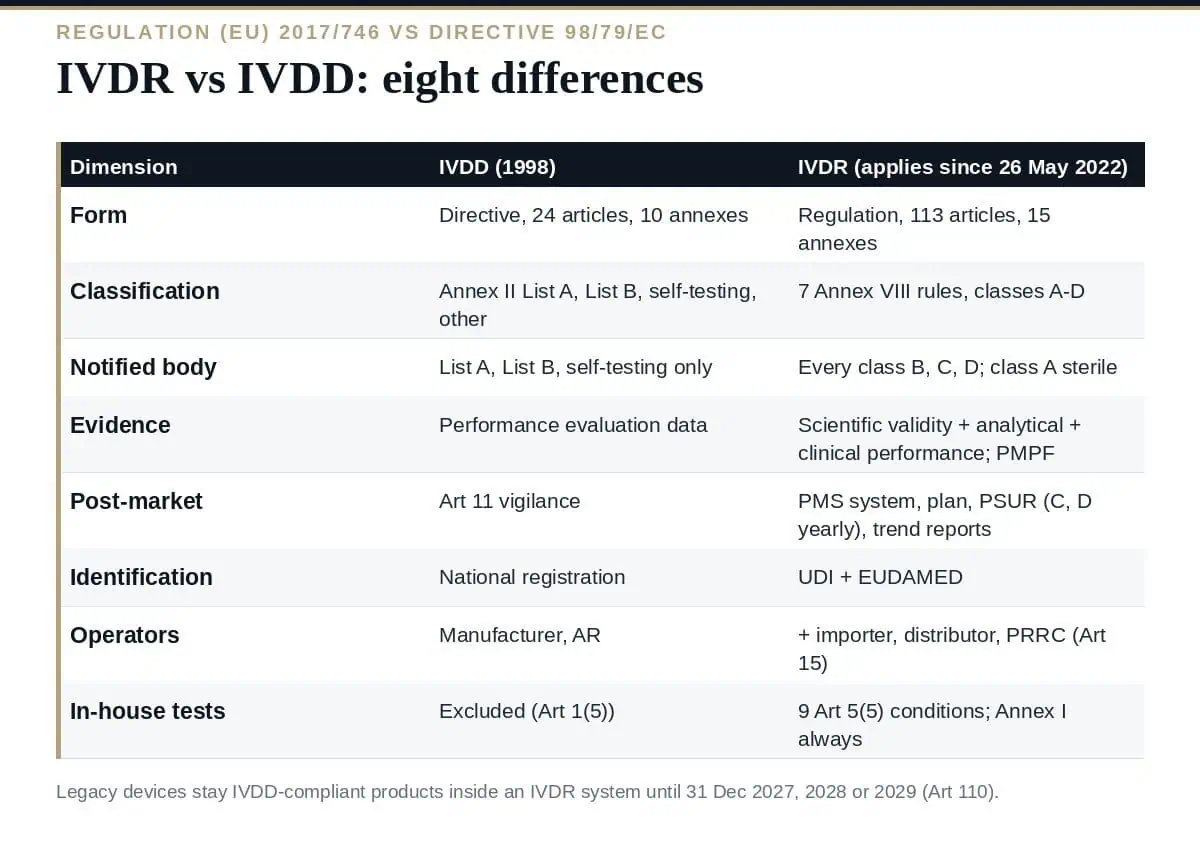
| Dimension | IVDD — Directive 98/79/EC | IVDR — Regulation (EU) 2017/746 |
|---|---|---|
| Legal form | Directive, transposed into national law; 24 articles, 10 annexes | Regulation, directly applicable; 113 articles, 15 annexes; applied from 26 May 2022, consolidated at 10 January 2025 |
| Classification | Lists: Annex II List A (ABO and rhesus grouping, HIV, HTLV, hepatitis B, C and D, vCJD), List B (Duffy and Kidd, rubella, toxoplasmosis, PKU, CMV, chlamydia, HLA, PSA and others), self-testing devices, and everything else | Seven rules in Annex VIII assigning every device to class A, B, C or D by risk to the individual and to public health |
| Notified body | Only for List A, List B and self-testing devices (Article 9); all other devices self-certified under Annex III | Every class B, C and D device, and class A sterile for sterility only (Article 48); companion diagnostics add a medicines-authority consultation |
| Clinical evidence | “Performance evaluation” data supporting the essential requirements | Article 56 and Annex XIII: scientific validity, analytical performance and clinical performance, each demonstrated and reported, plus a performance evaluation plan and post-market performance follow-up |
| Post-market surveillance | Vigilance reporting of incidents under Article 11; no structured PMS system | A PMS system, plan and report (Articles 78 to 80); PSUR at least annually for class C and D (Article 81); trend reporting (Article 83); serious incidents within 15 days (Article 82) |
| Identification and registration | National registration of manufacturers and devices | UDI on every device (Articles 24 and 26) and EUDAMED registration of actors and devices |
| Economic operators | Manufacturer and authorised representative | Manufacturer, authorised representative, importer and distributor each with defined obligations (Articles 10 to 14); a person responsible for regulatory compliance (Article 15) |
| In-house devices | Excluded outright when manufactured and used within the same health institution (Article 1(5)) | Exempt from the Regulation apart from Annex I only if all nine Article 5(5) conditions are met, including EN ISO 15189 compliance and a public declaration |
The first IVDR vs IVDD difference is how a device finds its route. Under the IVDD a manufacturer looked its analyte up. If it was on List A, the route was full quality assurance or type examination with production quality assurance; on List B, one of three notified body routes; a self-testing device had a supplementary Annex III step; anything else was self-certified.
Under the IVDR the same manufacturer applies Annex VIII: rule 1 sends transfusion and transplant screening and high-risk transmissible agents to class D, rule 2 blood grouping to C or D, rule 3 a long list of infectious disease, companion diagnostic, genetic and screening uses to class C, rule 4 self-testing to C with exceptions, rule 5 instruments and general laboratory products to A, rule 6 the residual to B, and rule 7 controls without an assigned value to B.
Our guide to IVDR classification works through the rules; MDCG 2020-16 rev.5, published September 2026, is the current Commission guidance on applying them. The practical effect is that most of the products the Directive left to self-certification landed in class B or C.
Article 48 of the IVDR involves a notified body for every device above class A non-sterile. Class B and C manufacturers have their quality management system audited under Annex IX Chapters I and III and their technical documentation assessed for at least one representative device per category (class B) or per generic device group (class C).
Class D manufacturers have every file assessed, plus EU reference laboratory verification where one is designated and batch verification. Under the IVDD the only files a notified body read were those for List A, List B and self-testing devices. That is the single largest IVDR vs IVDD change in cost and time, and it is why Article 110 gives self-certified legacy devices their own transitional bracket with application and written-agreement deadlines.
The third IVDR vs IVDD difference is evidence. The IVDD’s essential requirements asked manufacturers to show the device achieved its stated performance, and Annex III called for performance evaluation data. Article 56(3) of the IVDR requires a defined, methodologically sound procedure demonstrating scientific validity, analytical performance and clinical performance, and Annex XIII requires each in its own report inside a performance evaluation report that is updated throughout the device’s life. Post-market performance follow-up under Annex XIII Part B is mandatory unless justified. Our guide to IVDR performance evaluation covers the three limbs; the common IVDD-era mistake is a file that proves analytical and clinical performance and assumes scientific validity.
The Directive’s post-market obligation was Article 11 vigilance: report incidents, cooperate with recalls. The Regulation requires a post-market surveillance system proportionate to the class (Article 78), a plan whose content Annex III specifies (Article 79), a PMS report for class A and B devices (Article 80), a PSUR at least annually for class C and D — submitted to the notified body through EUDAMED for class D (Article 81) — trend reporting of non-serious incidents (Article 83), and serious incident reporting within 15 days of awareness (Article 82). Every one of these is an output the notified body audits.
The IVDD registered manufacturers nationally. The IVDR assigns a UDI to every device and its packaging levels (Articles 24 and 26), registers actors and devices in EUDAMED, defines importers and distributors as economic operators with verification duties of their own (Articles 13 and 14), and requires a person responsible for regulatory compliance within the manufacturer’s organisation under Article 15 — the same qualification routes as the MDR’s PRRC.
Article 1(5) of the Directive excluded devices “manufactured and used only within the same health institution” from the Directive altogether. Article 5(5) of the IVDR keeps them out of the Regulation’s other requirements only if all of nine conditions are met — no transfer to another legal entity, a quality management system, EN ISO 15189 compliance, a justification that no equivalent CE-marked device meets the patient group’s needs, information to the competent authority on request, a public declaration, class D documentation, manufacture to that documentation, and review of clinical experience — and the general safety and performance requirements of Annex I apply regardless. Our guide to IVDR in-house devices covers the conditions and their dates.
The IVDR widened the definition of an in vitro diagnostic to name software, predisposition and treatment-response testing expressly, added companion diagnostics as a defined category with their own conformity-assessment step, and in Article 4 added obligations on genetic testing information and counselling that the Directive never had. And being a regulation, it applies identically in every Member State without transposition — which removes the national variation the Directive allowed, but also removes the flexibility some national laws had given manufacturers.
The Directive is repealed, but legacy devices under Article 110 remain on the market on the condition that they “continue to comply with Directive 98/79/EC” and have no significant change in design or intended purpose. A manufacturer relying on Article 110(3a) or (3b) is therefore still an IVDD manufacturer for that device’s design and labelling, while already owing IVDR post-market surveillance, vigilance and registration. That dual status — old rules for the product, new rules for the system around it — is the shape of the IVDR vs IVDD transition for most companies until 31 December 2027, 2028 or 2029.
What is the biggest difference between IVDR vs IVDD?
Notified body involvement. Under the IVDD only Annex II List A, List B and self-testing devices needed one; under the IVDR every class B, C and D device does, and class A sterile for sterility. Classification by seven risk rules rather than lists is what moved most devices into the notified body’s scope.
Is the IVDD still in force?
It is repealed, but Article 110 of the IVDR allows legacy devices that continue to comply with the Directive to be placed on the market until 31 December 2027, 2028 or 2029 depending on class, provided six conditions including a notified body application and written agreement are met by their own earlier dates.
Did the IVDR change the definition of an IVD?
It widened it, naming software and predisposition and treatment-response testing expressly, defining companion diagnostics, and adding genetic-testing information obligations in Article 4.
Does the IVDR require a PSUR?
Yes, for class C and D devices, at least annually under Article 81, with class D PSURs submitted to the notified body through EUDAMED. Class A and B devices produce a post-market surveillance report under Article 80. The IVDD had no equivalent.
Are in-house tests still exempt?
Only partly. Article 5(5) exempts them from the Regulation’s other requirements when all nine conditions are met, but Annex I’s general safety and performance requirements always apply. The Directive excluded them outright.
Read IVDR vs IVDD as a change of model rather than of wording: classify by rule, expect a notified body for anything above class A non-sterile, build the three-limb performance evaluation and the post-market system the Regulation audits, register actors and devices, appoint the PRRC, and manage any legacy device as an IVDD product inside an IVDR system until its Article 110 date.
The Device Classification Procedure, the Performance Evaluation Plan and Report templates, the Post-Market Surveillance System Procedure and the Legacy Device Transition Plan are in the EU IVDR Toolkit, or start with the free templates.


September 20, 2026
September 19, 2026

September 19, 2026

September 19, 2026

September 19, 2026

