CART
IVDR technical documentation looks like its medical device cousin until Section 6, and then it stops resembling it entirely. Article 10(4) of Regulation (EU) 2017/746 requires every manufacturer to draw up and keep up to date technical documentation containing “the elements set out in Annexes II and III”; Annex II has six sections and Annex III two, in the same order as the MDR.
But the IVDR’s Section 6 is written for assays: it demands specimen-type data, trueness and precision, analytical sensitivity and specificity, metrological traceability, measuring range, cut-off derivation, three-lot shelf-life studies, in-use and shipping stability, and a performance evaluation report that contains the scientific validity, analytical performance and clinical performance reports rather than citing them. This guide sets out the eight parts of the file as the consolidated text of 10 January 2025 lists them, the assay-specific evidence Section 6 requires, which files the notified body reads under Article 48, and the six failures that turn a technical documentation assessment into a second round.
Free gap assessment
How much of ISO 13485 could you evidence today?
Score clauses 4 to 8, free, with the FDA QMSR and EU MDR duties kept separate so you can see what is the standard and what is the regulator.
Run the free ISO 13485 gap assessment → or View premium report sample
The obligation mirrors the MDR’s: documentation that “shall be such as to allow the conformity of the device with the requirements of this Regulation to be assessed”, including the Annex II and III elements, presented — in Annex II’s opening words — “in a clear, organised, readily searchable and unambiguous manner”.
Article 10(7) sets retention at least 10 years after the last device covered by the declaration of conformity is placed on the market, and requires the documentation, or a summary of it, on a competent authority’s request; a manufacturer outside the Union must keep it permanently available to its authorised representative. Unlike the MDR, the IVDR has no custom-made device carve-out and no 15-year implantable rule; every IVD manufacturer holds a full file for 10 years. Our guide to the EU IVDR covers the Regulation as a whole.
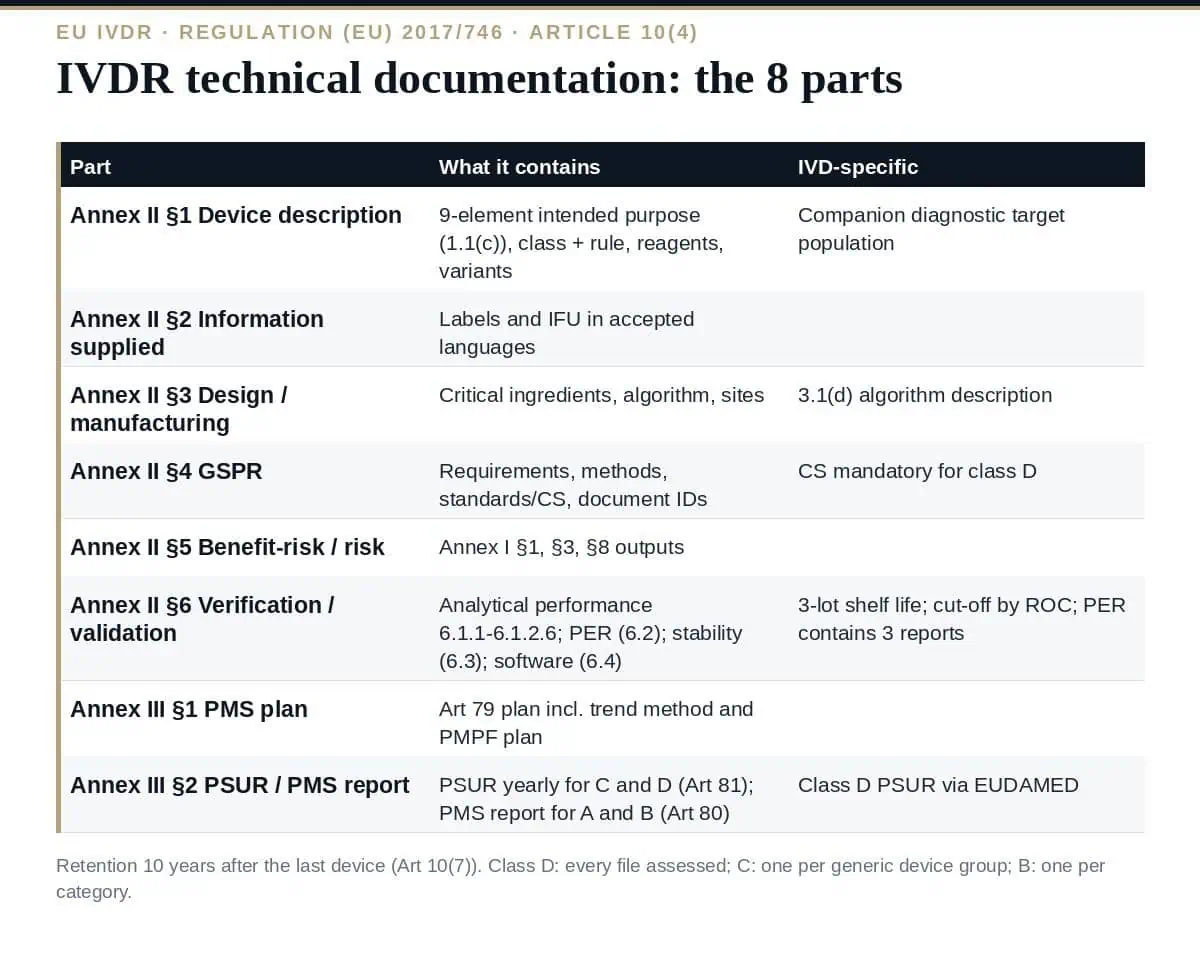
| Section | What the IVDR technical documentation must contain | IVD-specific detail |
|---|---|---|
| 1. Device description and specification | Trade name and general description; Basic UDI-DI; the intended purpose broken down under 1.1(c) into what is detected or measured, the function (screening, monitoring, diagnosis, prognosis, prediction, companion diagnostic), the disorder or risk factor, automated or not, qualitative or quantitative, specimen types, testing population, intended user and — for companion diagnostics — the target population and medicinal product; the assay principle; the qualification rationale; the risk class with the Annex VIII rule justified; components and reactive ingredients such as antibodies, antigens and primers; specimen collection materials; instrument–assay pairings; software; every configuration and variant; accessories. 1.2: previous generations and similar devices | The nine-part intended purpose statement in 1.1(c) is the IVDR’s own; it is what every performance claim is measured against |
| 2. Information supplied by the manufacturer | The complete set of labels and the instructions for use in the languages accepted where the device is sold | |
| 3. Design and manufacturing information | 3.1 Design: critical ingredients; for instruments, subsystems, analytical technology, hardware and software; the whole-system overview; for software, the data interpretation methodology — the algorithm; for self-testing and near-patient devices, the design aspects that make them suitable. 3.2 Manufacturing: production, assembly, final testing and packaging; every site including suppliers and subcontractors | The algorithm description in 3.1(d) is where software-driven IVDs are most often thin |
| 4. General safety and performance requirements | The applicable Annex I GSPRs and why others do not apply; the method for each; harmonised standards, common specifications or other solutions; the precise identity of the controlled documents evidencing each, cross-referenced | Common specifications exist for class D devices and are mandatory unless equivalence is justified |
| 5. Benefit-risk analysis and risk management | The Annex I Section 1 and 8 benefit-risk analysis; the solutions adopted and results of Annex I Section 3 risk management |
Section 6 is where IVDR technical documentation earns its own guide. Annex II specifies the analytical performance evidence subsection by subsection.
| Annex II 6.x | Required content | What reviewers look for |
|---|---|---|
| 6.1.1 Specimen type | Every specimen type analysed, its stability, transport conditions and the time between sampling and analysis for time-critical methods | Matrix-by-matrix data, not a single serum study extended to plasma by assertion |
| 6.1.2.1 Accuracy | Trueness — against a certified reference material or comparative method — and precision as repeatability and reproducibility studies | The reference material named; precision at more than one level |
| 6.1.2.2 Analytical sensitivity | Study design and results, specimen preparation, analyte levels and how they were established, replicates per concentration, the calculation used | Replicate counts and the statistic, not just the limit |
| 6.1.2.3 Analytical specificity | Interference and cross-reactivity studies: substance, concentration, specimen type, analyte level, result — covering medicinal products, foods, preservatives, haemoglobin, lipids, bilirubin, proteins, and structurally similar analytes or mimicking conditions | A rationale for the interferent panel chosen |
| 6.1.2.4 Metrological traceability | Traceability of calibrator and control material values | The chain to the reference |
| 6.1.2.5 Measuring range | The range, linear or not, the limit of detection and how both were established; high-dose hook effect and its mitigation where applicable | Hook-effect data for sandwich immunoassays |
| 6.1.2.6 Assay cut-off | The population studied with demographics and inclusion criteria, specimen characterisation, the statistical method such as ROC, and any grey zone | A cut-off derived from the intended population, not transferred |
| 6.1.3 / 6.2 | The analytical performance report; the performance evaluation report containing the scientific validity, analytical and clinical performance reports with an assessment of them; clinical performance study documents included or fully referenced | Three limbs present, each with its own report inside the PER |
| 6.3 Stability | Claimed shelf life on at least three lots manufactured under conditions essentially equivalent to routine production, with protocol, acceptance criteria and intervals and the accelerated method where used; in-use stability on one lot including open-vial or on-board stability and calibration stability where claimed; shipping stability on one lot under variable conditions including extreme heat and cold | Three lots for shelf life; simulated shipping that includes both temperature extremes |
| 6.4 Software | Evidence of validation of the software as used in the finished device, in-house and in an actual user environment, addressing every hardware configuration and operating system | |
| 6.5 Specific cases | Sterile or microbiologically controlled devices; tissues, cells and substances of animal, human or microbial origin; measuring function; devices connected to other equipment |
The three-lot rule in 6.3.1 is the most frequently missed number in the annex, and the performance evaluation report structure in 6.2 the most frequently misread sentence: the PER “includes the reports on the scientific validity, the analytical and the clinical performance” — it contains them. Our guide to IVDR performance evaluation covers the three limbs and their permitted sources.
Annex III is the part of IVDR technical documentation that keeps changing after certification. Section 1 is the post-market surveillance plan required by Article 79, and it specifies both the inputs — serious incidents and field safety corrective actions, non-serious incidents and undesirable side-effects, trend data, literature and registers, user and distributor feedback, information about similar devices — and the plan’s minimum content: a proactive collection process, assessment methods, indicators and thresholds for reassessing benefit-risk, complaint investigation tools, the Article 83 trend-reporting protocol with its statistical method and observation period, communication methods, references to the Article 78, 79 and 81 procedures, corrective-action procedures, traceability tools, and a PMPF plan under Annex XIII Part B or a justification for its absence.
Section 2 is the output: the PSUR under Article 81 — at least annually for class C and D, submitted through EUDAMED to the notified body for class D — or the post-market surveillance report under Article 80 for class A and B. Both are part of the technical documentation, and both age.
| Class | Technical documentation assessment under Article 48 | Additional step |
|---|---|---|
| D | Every device, Annex IX Chapters I, II (except Section 5) and III, or Annex X with XI | EU reference laboratory testing where designated; expert panel consultation for a first-of-type without CS; batch verification |
| C | At least one representative device per generic device group (Annex IX Section 4) | Self-testing and near-patient: Annex IX 5.1 for the device; companion diagnostics: Annex IX 5.2 with medicines-authority or EMA consultation for every device |
| B | At least one representative device per category of devices | Self-testing and near-patient: Annex IX 5.1 |
| A sterile | Sterility aspects only | |
| A | None — self-declared on Annexes II and III |
Sampling does not reduce the IVDR technical documentation obligation: a class B or C manufacturer holds a complete Annex II and III file for every device, because the notified body samples further files during surveillance and the competent authority can request any of them under Article 10(7). Our guide to the IVDR notified body covers the routes and the engagement.
What does IVDR technical documentation contain?
The elements of Annex II — device description and specification, information supplied by the manufacturer, design and manufacturing information, the GSPR demonstration, benefit-risk and risk management, and product verification and validation including analytical performance, the performance evaluation report, stability and software — plus Annex III, the post-market surveillance plan and the PSUR or PMS report. Article 10(4) requires all of it.
How does it differ from MDR technical documentation?
The structure is the same eight parts, but Section 6 is written for assays: specimen types, trueness and precision, analytical sensitivity and specificity, traceability, measuring range, cut-off, three-lot shelf life, in-use and shipping stability, and a performance evaluation report containing three reports rather than a clinical evaluation report. There is no custom-made carve-out and no 15-year implantable retention.
How many lots are needed for shelf-life studies?
At least three, manufactured under conditions essentially equivalent to routine production, under Annex II Section 6.3.1. They need not be consecutive. In-use and shipping stability need one lot each.
Does the notified body assess every file?
For class D, yes. For class C it assesses at least one representative device per generic device group, for class B one per category, with further sampling during surveillance; self-testing, near-patient and companion diagnostic devices carry additional assessments under Annex IX Sections 5.1 and 5.2.
How long must the file be kept?
At least 10 years after the last device covered by the declaration of conformity is placed on the market, under Article 10(7), available to competent authorities in full or in summary on request.
Build IVDR technical documentation as eight parts with a Section 6 written for the assay: a nine-element intended purpose, analytical performance evidenced subsection by subsection, a performance evaluation report that contains its three reports, stability on three lots, a described algorithm, and a post-market plan whose PSUR or PMS report is current. Then hold a complete file for every device, sampled or not.
The Technical Documentation Procedure, the Technical Documentation on Post-Market Surveillance template, the Technical Documentation Completeness Matrix, the Performance Evaluation Report Template and the Post-Market Performance Follow-up Plan are in the EU IVDR Toolkit, or start with the free templates.


October 11, 2026

October 11, 2026

October 11, 2026

October 11, 2026

October 11, 2026

