CART
IVDR in-house devices — the laboratory-developed tests a hospital makes and uses on its own patients — are the part of Regulation (EU) 2017/746 that reaches into institutions that never thought of themselves as manufacturers. Under the Directive they were excluded outright. Under Article 5(5) of the IVDR they are exempt from the Regulation’s other requirements only while all nine listed conditions are met, and the general safety and performance requirements of Annex I apply to them regardless.
Seven of the nine conditions have applied since 26 May 2024; the ninth in order of difficulty — the justification that no equivalent CE-marked device meets the patient group’s needs — applies from 31 December 2030 after Regulation (EU) 2024/1860 moved it. This guide sets out the nine conditions as the consolidated text of 10 January 2025 words them, what Annex I demands even inside the exemption, the two dates, the industrial-scale limit, what MDCG 2023-1 adds, and how a laboratory builds the evidence a competent authority can ask for at any time.
Free gap assessment
How much of ISO 13485 could you evidence today?
Score clauses 4 to 8, free, with the FDA QMSR and EU MDR duties kept separate so you can see what is the standard and what is the regulator.
Run the free ISO 13485 gap assessment → or View premium report sample
The text is precise about the shape of the exemption: “With the exception of the relevant general safety and performance requirements set out in Annex I, the requirements of this Regulation shall not apply to devices manufactured and used only within health institutions established in the Union, provided that all of the following conditions are met.” Three things follow. The exemption is from conformity assessment, CE marking, UDI, registration and the rest — not from Annex I.
It is conditional on all nine conditions, continuously. And it belongs to health institutions established in the Union; Article 5(4) confirms that devices manufactured and used within a health institution are “considered as having been put into service”, so the Regulation’s reach is not in doubt. The last subparagraph adds the ceiling: “This paragraph shall not apply to devices that are manufactured on an industrial scale.” Our guide to the EU IVDR covers the Regulation as a whole.
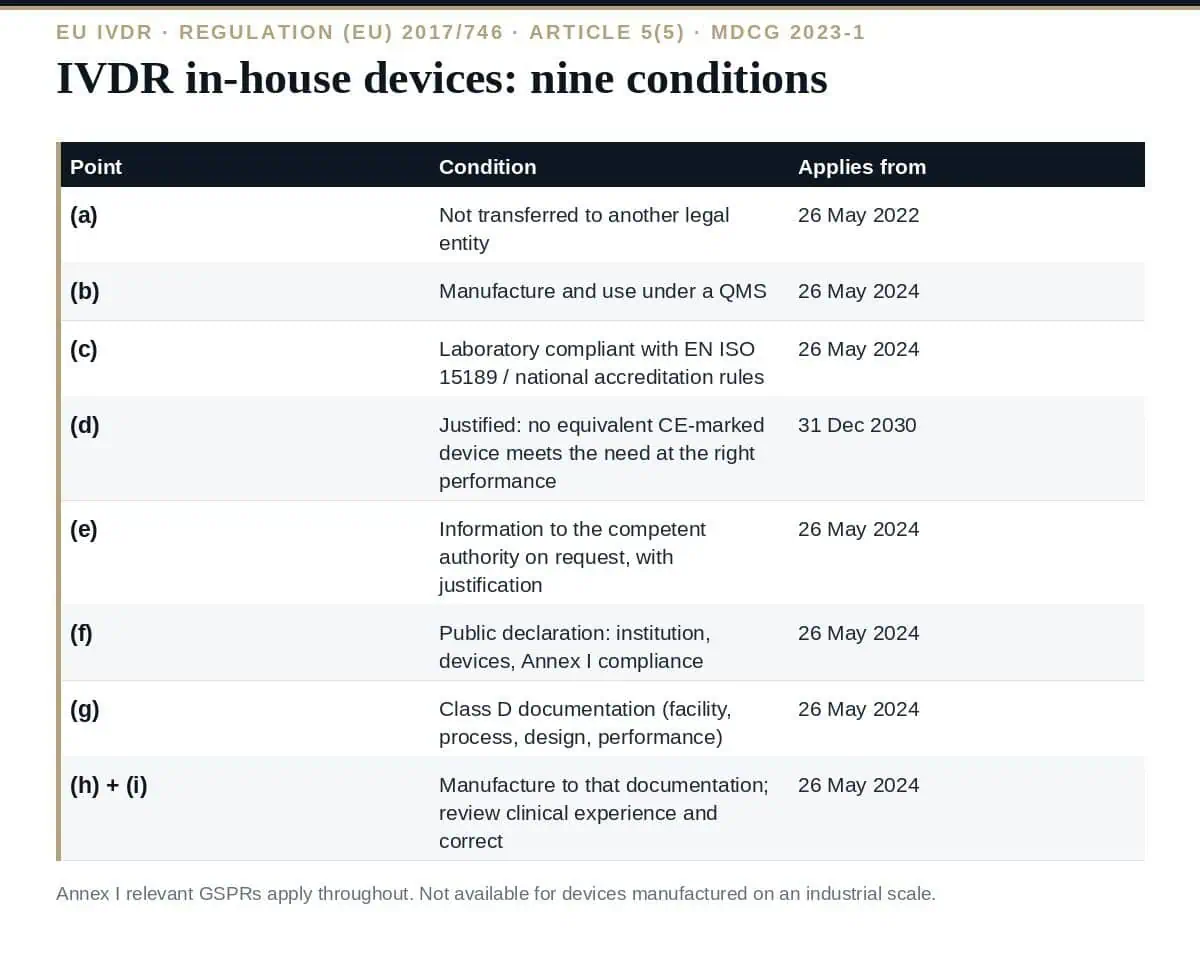
| Point | Condition (Article 5(5)) | Applies from | Evidence |
|---|---|---|---|
| (a) | The devices are not transferred to another legal entity | 26 May 2022 | Scope of use confined to the institution; a hospital group with separate legal entities has to check where the legal boundary falls |
| (b) | Manufacture and use occur under appropriate quality management systems | 26 May 2024 | A QMS covering the design, validation, production and use of the test |
| (c) | The laboratory is compliant with EN ISO 15189 or, where applicable, national provisions including national accreditation provisions | 26 May 2024 | ISO 15189 accreditation, or compliance where national rules substitute |
| (d) | The institution justifies in its documentation that the target patient group’s specific needs cannot be met, or cannot be met at the appropriate level of performance, by an equivalent device available on the market | 31 December 2030 (moved by Regulation (EU) 2024/1860) | A documented market search and a performance comparison per test |
| (e) | The institution provides information on request to its competent authority on the use of such devices, including a justification of their manufacturing, modification and use | 26 May 2024 | A register of in-house devices with the justification per device, ready to send |
| (f) | The institution draws up and makes publicly available a declaration with its name and address, the details necessary to identify the devices, and a statement that they meet the Annex I GSPRs — or, where not fully met, which requirements are not met with a reasoned justification | 26 May 2024 | A published declaration, usually on the institution’s website |
| (g) | For class D devices, documentation enabling an understanding of the manufacturing facility, process, design and performance data including intended purpose, detailed enough for the competent authority to ascertain Annex I compliance; Member States may extend this to class A, B and C | 26 May 2024 | A technical file for every in-house class D test; check national law for extension |
| (h) | The institution takes all necessary measures to ensure the devices are manufactured in accordance with the (g) documentation | 26 May 2024 | Production records tied to the documented process |
| (i) | The institution reviews experience gained from clinical use and takes all necessary corrective actions | 26 May 2024 | A review cycle with recorded actions — a post-market surveillance process in all but name |
The dates come from Article 113(3): point (i) of that paragraph applies points (b), (c) and (e) to (i) from 26 May 2024, and point (j) applies point (d) from 31 December 2030. Point (a) has applied since the Regulation’s date of application. Regulation (EU) 2022/112 set the original staggered dates; Regulation (EU) 2024/1860 moved the condition (d) date from 26 May 2028 to 31 December 2030.
The exemption’s opening clause keeps the “relevant” general safety and performance requirements in force for IVDR in-house devices. In practice that means the risk management system of Annex I Section 3, the performance requirements — analytical and clinical performance appropriate to the intended purpose — and the labelling and information requirements to the extent they are relevant to a test used only by the institution’s own staff. Condition (f)’s declaration is the public statement that those requirements are met, and it allows the institution to declare which are not fully met with a reasoned justification, which is the mechanism for a test whose performance is limited by the state of the art.
MDCG 2023-1, published January 2023, walks through Annex I chapter by chapter — the risk management system of Chapter I, the design, manufacture and performance requirements of Chapter II, and the parts of Chapter III on supplied information that still matter, such as operating protocols, expiry dates, storage conditions and lot identification — and adds that the proof of Annex I compliance must be documented and regularly updated because it is what competent authorities use to assess Article 5(5).
The Regulation does not define industrial scale, and MDCG 2023-1 section 3.11 says so directly, then offers factors rather than a number: “a combination of many factors to be considered on a case-by-case basis, including e.g. volume of production, commercial aspects and manufacturing process”. It distinguishes industrial scale from “mass-produced”, states that the manufacturing process “should not produce more than the estimated number of required devices”, and notes that analysing a large number of patient specimens does not by itself make an in-house IVD industrial.
A central laboratory producing an assay beyond its own estimated need, or producing it commercially, is the case at risk. An institution that crosses the line loses the exemption entirely and becomes a manufacturer under Article 10, with a notified body ahead of it for anything above class A.
Condition (d) is the reason the IVDR in-house devices date moved twice. It requires, per device, a documented justification that no equivalent CE-marked device meets the patient group’s needs at the appropriate performance. For rare diseases and novel markers the justification writes itself; for a routine analyte where the laboratory prefers its own method, it does not. Laboratories that wait for 2030 will discover the size of the exercise late. The workable approach is to add the market-search record to the in-house device register now, review it when the register is reviewed, and retire tests the search does not support before the date makes the decision for them.
The IVDR vs IVDD comparison sets this against the Directive’s Article 1(5) exclusion, which asked for none of it.
Are IVDR in-house devices exempt from the Regulation?
Partly. Article 5(5) exempts devices manufactured and used only within EU health institutions from the Regulation’s other requirements while all nine conditions are met, but the relevant general safety and performance requirements of Annex I always apply, and devices manufactured on an industrial scale are never exempt.
Which conditions apply now?
Points (a), (b), (c) and (e) to (i) — no transfer, QMS, EN ISO 15189, information to the authority, the public declaration, class D documentation, manufacture to it, and review of clinical experience. Point (d), the justification that no equivalent CE-marked device meets the need, applies from 31 December 2030.
Does the laboratory need ISO 15189 accreditation?
Condition (c) requires compliance with EN ISO 15189 or, where applicable, national provisions including national accreditation rules. In most Member States accreditation is the accepted evidence; some national laws substitute their own requirements.
What must the public declaration contain?
The institution’s name and address, the details necessary to identify the devices, and a statement that they meet the Annex I general safety and performance requirements — or, where not fully met, which requirements are not met and a reasoned justification.
What counts as industrial scale?
The Regulation does not define it. MDCG 2023-1 calls it a case-by-case combination of factors — volume of production, commercial aspects and the manufacturing process — distinct from mass production, and says the process should not produce more than the estimated number of devices required; an institution on the wrong side of the line is a manufacturer under Article 10.
Run IVDR in-house devices as a conditional exemption with a file behind it: a register with per-device justifications, an ISO 15189-anchored QMS, class D technical documentation, a published declaration, a clinical-experience review with recorded actions, and — started now, due by 31 December 2030 — a market-search record for every test that shows why no CE-marked equivalent will do. Annex I applies throughout, and industrial scale ends the exemption.
The In-House Device Exemption Procedure, the Device Classification Procedure, the Performance Evaluation Plan Template and the Post-Market Surveillance System Procedure are in the EU IVDR Toolkit, or start with the free templates.


October 11, 2026

October 11, 2026

October 11, 2026

October 11, 2026

October 11, 2026

