CART
The PRRC — the person responsible for regulatory compliance — is the one named individual Regulation (EU) 2017/745 requires every medical device manufacturer to have, and the role is defined more tightly than most organisations realise. Article 15 fixes who qualifies (a relevant degree plus one year’s regulatory or quality experience, or four years’ experience), where the person must sit (within the organisation, except for micro and small enterprises), what the person is responsible for (five duties, from release checks to vigilance reporting), and how the person is protected (no disadvantage for doing the job). The IVDR carries an identical Article 15, and MDCG 2019-7 rev.1 of December 2023 interprets both. This guide sets out the qualification routes, the five responsibilities as the Regulation words them, the rules for small companies, authorised representatives and shared roles, and the four ways manufacturers get the appointment wrong.
Free gap assessment
How much of ISO 13485 could you evidence today?
Score clauses 4 to 8, free, with the FDA QMSR and EU MDR duties kept separate so you can see what is the standard and what is the regulator.
Run the free ISO 13485 gap assessment → or View premium report sample
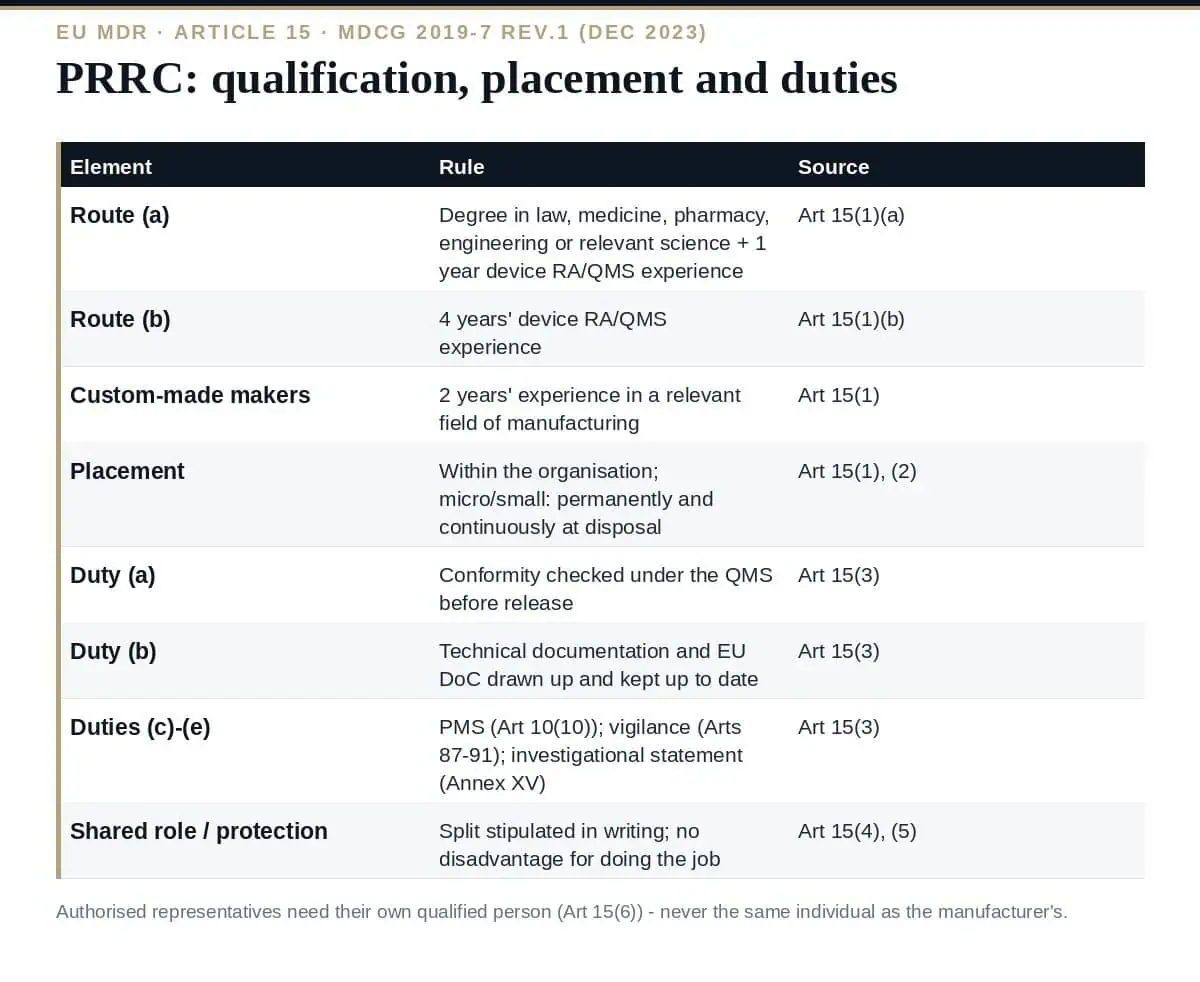
Article 15(1) requires manufacturers to “have available within their organisation at least one person responsible for regulatory compliance who possesses the requisite expertise in the field of medical devices”, demonstrated by one of two routes.
| Route | Article 15(1) requirement | Note |
|---|---|---|
| (a) Qualification plus experience | A diploma, certificate or other formal qualification from a university degree (or a course recognised as equivalent by the Member State) in law, medicine, pharmacy, engineering or another relevant scientific discipline, and at least one year of professional experience in regulatory affairs or quality management systems relating to medical devices | The degree list is open-ended (“another relevant scientific discipline”); the experience must relate to medical devices |
| (b) Experience alone | Four years of professional experience in regulatory affairs or in quality management systems relating to medical devices | No degree required |
| Custom-made device manufacturers | At least two years of professional experience within a relevant field of manufacturing | Without prejudice to national rules on professional qualifications |
Two readings matter in practice. The experience in both routes is “relating to medical devices” — four years in pharmaceutical quality is not route (b) — and MDCG 2019-7 rev.1 adds that it should relate to the EU requirements and be “substantive, and recent”. And the qualification is personal: the Regulation names a person, not a department, and the notified body will ask for that person’s CV and evidence of the degree or the years.
Article 15(3) states that the person “shall at least be responsible for ensuring that” five things happen. The verb is ensuring, not performing — the person need not write the technical documentation, but is accountable for its existence and currency.
| Article 15(3) | The PRRC ensures that | What that means operationally |
|---|---|---|
| (a) | the conformity of the devices is appropriately checked, in accordance with the quality management system under which the devices are manufactured, before a device is released | A release procedure the PRRC has approved, with the PRRC’s oversight of its operation — not a signature on every batch |
| (b) | the technical documentation and the EU declaration of conformity are drawn up and kept up-to-date | Ownership of the Annex II and III file’s currency and of every DoC issued under Article 19 |
| (c) | the post-market surveillance obligations are complied with in accordance with Article 10(10) | The PMS system, plan, PSUR or PMS report cadence under Articles 83 to 86 |
| (d) | the reporting obligations referred to in Articles 87 to 91 are fulfilled | Serious incidents and field safety corrective actions within the Article 87 timelines, trend reports, periodic summary reports |
| (e) | in the case of investigational devices, the statement referred to in Section 4.1 of Chapter II of Annex XV is issued | The statement that the device conforms to the GSPRs apart from the aspects under investigation |
Where more than one person shares the role, Article 15(4) requires “their respective areas of responsibility” to be “stipulated in writing”. A company with a regulatory lead for (b) and (d) and a quality lead for (a) and (c) is compliant only if the split is documented. Our guide to MDR technical documentation covers what duty (b) actually maintains.
| Organisation | Rule | Source |
|---|---|---|
| Manufacturer (medium or large) | At least one person “within their organisation” — an employee, in practice | Art 15(1) |
| Micro and small enterprises (Recommendation 2003/361/EC: under 50 staff and up to EUR 10 million turnover or balance sheet) | Not required to have the person within the organisation, but must have such a person “permanently and continuously at their disposal” — a contracted external PRRC is permitted | Art 15(2) |
| Authorised representative | Must have permanently and continuously at its disposal at least one person with the requisite expertise in Union regulatory requirements, qualified by the same two routes | Art 15(6) |
MDCG 2019-7 rev.1 reads “permanently and continuously at their disposal” as permitting a micro or small enterprise to subcontract the role to an external organisation, “so long as the qualification criteria are met and the manufacturer can demonstrate and document how they can meet their legal obligations” — a contract that ensures the person’s permanent and continuous availability, not a name on a retainer. It adds two constraints the Regulation leaves implicit: a manufacturer located in the Union should have its PRRC located in the Union, and a corporate group with more than one legal manufacturer needs one for each legal manufacturer. On authorised representatives it is categorical: the person appointed by an authorised representative and by its non-EU manufacturer “cannot be the same person”, even within the same large organisation, and for a micro or small enterprise the two appointees may not belong to the same external organisation either, because the representative exists to add a level of scrutiny the manufacturer’s own person cannot supply.
Article 15(5) is the provision most often left out of the job description: the person “shall suffer no disadvantage within the manufacturer’s organisation in relation to the proper fulfilment of his or her duties, regardless of whether or not they are employees of the organisation”. A person who blocks a release under 15(3)(a), or who reports a serious incident the commercial team would rather not report under 15(3)(d), is protected by the Regulation from the consequences. Notified bodies read this as requiring a reporting line that lets the person escalate to top management, and a written appointment that records it.
What is a PRRC?
The person responsible for regulatory compliance required by Article 15 of the EU MDR (and the identical Article 15 of the IVDR): a named individual, qualified by a relevant degree plus one year of device regulatory or quality experience or by four years of such experience, who ensures release checks, technical documentation and the declaration of conformity, post-market surveillance, vigilance reporting and investigational-device statements.
Can the person be an external consultant?
Only for micro and small enterprises under Recommendation 2003/361/EC, which must have the person permanently and continuously at their disposal rather than within the organisation. Larger manufacturers must have the person within the organisation.
Can two people share the role?
Yes. Article 15(4) permits several persons to be jointly responsible, provided their respective areas of responsibility are stipulated in writing.
Does an authorised representative need one?
Yes. Article 15(6) requires the authorised representative to have at least one qualified person permanently and continuously at its disposal, and MDCG 2019-7 rev.1 treats it as a separate role from the manufacturer’s.
Is the person personally liable?
Article 15 makes the person responsible for ensuring the five duties are met and protects them from disadvantage for doing so; it does not create a personal liability regime. National law and the manufacturer’s own governance determine consequences.
Appoint the person as the Regulation describes the role: a person who qualifies by one of the two routes, sits within the organisation unless the company is micro or small, holds a written charter for the five Article 15(3) duties with any split stipulated, reports to top management under Article 15(5) protection, and is registered in EUDAMED. Then treat their duties as the spine of the QMS rather than a name on the org chart.
The Person Responsible for Regulatory Compliance Charter, the Manufacturer Obligations Procedure, the Technical Documentation Procedure and the Vigilance and Serious Incident Reporting Procedure are in the EU MDR Toolkit, or start with the free templates.

October 11, 2026
October 11, 2026
October 11, 2026
October 11, 2026
October 11, 2026

