CART
ISO 22000 certification cost is set by three things the standard does not price: how many auditor days the certification body needs for your site, what it charges per day, and how much preparation the food safety management system needs before it can pass a stage 2 audit. The auditor days are the most predictable part. ISO 22003-1:2022 — the standard certification bodies are accredited against for FSMS audits — sets minimum audit time by the number of employees and the number of HACCP studies at the site, adjusted for the food chain category and the number of sites, so a single-site processor with 40 staff and two HACCP plans is quoted from a table, not a guess. What follows is our own estimate, labelled as such and built the way we build every certification-cost guide on this site: the cost drivers first, then the certification-body fees by site size using the day rate accredited bodies charge for food safety audits in 2026, then the internal preparation cost, then the three-year cycle total and a worked example. None of the figures are ISO or certification-body figures; the right number for your site is the one on the quotation.
| Driver | Effect | What you control |
|---|---|---|
| Number of employees at the site | The first axis of the ISO 22003-1 audit-time table; more people, more days | Scope definition — the certified site and activities |
| Number of HACCP studies | The second axis: each distinct hazard control plan (product family or process line) adds audit time | Grouping products into fewer, well-justified HACCP studies |
| Food chain category | Categories (e.g. farming, processing of perishable products, catering, packaging manufacture) carry different complexity factors | None — it is what you do |
| Number of sites | Each site is audited; multi-site sampling applies only under strict conditions | Whether to certify one site first |
| Integration with other standards | An integrated audit with ISO 9001 or ISO 14001 shares planning and reporting time | Choosing one certification body for all |
| Readiness | A system with PRPs, hazard analysis, validation and records in place needs no repeat stage 2 | Internal audit and a full management review before stage 1 |
| Day rate and region | Accredited certification bodies charge per auditor day; rates vary by country and body | Competitive quotations from three accredited bodies |
The audit-time table matters because it removes most of the negotiation. Certification bodies must justify any reduction from the ISO 22003-1 minimum, so the quotes you receive differ mainly on day rate, travel and the body’s own overheads. Our guide to ISO 22000 covers the standard the audit tests.
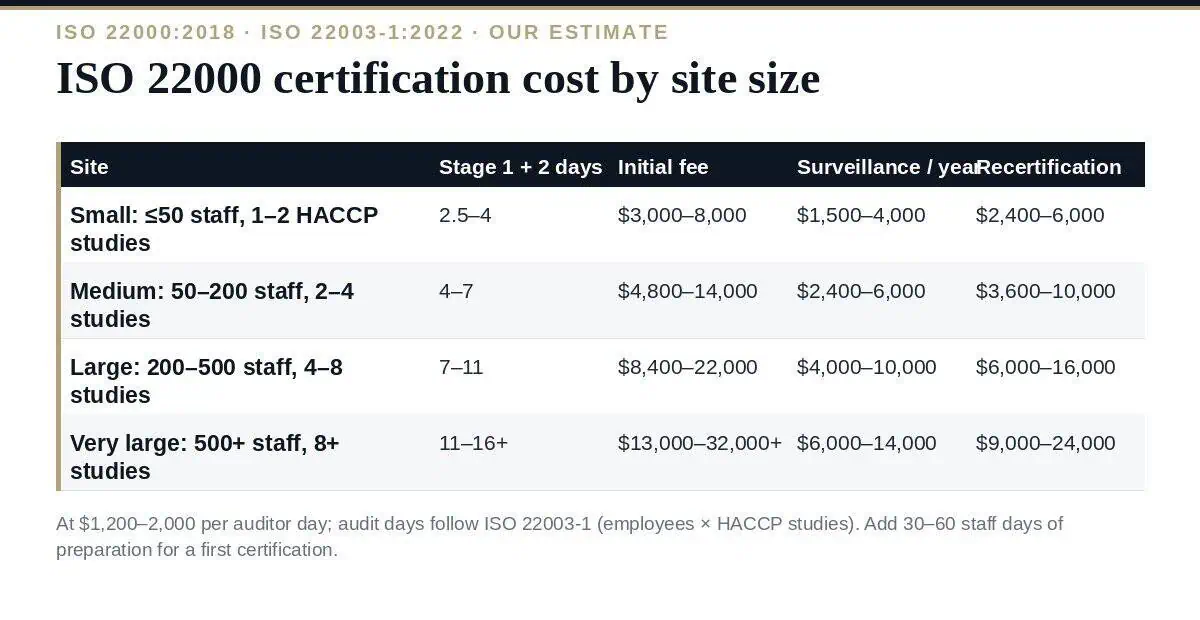
The estimates below assume one site, a system ready for audit, and an accredited certification body at the $1,200 to $2,000 per auditor day that food safety audits typically command in North America and Western Europe in 2026 — the same band used in our HACCP and FSSC 22000 cost guides. Day counts are our estimate of what the ISO 22003-1 table produces for typical sites; the certification body calculates the actual figure.
| Site | Stage 1 + stage 2 days (our estimate) | Initial certification fee | Annual surveillance (each of 2 years) | Recertification (year 3) |
|---|---|---|---|---|
| Small: up to 50 staff, 1–2 HACCP studies | 2.5 – 4 | $3,000 – $8,000 | $1,500 – $4,000 | $2,400 – $6,000 |
| Medium: 50–200 staff, 2–4 HACCP studies | 4 – 7 | $4,800 – $14,000 | $2,400 – $6,000 | $3,600 – $10,000 |
| Large: 200–500 staff, 4–8 HACCP studies | 7 – 11 | $8,400 – $22,000 | $4,000 – $10,000 | $6,000 – $16,000 |
| Very large or multi-line: 500+ staff, 8+ HACCP studies | 11 – 16+ | $13,000 – $32,000+ | $6,000 – $14,000 | $9,000 – $24,000 |
Add application and certificate fees — typically a few hundred to around a thousand dollars — and travel. A site whose stage 1 finds the hazard analysis unvalidated or the PRPs undocumented pays for a second stage 1 or a delayed stage 2, which is the commonest reason a first certification exceeds the quote.
The larger part of the ISO 22000 certification cost for a first-time site is internal: building the FSMS to the standard’s clause 8 — PRPs, the preliminary steps, hazard analysis, validation, the hazard control plan, traceability, emergency preparedness, verification and the handling of potentially unsafe product — and running it long enough to have records. Our estimate for a medium single-site processor starting from a working HACCP plan:
| Activity | Who | Staff days (our estimate) | External cost (our estimate) |
|---|---|---|---|
| Gap assessment against ISO 22000:2018 | Food safety team leader | 3 – 5 | $0 – $4,000 if outsourced |
| Documentation: policy, objectives, procedures, PRPs, hazard analysis, hazard control plan, records | Food safety team, QA | 15 – 30 | $0 – $2,000 (toolkit) to $10,000+ (consultant-drafted) |
| PRP implementation gaps: facility, pest control, hygiene, allergen, maintenance | Operations, engineering | Varies | $0 – $50,000+ depending on findings |
| Validation of control measures and verification records | Technical, laboratory | 5 – 10 | $1,000 – $5,000 in testing |
| Training: food safety team, internal auditors, staff awareness | HR, QA | 5 – 10 | $1,000 – $5,000 |
| Internal audit and management review | Internal auditor, management | 3 – 5 | $0 – $3,000 if outsourced |
| Consultant support, if used | External | — | $5,000 – $25,000 |
That is 30 to 60 staff days before facility remediation. A site that already runs a Codex HACCP plan with documented PRPs sits at the bottom; one certifying from a paper HACCP plan and informal hygiene practice sits at the top. Our guide to ISO 22000 mandatory documents lists what the documentation line has to produce.
| Year | What happens | Medium site (our estimate) |
|---|---|---|
| Year 0 | Preparation: documentation, PRP gaps, validation, training, internal audit | $5,000 – $40,000 external plus 30–60 staff days |
| Year 1 | Stage 1 and stage 2 audits, application and certificate fees | $5,500 – $15,000 |
| Year 2 | Surveillance audit | $2,400 – $6,000 |
| Year 3 | Surveillance audit | $2,400 – $6,000 |
| Year 4 | Recertification audit (new three-year cycle) | $3,600 – $10,000 |
| Three-year cycle total (certification body only) | $10,300 – $27,000 |
A single-site sauce manufacturer, 120 staff, three HACCP studies, an existing HACCP plan and documented PRPs, certification body at $1,600 per day — our estimate, illustrative only:
| Line | Basis | Estimate |
|---|---|---|
| Stage 1 + stage 2 | 5.5 auditor days at $1,600 | $8,800 |
| Application and certificate fees | Typical | $800 |
| Preparation, external | Toolkit, allergen validation testing, internal auditor training | $4,500 |
| Preparation, internal | 40 staff days at $350 loaded | $14,000 |
| Year 1 total | $28,100 | |
| Surveillance, years 2 and 3 | 2 days at $1,600 each year | $3,200 per year |
| Three-year cycle, certification body only | $16,000 |
| Scheme | Relative cost | Why |
|---|---|---|
| HACCP certification (non-GFSI) | Lower | Fewer audit days; no management-system clauses; not GFSI-recognised |
| ISO 22000 | Baseline | Management system plus HACCP; not GFSI-benchmarked on its own |
| FSSC 22000 | Higher | ISO 22000 plus ISO/TS 22002 PRPs plus FSSC additional requirements, unannounced audits from the first surveillance; GFSI-recognised |
| BRCGS / SQF / IFS | Similar to FSSC | GFSI-recognised, prescriptive; different audit-day rules |
Our guides to HACCP certification cost and FSSC 22000 certification cost cover the two neighbours; if a GFSI-recognised certificate is the customer’s real requirement, budget for FSSC 22000 from the start rather than certifying ISO 22000 first and upgrading.
How much does ISO 22000 certification cost?
Our estimate for a single site with an accredited certification body at $1,200–2,000 per auditor day: initial certification $3,000–8,000 for a small site, $4,800–14,000 for a medium site and $8,400–22,000 for a large one, plus annual surveillance and internal preparation of 30–60 staff days for a first-time medium site.
How are audit days calculated?
ISO 22003-1:2022 sets minimum audit time from the number of employees and the number of HACCP studies at the site, adjusted for food chain category and multi-site arrangements. Certification bodies must justify reductions, so quotes differ mainly on day rate.
Is ISO 22000 cheaper than FSSC 22000?
Yes, because FSSC adds the ISO/TS 22002 prerequisite programme standard, the FSSC additional requirements and unannounced surveillance audits. If the customer needs a GFSI-recognised certificate, ISO 22000 alone will not satisfy them and the saving is illusory.
How long does the certificate last?
Three years, with surveillance audits in years 2 and 3 and a recertification audit before expiry.
Can we reduce the cost with a consultant?
A consultant reduces staff days and the risk of a failed stage 1, at $5,000–25,000; a documentation toolkit reduces the drafting time at a fraction of that. Neither reduces the certification body’s audit days.
Budget the ISO 22000 certification cost as three parts — the certification body’s audit days from the ISO 22003-1 table at the day rate you negotiate, the surveillance and recertification cycle behind them, and the preparation that dominates a first certification — and reduce it where it can be reduced: fewer HACCP studies, an integrated audit, three quotations, and a system that has run for three months before stage 1.
The food safety policy, the prerequisite programme manual, the hazard analysis and CCP/OPRP monitoring and verification plans, the traceability procedure and the internal audit and management review procedures are in the ISO 22000 Toolkit, or start with the free templates.

September 21, 2026
September 20, 2026
September 20, 2026
September 19, 2026
September 19, 2026

