

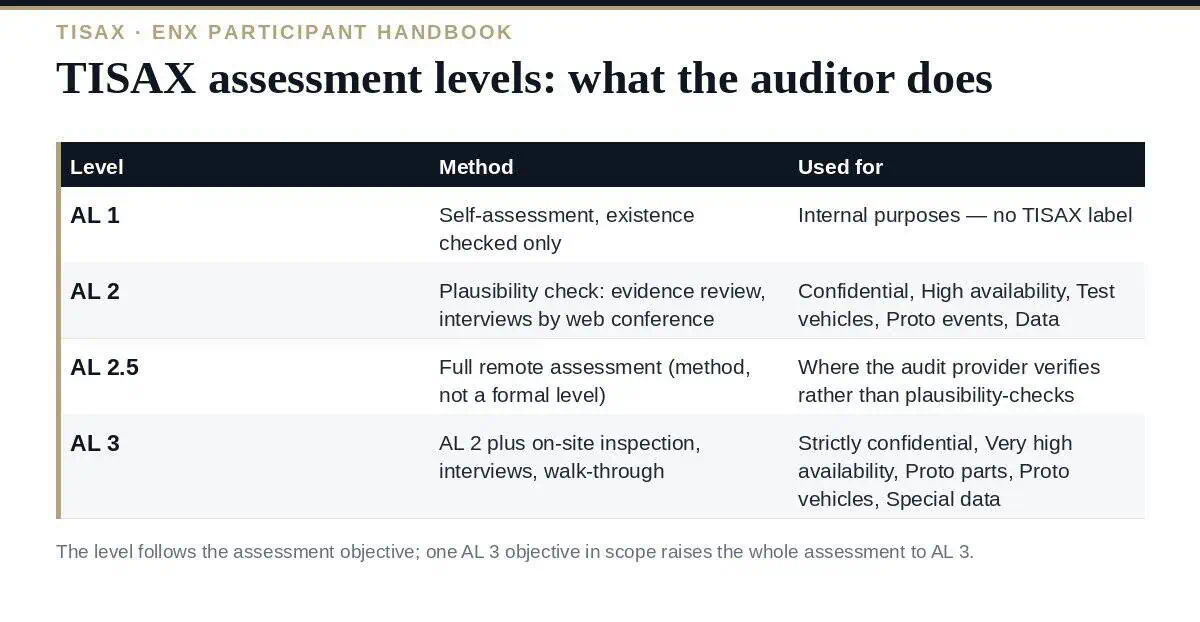
TISAX assessment levels decide how hard the audit provider looks. Level 1 is a self-assessment nobody checks; level 2 is a plausibility check of your self-assessment by web conference with evidence sampled; level 3 is the full on-site assessment with interviews, inspection and document review. Which level applies is not your choice — it follows from the assessment objectives your customer asks for, which in turn follow from the protection needs of the information you handle for them.
Most suppliers misread this in one of two directions: they register for a lower level than the objective requires and have to start again, or they treat AL 2 as the “light” option and are then surprised by how much documentation the plausibility check demands. This guide explains the three levels as the ENX participant handbook defines them, the objective-to-level mapping, the “AL 2.5” variant, the practical differences between TISAX AL2 and AL3 (method, audit days, internal effort, upgrade path), and what ISA2027 changes for the prototype labels from 2027.
Free gap assessment
Where do you actually stand against ISO 27001?
Score every management system clause and all 93 Annex A controls, free, and get a prioritised gap list back.
Run the free ISO 27001 gap assessment → or View premium report sample
Where TISAX assessment levels come from
TISAX is built on the VDA ISA catalogue and operated by ENX Association. A customer who requires TISAX names one or more assessment objectives — the twelve currently available run from “Confidential” and “High availability” through the prototype objectives to “Data” and “Special data” — and each objective carries protection needs that the ISA classifies as normal, high or very high.
The participant handbook is explicit: “The higher the protection needs, the more your partner is interested in making sure that it is safe to let you handle their information. Therefore, TISAX differentiates three assessment levels.” The assessment level “defines which assessment method the audit provider has to apply”, and a higher level “increases the effort that goes into the assessment”. Our guide to TISAX labels and the twelve assessment objectives covers what each objective requires; this post covers how each is assessed.
The three TISAX assessment levels
| Level | Method (ENX participant handbook) | Evidence checked | Used in TISAX? |
|---|---|---|---|
| AL 1 | An auditor checks that a completed self-assessment exists; does not assess its content; requires no further evidence | None | No — results have a low trust level and are not used in TISAX; a partner may request one outside TISAX |
| AL 2 | Plausibility check of your self-assessment for all locations in scope, supported by checking evidence and an interview with the person in charge of information security, generally by web conference | Sampled evidence; interview | Yes — for high protection needs |
| AL 2.5 (variant) | A full remote assessment instead of the plausibility check: the auditor verifies whether the ISMS fulfils the applicable requirements, without the on-site activities of AL 3 | Full verification, remotely | Yes — an alternative method for AL 2 objectives |
| AL 3 | Comprehensive verification: the AL 2 activities plus on-site inspection of locations, interviews with process owners and staff, and inspection of the physical environment | Full verification, on site | Yes — for very high protection needs and prototype objectives |
AL 1
The handbook is candid that AL 1 exists “mainly for internal purposes in the true sense of a self-assessment”. No TISAX label is issued from it. Its practical role is the first step of every TISAX journey: the self-assessment against the ISA that AL 2 and AL 3 then test. Our guide to the TISAX self-assessment covers how to complete it and read the score.
AL 2
The audit provider takes your self-assessment as the starting point and checks whether it is plausible: evidence is requested and reviewed, and the person responsible for information security is interviewed, normally by web conference. Two options exist. You can request the interview in person, and if you hold evidence you do not want to send — “for your eyes only” material — you can request an on-site inspection so the auditor can still check it. AL 2 applies to the “high” protection-need objectives: Confidential, High availability, Test vehicles, Proto events and Data. Test vehicles and Proto events were moved from AL 3 to AL 2 on 1 January 2025 (participant handbook version 2.8), so older guides that list them as AL 3 are out of date.
AL 2.5
Not a formal level but a recognized method: the audit provider conducts a full remote assessment rather than a plausibility check, verifying fulfilment of each applicable requirement as at AL 3 but without visiting. Formally the result is an AL 2 assessment. The handbook gives two cases where it makes sense. First, you only need AL 2 labels today but cannot rule out a partner asking for AL 3 later: because an AL 2.5 result is methodically compatible with AL 3, the upgrade only needs the on-site activities added. Second, you are struggling to write a self-assessment conclusive enough to survive a plausibility check. AL 2.5 is optional, and partners who see your shared result on the ENX exchange cannot tell an AL 2 from an AL 2.5 assessment. Ask the audit provider which method its AL 2 quote assumes, because the effort on your side is closer to AL 3.
AL 3
The full assessment. On top of the AL 2 activities, the audit provider comes on site to inspect locations, interviews process owners and selected staff, and examines the physical environment — which for the prototype objectives means the workshops, test tracks and storage areas themselves. AL 3 applies to the “very high” protection-need objectives: Strictly confidential, Very high availability, Proto parts, Proto vehicles and Special data. Our guide to TISAX prototype protection covers the AL 3 prototype assessments specifically.
Objective to level: the mapping
| Assessment objective | Protection needs | Assessment level |
|---|---|---|
| Confidential | High | AL 2 |
| Strictly confidential | Very high | AL 3 |
| High availability | High | AL 2 |
| Very high availability | Very high | AL 3 |
| Proto parts | Very high | AL 3 |
| Proto vehicles | Very high | AL 3 |
| Test vehicles | High | AL 2 |
| Proto events | High | AL 2 |
| Data | High | AL 2 |
| Special data | Very high | AL 3 |
| Info high (legacy, selectable until 31 March 2024) | High | AL 2 |
| Info very high (legacy) | Very high | AL 3 |
Two consequences follow from the way TISAX assessment levels are assigned. If a customer asks for one AL 3 objective and one AL 2 objective in the same scope, the standard scope description applies: the whole assessment runs at the highest level of any objective listed, so it is an AL 3 assessment, and every criterion of every listed objective is assessed. And the level cannot be traded down: AL 2.5 is a more thorough method for AL 2 objectives, not a cheaper route to an AL 3 label.
What each level means for preparation and cost
- Requirements are the same at every one of the TISAX assessment levels. The ISA self-assessment must be complete, with target maturity levels met on every applicable question; AL 2 and AL 3 differ in how thoroughly that claim is tested, not in what is required. That changes where your effort goes: ENX notes that AL 2 usually needs a more comprehensive self-assessment and better internal documentation, because an auditor who never visits asks for precise documents, while at AL 3 showing how you work plus basic documentation is often enough. A supplier that treats AL 2 as “lighter requirements” fails the plausibility check.
- Evidence handling differs. At AL 2 you send evidence; organize it per control question before the audit, because the auditor samples and the interview is short. At AL 3 you show it; the auditor decides what to look at on site.
- Effort and cost scale with the level and the locations. AL 3 adds travel and on-site days per location in scope. Our guide to TISAX certification cost gives the ranges; the assessment level is the largest single driver after the number of sites.
- Labels are the same across TISAX assessment levels. An AL 2 label and an AL 3 label are both TISAX labels, valid three years, exchanged on the ENX platform. The level is recorded with the result, and a partner requiring AL 3 will see an AL 2 result as insufficient.
The level definitions do not change with the catalogue version. The prototype objectives do: the section on ISA2027 below covers what audit providers are saying about the two new prototype labels, and our guide to VDA ISA2027 covers the control changes.
TISAX AL2 vs AL3: side by side
Most of the search traffic on this topic is one question: what is actually different between TISAX AL2 and AL3? The answer is the method, and the method drives everything else, which is why the TISAX assessment levels are best compared row by row. The table combines the handbook’s method overview with its rough effort estimate and its notes on upgrades.
| Aspect | AL 2 (plausibility check) | AL 2.5 (full remote assessment) | AL 3 (full verification) |
|---|---|---|---|
| Self-assessment | Required; the basis of the check | Required | Required |
| Evidence | Plausibility check of what you submit | Verified against each applicable requirement | Thorough verification |
| Interviews | Person in charge of information security, by web conference (in person on request) | Remote | In person, on site, planned and unplanned, with process owners and participants |
| On-site inspection | Only at your request, for evidence you will not send | No | Yes, at every location in scope |
| Typical audit provider effort (ENX rough estimate, small company, one location) | 3.5 to 4 man-days | Not estimated by ENX; between AL 2 and AL 3 | 5 to 6 man-days |
| Your internal effort | Often higher: a conclusive, well-documented self-assessment | High: full verification without a visit means precise documents | Often lower on paper: showing how you work counts as evidence |
| Label result | AL 2 labels | Recorded as AL 2; partners cannot see the difference | AL 3 labels, which also satisfy any AL 2 request |
| Upgrade to AL 3 later | Close to a new initial assessment | Add the on-site activities only | Not needed |
The man-day figures are the handbook’s own rough guide for an average small company with one location, not a quote; ENX does not publish prices and audit providers set their own. Travel, the number of locations and the number of objectives move the number more than anything else. Our guide to TISAX certification cost turns days into budget ranges.
Which TISAX assessment level should you choose?
Usually you do not choose between TISAX assessment levels at all: your customer names the label or objective, and the level follows. When the choice is yours, for example because a customer says only “get TISAX” or you supply several OEMs, the handbook’s advice runs against intuition. ENX recommends picking objectives that imply AL 3, because AL 3 assessments are not generally more effort overall than AL 2, and a higher level always includes the lower one. Suppliers with several partners often go straight to AL 3 so that every future request is already covered. ENX also notes that choosing AL 3 over AL 2 is a choice smaller companies make more often than larger ones, since their documentation tends to be thinner.
| Your situation | Sensible choice | Why |
|---|---|---|
| One customer asks for Confidential or Data only | AL 2 | The objective sets the level; nothing more is needed |
| AL 2 today, an OEM prospect that handles prototypes | AL 2.5 (an AL 2 method) | Keeps the upgrade to AL 3 down to the on-site activities |
| Thin documentation, strong day-to-day practice | AL 3 objective, or AL 2.5 | Plausibility checks punish a weak self-assessment; on-site verification credits practice |
| Several OEM customers with mixed requests | AL 3 objectives | AL 3 satisfies every AL 2 request; one assessment, one result |
| Prototype parts or vehicles on your premises | AL 3 | Proto parts and Proto vehicles are AL 3 objectives |
| Customer says “we need AL 3” and nothing else | Ask which label | A level alone does not define a scope; you need the catalogue and the protection need |
Upgrading from AL 2 to AL 3
Moving between TISAX assessment levels after the fact happens through a scope extension assessment, the same mechanism used to add locations or objectives to an existing scope. Three rules matter for planning:
- Same audit provider. You cannot hand a scope extension assessment to a different audit provider.
- A plain AL 2 result cannot be reused. Because AL 2 only checks plausibility, the handbook says an upgrade to AL 3 takes essentially the same effort as a new initial assessment. An AL 2.5 result is different: the auditor only adds the on-site activities.
- No extra validity. A scope extension assessment does not extend the validity period of your existing labels, so an upgrade late in the three-year cycle buys little before the next full assessment.
When the AL 3 site visit cannot happen
AL 3 requires the audit provider at your locations. Where that is temporarily impossible or would take unreasonable effort, the audit provider may use the video-supported remote assessment method for the on-site activities. It comes with conditions: the auditor records it in the assessment report as a minor non-conformity, and a follow-up assessment on site must be scheduled as soon as a visit is possible, even if your other corrective actions are not finished. The benefit is time: you can share temporary TISAX labels with your partner instead of waiting for an auditor’s calendar.
Findings and deadlines are the same at all TISAX assessment levels
The assessment level changes the method, not the rules for findings. Every TISAX assessment grades findings into the same four types and rolls them up into one overall result:
| Finding type | What it means | What you must do |
|---|---|---|
| Major non-conformity | Significant immediate risk, or doubt about the effectiveness of the whole ISMS | Compensating measures immediately; corrective action without undue delay |
| Minor non-conformity | No significant immediate risk and no doubt about overall effectiveness | Corrective action without undue delay |
| Observation | Non-compliance that is not a risk yet but may become one | Investigate, monitor and decide how to handle it |
| Room for improvement | No risk, but an obvious improvement | Optional |
A “minor non-conform” overall result can still earn temporary labels while you close the gaps; a “major non-conform” result earns none until the issue is handled. From the initial assessment you have up to nine months to resolve non-conformities, and labels are valid for a maximum of three years whatever the level. Our TISAX audit checklist walks through the assessment steps in order.
TISAX assessment levels under ISA2027
ISA2027 is the catalogue for every TISAX assessment ordered from 1 January 2027; ENX gives March 2027 as the last date to open an initial assessment under ISA 6. The TISAX assessment levels themselves (AL 1, AL 2, AL 2.5 and AL 3) keep their definitions. What changes is the prototype side, which ISA2027 restructures into two areas (organisational requirements, and physical and environmental security).
Audit providers DQS and SGS both report that the prototype labels collapse into two under ISA2027: Prototype Protection Basic at AL 2 (processes and qualified people for handling prototypes) and Prototype Protection Facilities at AL 3 (physical safeguards at your own sites), with Facilities including every Basic requirement. That replaces today’s four prototype objectives (Proto parts, Proto vehicles, Test vehicles, Proto events). DQS describes its summary as preliminary until ENX publishes the audit-provider process documents, and when we checked on 18 November 2026 the participant handbook’s mapping table still listed the twelve current objectives. If your assessment will be ordered in 2027 and touches prototypes, ask your audit provider which labels it will register before you fix the scope. Labels already issued stay valid for their full term, and the annual catalogue cycle does not make reassessment more frequent.
Frequently asked questions
What are the TISAX assessment levels?
AL 1, a self-assessment whose existence is checked but whose content is not (not used for TISAX labels); AL 2, a plausibility check of the self-assessment with sampled evidence and a web-conference interview; AL 3, a full on-site assessment with inspection and interviews. AL 2.5 is a full remote assessment used as an alternative AL 2 method.
Who decides the assessment level?
The assessment objective does. Objectives with high protection needs (Confidential, High availability, Test vehicles, Proto events, Data) are assessed at AL 2; those with very high protection needs (Strictly confidential, Very high availability, Proto parts, Proto vehicles, Special data) at AL 3.
Can we choose AL 2 to save money if the customer asked for AL 3?
No. The level follows the objective, and a partner requiring an AL 3 objective will not accept an AL 2 result. AL 2.5 is a remote method for AL 2 objectives, not a discount on AL 3.
Is the on-site visit mandatory at AL 3?
Yes. AL 3 comprises the AL 2 activities plus on-site inspection, interviews and examination of the physical environment at the locations in scope.
Do the levels change under ISA2027?
The levels and their methods do not. The prototype labels do: DQS and SGS report two labels for assessments under ISA2027, Prototype Protection Basic (AL 2) and Prototype Protection Facilities (AL 3). Confirm the label set with your audit provider before ordering a 2027 assessment.
How many audit days does each level take?
ENX gives a rough estimate for an average small company with one location: 3.5 to 4 man-days at AL 2 and 5 to 6 man-days at AL 3. More locations, more objectives and travel push it up.
Can partners tell whether we had AL 2 or AL 2.5?
No. AL 2.5 is formally evaluated as AL 2, and the difference is not visible to partners you share the result with.
Can we upgrade an AL 2 label to AL 3 later?
Yes, through a scope extension assessment with the same audit provider. After a plain AL 2 assessment the effort is close to a new initial assessment; after AL 2.5 only the on-site activities are added. The upgrade does not extend your labels’ validity.
A customer only said “AL 3”. Is that enough to register?
Not quite. A level only means something with an ISA catalogue and a protection need. Ask which label they need; since protection needs map one to one to levels, the catalogue plus the level is enough to pick the objective.
Where this leaves you
TISAX assessment levels are an output, not an input. Start from the objective your customer named, read the level off the mapping, and prepare to the same standard whichever it is — the self-assessment must be true at every level. Then organize evidence for the method: a per-question evidence pack for AL 2’s sampling and interview, and site readiness for AL 3’s inspection. The level sets the audit provider’s effort; it never lowers yours.
References
- ENX Association: TISAX Participant Handbook — Sections 4.3.2.2 (standard scope), 4.3.3.5 (protection needs and assessment levels), 5.3.4 (audit provider effort estimate), 5.4 (assessment process and findings) and 7.10 (scope extension assessment); version 2.8 history note on Test vehicles and Proto events.
- ENX Association: VDA ISA downloads — The ISA catalogue used for the self-assessment, including the ISA2027 and ISA 6 files and the ISA 6 cut-off date.
- DQS: ISA 2027, what is changing in the new TISAX catalogue — Audit-provider summary of the two ISA2027 prototype labels (described as preliminary).
- SGS: VDA publishes ISA2027 catalog for TISAX assessments (16 September 2026) — Second audit-provider account of Prototype Protection Basic and Facilities.
More on TISAX
- TISAX assessment levels — you are here
- VDA ISA2027: what changed
- TISAX audit checklist: the seven steps
- TISAX labels: the twelve assessment objectives
- The TISAX self-assessment
- TISAX certification cost
The ISMS policy and manual, scope definition, the VDA ISA Statement of Applicability workbook, the internal audit checklist and the implementation roadmap that carry a supplier from self-assessment to AL 2 or AL 3 are in the TISAX Documentation Toolkit, or start with the free templates.
When a standard changes, know first
One email a month: edition changes, new deadlines, and what they mean for documentation you already have. No sales sequence.

Recent Posts
November 23, 2026

November 22, 2026
November 21, 2026
November 20, 2026
November 19, 2026