CART
A realistic ISO 42001 certification timeline runs six to twelve months from decision to certificate for an organization starting without a management system, and three to six months for one that already operates ISO/IEC 27001 with discipline. Those are typical ranges seen in 2026, not promises — the audit itself takes days; what takes months is building the evidence a stage 2 auditor needs to see operating.
This guide breaks the timeline into its eight phases, gives a typical duration and the exit criterion for each, explains where the calendar can be compressed and where it cannot, and covers the one external dependency — certification-body accreditation under ISO/IEC 42006:2025 — that can add weeks you do not control.
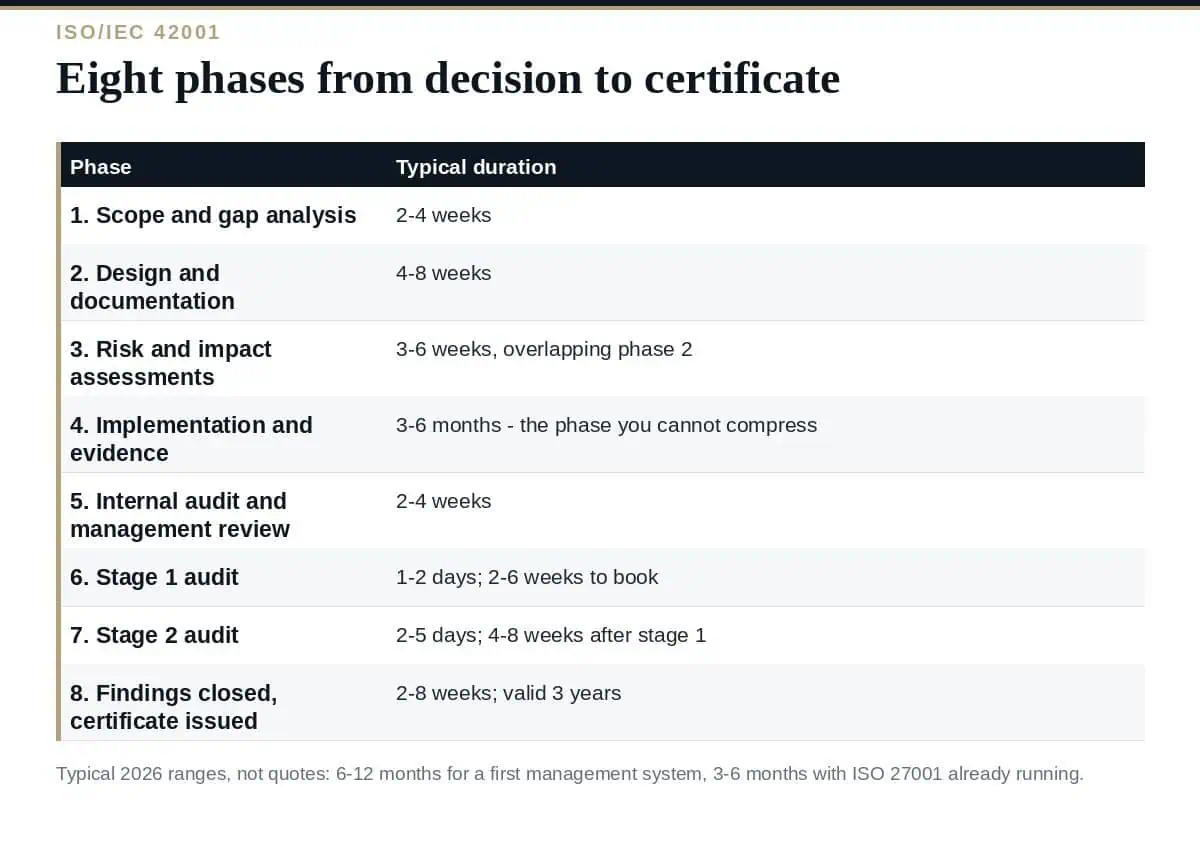
| Phase | Typical duration | Exit criterion |
|---|---|---|
| 1. Scope and gap analysis | 2–4 weeks | AIMS scope agreed (clause 4.3), AI system inventory complete, gap report against clauses 4–10 and Annex A |
| 2. Design and documentation | 4–8 weeks | AI policy, objectives, risk criteria, procedures and Statement of Applicability approved |
| 3. Risk and impact assessments | 3–6 weeks (overlaps 2) | Risk assessment (6.1.2) and an impact assessment (6.1.4) per AI system; treatment plan approved with residual risk accepted |
| 4. Implementation and evidence | 3–6 months | Controls operating; monitoring data, oversight logs and life-cycle records accumulating for every in-scope system |
| 5. Internal audit and management review | 2–4 weeks | Full internal audit (9.2) done, nonconformities in corrective action, management review (9.3) minuted |
| 6. Stage 1 audit | 1–2 days on site or remote, 2–6 weeks’ lead time to book | Documentation reviewed, readiness confirmed, stage 2 date set |
| 7. Stage 2 audit | 2–5 days, typically 4–8 weeks after stage 1 | Implementation verified; findings issued |
| 8. Findings closed and certificate issued | 2–8 weeks | Corrective actions accepted by the certification body; certificate valid 3 years |
Add the phases and the first-time ISO 42001 certification timeline lands at roughly six to twelve months. Organizations with an existing ISMS skip most of phase 2 for the shared clauses and shorten phase 4, because clause 7 disciplines — document control, competence, awareness, internal audit — already run.
Fast if the AI system inventory exists; slow if nobody can list which systems the organization develops, buys and uses. The scope decision itself — one product line, one business unit, or the whole organization — is the biggest single lever on everything that follows. Our ISO 42001 implementation guide covers how to draw it.
Writing from a blank page is where teams lose a quarter. Working from templates mapped to the clauses turns this into a review-and-tailor exercise measured in weeks. The documents that gate the next phase are the AI policy (5.2), the risk criteria (6.1.1), and the procedures for risk assessment, impact assessment and the AI system life cycle.
One impact assessment per AI system, or per justified grouping. Ten systems in scope means ten assessments, each needing product, engineering, legal and privacy input. This phase is limited by calendar availability of those people more than by effort. See our guides to the ISO 42001 risk assessment and the AI system impact assessment.
A stage 2 auditor tests whether the system is operating, not whether it is designed. Clause 9.1 monitoring needs results; A.6.2.6 operation and monitoring needs records; A.6.2.8 needs event logs; human oversight needs a log with entries in it. Three months of operating evidence is the practical minimum a certification body will accept as demonstrating an implemented and maintained system; six is comfortable. Starting the clock early — turning controls on before the documentation is polished — is the single most effective way to shorten the whole ISO 42001 certification timeline.
Both must have happened before stage 2, and the certification body will want to see the corrective actions from the internal audit at least in progress. Book the internal audit for the point at which three months of evidence exists, not at the end of documentation. Our guide to the ISO 42001 internal audit sets out what it has to cover.
Stage 1 is a documentation and readiness review; stage 2 is the implementation audit. The gap between them is set by the certification body and by how many stage 1 observations you have to clear. Booking lead times for AI management system audits are longer than for ISO 27001 in 2026 because the pool of auditors competent under ISO/IEC 42006 is still small — engage the certification body during phase 2, not phase 5.
Minor nonconformities are usually closed with a corrective action plan and evidence; major ones may require a follow-up visit. The certificate runs for three years, with surveillance audits in years one and two and a recertification audit before expiry — the standard ISO/IEC 17021-1 cycle.
ISO/IEC 42006:2025, published on 7 July 2025, sets the requirements for bodies auditing and certifying AI management systems — competence of auditors, audit time calculation, impartiality — on top of ISO/IEC 17021-1. Accreditation bodies are extending certification bodies’ scopes to it. In practice this means two things for your ISO 42001 certification timeline:
| Profile | Starting position | Typical ISO 42001 certification timeline |
|---|---|---|
| AI-native startup, 2–3 AI systems, no management system | Engineering discipline, no governance documents | 6–9 months; phase 4 dominates |
| Mid-size company with ISO 27001, deploying vendor AI | ISMS running, no AI inventory | 3–6 months; phases 1 and 3 dominate because scope and impact assessments are new |
| Enterprise AI provider, 15+ systems, several jurisdictions | Some governance, uneven across teams | 9–14 months; the per-system impact assessments and audit-day count stretch every phase |
What no ISO 42001 certification timeline can compress: the operating evidence in phase 4, the mandatory internal audit and management review, and the certification body’s own gap between stages.
How long does ISO 42001 certification take?
Six to twelve months is typical for a first-time management system; three to six for organizations that already run ISO 27001 well. The audits are days; the evidence-building is months.
Can we get certified in 90 days?
Only with an existing management system, a small scope, evidence already accumulating and a certification body with availability. For most organizations the three-month figure is the length of phase 4 alone.
How long is the certificate valid?
Three years, subject to surveillance audits in years one and two and a recertification audit before expiry.
Does the ISO 42001 certification timeline change if we already hold ISO 27001?
Yes, materially. The shared clauses — context, leadership, support, performance evaluation, improvement — are already implemented; what remains is the AI-specific work in clauses 6 and 8 and Annex A.
What most often delays certification?
Impact assessments that are late or shallow, evidence that started accumulating too late, and certification-body lead times. All three are avoidable with early planning.
Plan the ISO 42001 certification timeline backwards from the stage 2 date the certification body can offer, and make sure at least three months of operating evidence will exist by then. Front-load the scope decision and the impact assessments, template the documentation, and treat the internal audit as a milestone in the middle of the project rather than a task at the end. Do that and the six-to-twelve-month range becomes a schedule rather than a hope.
Every document the eight phases require — policy, procedures, assessment templates, registers and the audit set — is in the ISO 42001 Toolkit (68 templates), or start with the free ISO templates.

September 13, 2026

September 13, 2026
September 13, 2026
September 13, 2026
September 13, 2026

