CART
A journey risk assessment is how an ISO 39001 road traffic safety management system reaches the one place it actually matters: the trip somebody is about to make. Policies do not prevent collisions. Decisions about route, timing, vehicle, driver and load do, and those decisions have to be made before the vehicle moves.
This guide covers the five factors a journey risk assessment weighs, when a journey needs one at all, and how to keep the process from becoming a form nobody reads.
Free gap assessment
Could you prove workers take part in safety decisions?
Score every clause of ISO 45001, free, including the consultation and participation evidence that fails more audits than any other requirement.
Run the free ISO 45001 gap assessment → or View premium report sample
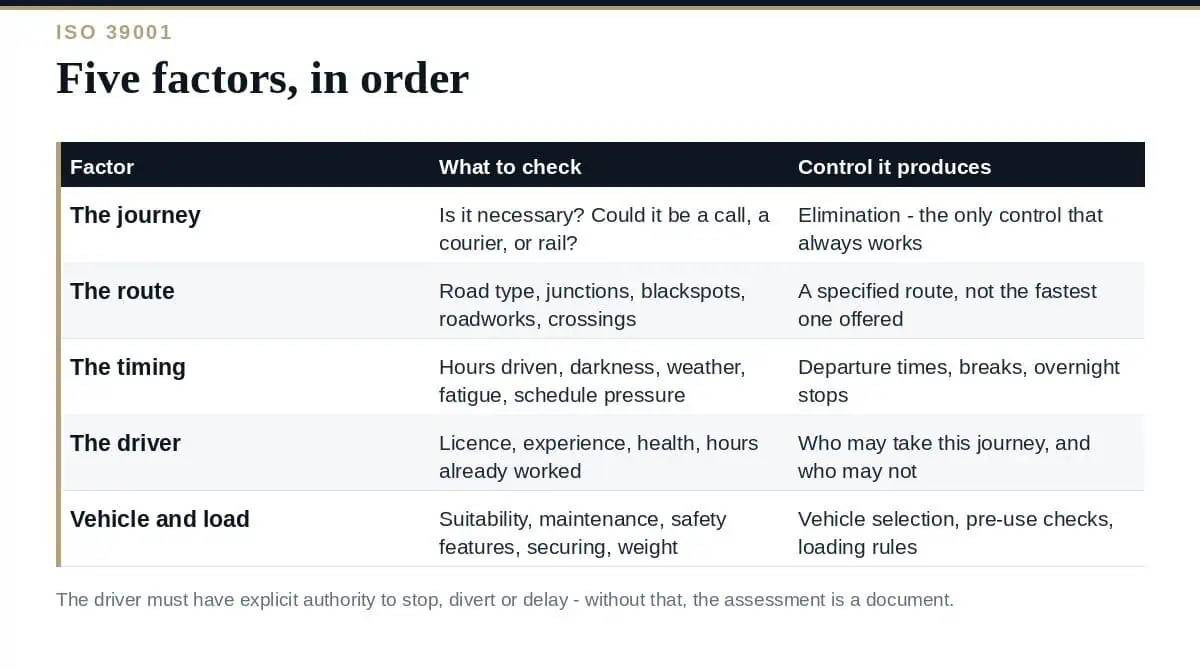
| Factor | What to check | Control it produces |
|---|---|---|
| The journey | Is it necessary? Could it be a call, a courier, or rail? | Elimination — the only control that works every time |
| The route | Road type, junctions, known blackspots, roadworks, crossings | A specified route, not the fastest one the app offers |
| The timing | Hours driven, darkness, weather, fatigue windows, schedule pressure | Departure times, breaks, overnight stops |
| The driver | Licence, experience on this vehicle and terrain, health, hours already worked | Who may take this journey, and who may not |
| The vehicle and load | Suitability, maintenance status, safety features, securing, weight | Vehicle selection, pre-use checks, loading requirements |
The first row does most of the work and is the one organizations skip. A journey risk assessment that starts at “which route” has already accepted the trip, and the safest kilometre is the one nobody drives.
ISO 39001 asks you to identify the road traffic safety performance factors you can influence and to set objectives against them. Journey planning is where exposure, speed, route choice, vehicle condition, driver fitness and journey purpose all become controllable in a single decision. Our guide to RTS performance factors covers the three kinds and how to choose the ones you can actually move.
Assessing every trip individually is unworkable for a fleet doing hundreds a day, and assessing none is indefensible. The practical answer is tiering:
Write the triggers down. A rule that says “any journey over four hours, any journey after dark, any journey with a load outside the standard profile” is one anybody can apply. “Assess where appropriate” is one nobody will.
Conditions change after departure. A journey risk assessment is worth little if the driver has no authority to stop, divert or delay when weather closes in or fatigue arrives early. State plainly that the driver may abort, that doing so carries no penalty, and who to notify. That single sentence is the difference between a document and a control.
They assess the driver only. Driver behaviour is the easiest thing to blame and the hardest to change alone. Route, schedule and vehicle are organizational decisions and usually the bigger lever.
They are done by the office, not with the driver. The person who has driven the route knows about the junction that floods. A desk-based assessment misses it.
Weather is treated as an input, not a trigger. A forecast that would have changed the decision has to be checked before departure, not attached to the file afterwards.
Fatigue is measured in driving hours only. The shift before the drive counts. A driver who has loaded for six hours is not fresh because the wheel time is short.
Is a journey risk assessment required by ISO 39001?
The standard does not name the document. It requires you to identify and control your road traffic safety performance factors, and journey planning is the usual operational control through which route, speed, timing, vehicle and driver factors are managed.
Who should complete it?
Whoever plans the work, with the driver. Approval for higher-risk journeys should sit with a manager who can change the schedule, because that is often the control that matters.
How often should standing assessments be reviewed?
At least annually, and whenever the route, vehicle type, load, schedule or driver population changes — plus after any incident on that journey.
Does it apply to employees using their own cars?
Yes, in substance. Grey fleet journeys carry the same duty of care, and the vehicle checks are harder rather than unnecessary.
What about security risk on the route?
Assess it in the same document where it applies. Separating safety from security produces two plans that contradict each other on the same road.
Build the journey risk assessment around the question of whether the journey is needed, then work through route, timing, driver and vehicle in that order. Tier it so routine trips run on standing assessments and exceptions get real attention, write the triggers down so the rule is applicable, and give the driver explicit authority to stop or divert. Record what the assessment changed — if the answer is never anything, the process is documentation rather than control.
Assessment forms, journey planning procedures and driver briefing records are in the ISO 39001 Road Traffic Safety Toolkit, or start with the free ISO templates.

October 24, 2026
October 24, 2026
October 23, 2026
October 23, 2026
October 22, 2026

