CART
Achieving ISO 9001 certification proves to customers, tenders, and partners that your organization delivers consistent quality. It is the most widely recognised quality credential in the world, and with the right preparation it is very achievable. This guide walks through what certification involves, the step-by-step process, how long it takes, and what it costs.
New to the standard? Start with our complete ISO 9001 guide.
Certification means an accredited, independent certification body has audited your Quality Management System and confirmed it meets ISO 9001:2026 (or, during the transition period that follows the September 2026 publication, ISO 9001:2015). You are certifying the management system that governs how you deliver quality — your policy, objectives, processes, and improvement mechanisms — not any single product. The certificate is typically valid for three years, with annual surveillance audits to confirm the QMS stays effective.
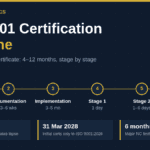
For most organizations, reaching certification takes a few months, depending on how mature your processes already are and how quickly you can produce the documentation and evidence. Building the QMS from scratch is the slow part; starting from a mapped toolkit and tailoring it typically compresses the timeline from months of drafting to weeks of review.
Total cost depends on organization size, the scope of the QMS, and whether you build internally or use templates and consultants. The main components are preparation effort (documentation and implementation), the certification body’s audit fees (scaled to headcount and complexity), and ongoing surveillance. Using a ready-made toolkit reduces the largest and most variable cost — the internal time spent authoring the management system.
Get certification-ready faster.
Our ISO 9001 Toolkit gives you a complete, audit-ready QMS — quality policy, objectives, process procedures, and records — so you walk into your Stage 2 audit prepared.
Build and operate a Quality Management System, run an internal audit and management review, then pass a two-stage external audit (documentation, then implementation) by an accredited certification body.
Typically a few months, depending on your process maturity and how quickly you produce the documentation. A toolkit shortens the preparation phase considerably.
Usually three years, with annual surveillance audits to confirm the QMS remains effective, followed by recertification.

September 22, 2026
September 21, 2026
September 21, 2026
September 20, 2026
September 20, 2026

