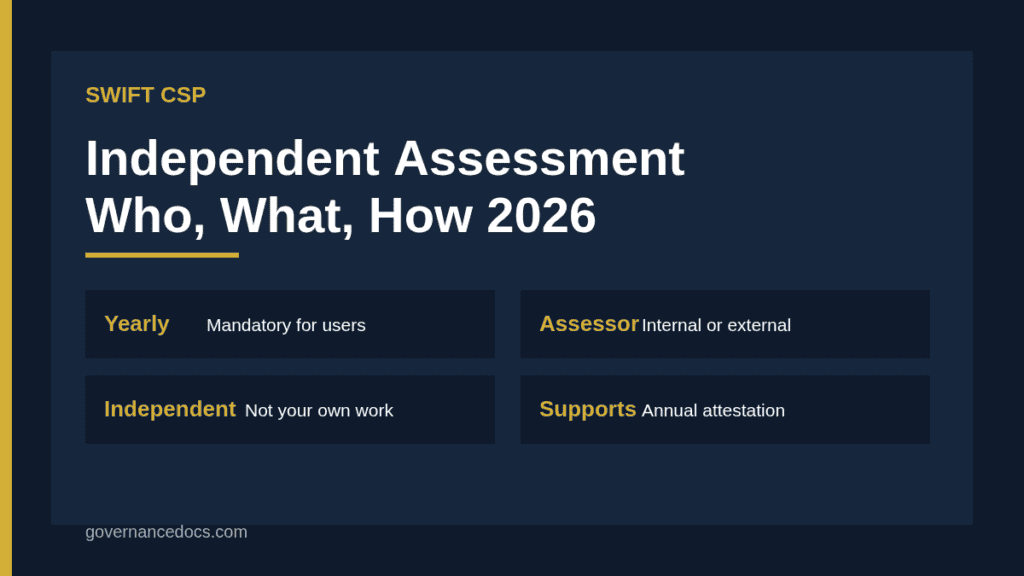
A SWIFT CSP independent assessment is the annual check that confirms the security attestation you submit truly reflects how your Swift environment is designed and run. Swift’s Customer Security Programme requires every user to attest against the Customer Security Controls Framework, and Swift’s guidance says that an independent assessment of that attestation is mandatory each year. This guide explains who can perform the assessment, what independence means, what the assessor reviews and how to prepare.
The requirements below follow Swift’s published page on performing an independent assessment. Details change between framework versions, so confirm current rules on Swift’s site. For the wider picture, read our guides to the SWIFT CSCF, CSP attestation and CSCF v2026.
Free gap assessment
Where do you actually stand against ISO 27001?
Score every management system clause and all 93 Annex A controls, free, and get a prioritised gap list back.
The assessment supports the yearly attestation. According to Swift, its purpose is to make sure the declared level of compliance accurately reflects actual design and implementation. Assessors evaluate compliance with the mandatory and advisory controls that apply to your connectivity configuration, and they look at both design and implementation. In plain terms, they test whether the controls exist, whether they are set up properly and whether they work.
The result feeds your attestation in the KYC Security Attestation application. Users that declare compliance without support risk questions from counterparties, who can see attestation data. Our guide to SWIFT CSP non-compliance covers the consequences of gaps.
Who can perform a SWIFT CSP independent assessment
Assessor type
Options described by Swift
External
Swift CSP certified assessors, which Swift prefers and lists in a directory; or non-certified assessors with cybersecurity experience, such as PCI DSS, ISO 27002 or NIST CSF
Internal
Swift CSP certified internal assessors; or non-certified internal teams independent from the first line of defence, typically internal audit or a risk office
Mixed
Combined internal and external teams
The choice depends on your size, the complexity of your architecture and your appetite for external comfort. Large institutions often use their internal audit function, and smaller ones tend to hire an external assessor because they lack an independent second or third line.
Independence and competence rules
Independence is the central test. Swift’s page says assessors must be independent from operational control design, with the plain statement that no one should assess their own work or be involved in the design of the controls. If the person who configured the firewall rules also assesses them, the assessment does not count as independent.
On competence, Swift expects the lead assessor to hold a relevant industry professional certification, for example CISA, and it recommends that other team members hold relevant security credentials. Document each assessor’s qualifications and the reason you consider them competent, and keep the record with the assessment file.
Applying the three lines model
First line. Operational teams design and run the controls. They cannot assess them.
Second line. Risk or compliance may assess if independent of design and operation, and if the team has the right skills.
Third line. Internal audit is the natural choice for larger organizations.
External. A certified or experienced outside firm gives extra independence and expertise.
Scope: which controls are assessed
Scope follows your architecture type. The controls that apply depend on how you connect to Swift and what components you operate. Our page on SWIFT architecture types explains the categories, and the mandatory controls lists the controls that must be met. Confirm which advisory controls also apply to your configuration, because Swift says assessors review mandatory and advisory controls that apply.
Define the scope in writing before the work starts. Include the Swift infrastructure, connected systems, operators, the secure zone and any service bureau or third-party components. If part of your environment is managed by a provider, decide how you will obtain and rely on evidence from them.
How to prepare for the assessment
Confirm your architecture type and the controls that apply.
Complete a self-assessment against each control, with evidence references.
Collect evidence: configuration exports, screenshots, policies, access reviews, patch records, logs and test results.
Brief the assessor on the environment, roles and any known gaps.
Fix known gaps or record a remediation plan with dates.
Agree the timeline so the attestation deadline is met with time to spare.
Start well before the attestation window. Assessors need time to test, and remediation of findings often takes longer than expected. For budget planning, see our note on SWIFT CSP assessment cost.
Consider also how your program changes from year to year. Framework versions add and adjust controls, so compare the new version with the last one before each cycle and record which controls are new or changed. A short change summary helps the assessor and your own teams focus on what is different, and it makes your SWIFT CSP independent assessment easier to plan and defend.
What assessors typically test
Assessors test design and implementation. For design, they read policies and architecture documents and ask whether the control would meet its objective if operated. For implementation, they sample configurations and records. Examples include reviewing firewall rulesets for the secure zone, checking that administrators use multi-factor authentication, examining patching evidence, verifying logging and monitoring, and testing the incident response plan. The assessor documents results per control, and identifies any gaps.
Using findings to correct your attestation
If the assessment finds that a control is not met, change the attestation to reflect the truth. Then create a remediation plan with owners and dates, and track it. An attestation that claims compliance when the assessor found a gap is a serious problem, both for regulators and for counterparties reading your data. Treat the assessment as a chance to improve, not a hurdle to clear.
Working with service providers and third parties
Many Swift users rely on service bureaus, hosting providers or managed security teams. The assessor still has to form a view on the controls that apply to your environment, so plan how to gather evidence from those parties early. Ask the provider for its own assurance reports, evidence that maps to the controls in scope and the contact person for questions. Record the documents received and what each covers. Where evidence is missing, note the gap, and agree how it will be closed. Contracts should require providers to support your SWIFT CSP independent assessment on a reasonable timetable, and to notify you of relevant changes.
Timeline for a typical assessment cycle
Months before the deadline. Confirm assessor, scope and architecture type, and agree the plan.
Weeks 1 to 3. Complete self-assessment and collect evidence.
Weeks 4 to 6. Assessor tests design and implementation, and raises questions.
Weeks 7 to 8. Fix or plan remediation of findings and agree the report.
Before the attestation deadline. Submit an attestation that reflects the assessment.
Adjust the durations to your environment, and leave a buffer. A single missing piece of evidence from a third party can delay the whole cycle.
Keeping the assessment file
Keep a file for each cycle: scope statement, assessor qualifications and independence declaration, self-assessment, evidence index, test results, findings, remediation plan and the final attestation. Store it securely with restricted access, since it describes your security weaknesses. A tidy file makes the next cycle much easier, because you can reuse the structure and see which findings recurred.
A hypothetical example
A hypothetical mid-sized bank runs a Swift messaging interface in a secure zone. Its internal audit team is independent of the network and security teams, and holds the relevant certifications, so it performs the assessment. The lead assessor reviews the self-assessment and samples firewall rules, administrator accounts and patch records. She finds that one operator account lacks multi-factor authentication. The bank fixes it within two weeks, updates the attestation to show the gap and its remediation, and files the evidence. The example is invented for illustration.
Common mistakes with a SWIFT CSP independent assessment
Letting the team that designed the controls assess them.
Choosing an assessor with no relevant certification or experience.
Defining scope too narrowly and leaving out provider-managed components.
Collecting evidence at the last minute.
Attesting to compliance before the assessment finishes.
Failing to keep records of assessor qualifications.
Swift’s own page on how to perform an independent assessment is the primary source, so check it for the current version before you plan.
Templates for a SWIFT CSP independent assessment
To avoid building self-assessment workbooks, evidence trackers and assessor briefing packs from scratch, the SWIFT CSP Toolkit provides documents you can adapt. Review them against the current framework version.
SWIFT CSP independent assessment FAQ
Is an independent assessment mandatory?
Swift describes it as mandatory yearly for all users, supporting the annual attestation.
Can internal audit perform it?
Yes, if the team is independent from the first line and from control design, and has the right skills. Swift lists internal audit or a risk office as typical examples.
Does the assessor need a certification?
Swift prefers certified assessors and expects the lead assessor to hold a relevant professional certification such as CISA. Document your assessor’s credentials.
What is assessed?
Both design and implementation of the mandatory and advisory controls that apply to your configuration.
What happens if the assessment finds a gap?
Update the attestation to reflect the real position and put a remediation plan in place with owners and dates.