CART

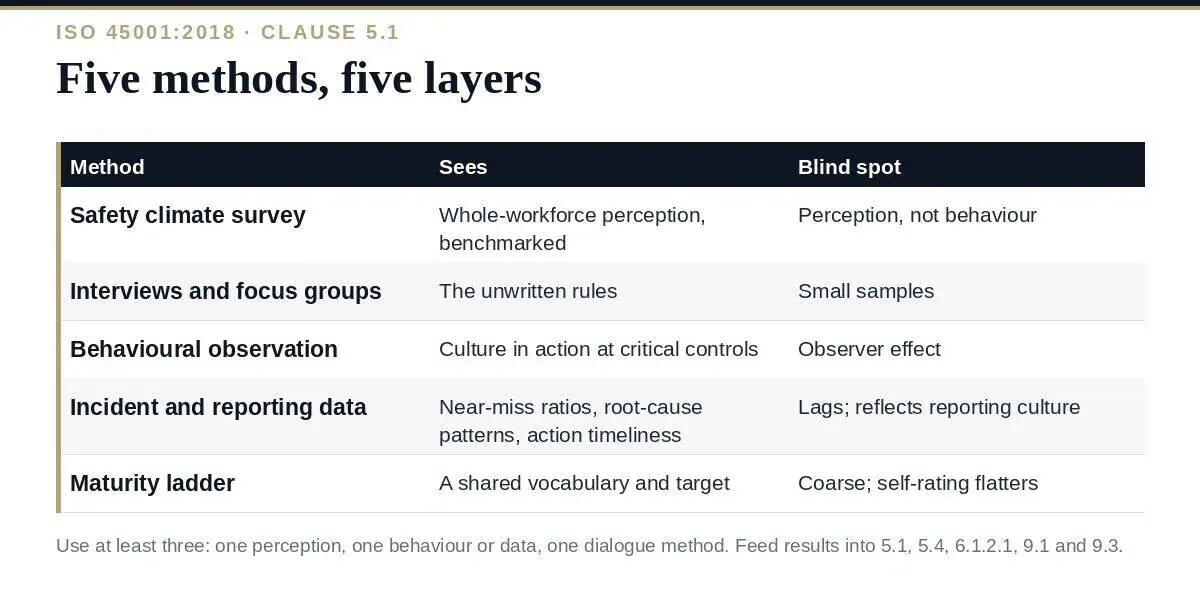
A safety culture assessment measures the part of occupational health and safety that ISO 45001 requires but cannot audit directly: what people actually do when the procedure is inconvenient and nobody is watching. The standard puts culture in the text — clause 5.1 requires top management to develop, lead and promote “a culture in the organization that supports the intended outcomes of the OH&S management system”, and clause 6.1.2.1 lists “leadership and the culture in the organization” among the things hazard identification must consider — but it gives no method for measuring it. Five methods exist, each measuring a different layer, and an assessment that uses only one measures only that layer. This guide explains what safety culture is as distinct from safety climate, the five assessment methods and what each can and cannot see, how to combine them, and how the result feeds an ISO 45001 system rather than sitting in a report.
Free gap assessment
Could you prove workers take part in safety decisions?
Score every clause of ISO 45001, free, including the consultation and participation evidence that fails more audits than any other requirement.
Run the free ISO 45001 gap assessment → or View premium report sample
Safety culture is the shared assumptions, values and behaviours about risk that an organization actually holds — the way things are done. Safety climate is the workforce’s perception of that culture at a point in time, which is what a questionnaire measures. The distinction matters for assessment design: a survey measures climate, is cheap and repeatable, and is easily gamed by a workforce that has learned the right answers; culture itself is inferred from what people do and what the organization’s data shows, which is slower and harder to fake. A safety culture assessment worth the name triangulates: perception, behaviour and data. Our guide to the ISO 45001 maturity assessment covers the system-level grading that sits beside it.
| # | Method | Measures | Strength | Blind spot |
|---|---|---|---|---|
| 1 | Safety climate survey | Perceptions of management commitment, communication, priority of safety over production, reporting confidence, competence, involvement | Whole-workforce reach; benchmarkable; repeatable annually | Perception, not behaviour; social desirability; survey fatigue |
| 2 | Structured interviews and focus groups | How decisions are made when safety and production conflict; what stops people reporting; how leaders are seen | Depth; surfaces the unwritten rules | Small samples; interviewer effects; slow |
| 3 | Behavioural observation | Adherence to critical controls; at-risk behaviours; supervisory presence; housekeeping | Direct evidence of the culture in action | Observer presence changes behaviour; measures the observed area only |
| 4 | Incident and reporting data analysis | Near-miss to incident ratio; reporting rates by site and shift; root-cause patterns; corrective action timeliness | Objective; already collected; trendable | Reflects reporting culture as much as risk; lags |
| 5 | Maturity ladder | Position on a five-level scale (pathological, reactive, calculative, proactive, generative) per dimension | A shared vocabulary; sets targets; useful for leadership conversations | Coarse; self-assessed versions flatter |
The most used method, and the one with a research base. Validated instruments — the HSE’s Safety Climate Tool, the Nordic Safety Climate Questionnaire (NOSACQ-50), and sector-specific instruments in healthcare, rail and offshore — measure a consistent set of factors: management commitment, supervisor support, communication, priority of safety over production, confidence in reporting, competence and training, worker involvement, and fatalism. Use a validated instrument rather than a home-written one, because the value is in the benchmark and the year-on-year comparison; report by site, shift and role, not only overall; and treat a response rate below 60% as a finding in itself.
The method that finds what the survey scores mean. A dozen interviews across leaders, supervisors, workers and contractors, with a fixed question set — what happens when a job cannot be done safely on time; what happened the last time someone stopped work; what happens to someone who reports a near miss; what leaders actually say about safety — produce the narrative the numbers lack. Worker focus groups without managers present are where the unwritten rules are stated.
Structured observation of critical controls and behaviours, by trained observers with a checklist, produces the only direct evidence of culture in action. It is the basis of behaviour-based safety programs and of the layered inspection programs many ISO 45001 systems already run under clause 9.1. The assessment use is different from the program use: sample across sites and shifts, include supervisors’ behaviour as well as workers’, and record the presence or absence of leaders in the field.
The data the system already holds says a great deal about culture if read for it. A rising near-miss-to-incident ratio indicates a reporting culture improving; a site with zero near misses and average incidents indicates one that is not reporting. Root-cause patterns that stop at “failure to follow procedure” indicate a blame culture in the investigation process. Corrective action timeliness indicates whether safety findings compete successfully for resources. These indicators cost nothing to compute and are the least gameable of the five.
The ladder popularized by Hudson and Parker — pathological, reactive, calculative, proactive, generative — and its sector variants give the assessment a shared language and a target. Used as a facilitated exercise with leadership and worker groups separately, the gap between the two groups’ placements is itself one of the most informative results an assessment produces. Used as a self-rating by the HSE function it is worthless.
A defensible safety culture assessment uses at least three of the five, and the choice follows a rule: one perception method, one behavioural or data method, and one dialogue method. The common design is a climate survey to the whole workforce, incident and reporting data analysis across the same period, and interviews and focus groups at the sites the survey and data flag. Behavioural observation is added where critical controls exist and the ladder is used to frame the leadership conversation at the end. Results are reported by site and by the same factor set across methods — management commitment, reporting confidence, priority of safety over production — so that a survey score, an interview theme and a data indicator for the same factor sit together.
Our guide to the ISO 45001 readiness assessment covers the six checks that a weak culture undermines first.
What is a safety culture assessment?
A structured measurement of the shared values and behaviours around risk in an organization, using a combination of climate surveys, interviews and focus groups, behavioural observation, incident and reporting data analysis and maturity ladders — because each method sees a layer the others miss.
Does ISO 45001 require one?
It requires top management to develop, lead and promote a supportive culture (5.1) and hazard identification to consider leadership and culture (6.1.2.1), but prescribes no method. A safety culture assessment is how organizations evidence both.
Which survey should we use?
A validated instrument with a benchmark — the HSE’s Safety Climate Tool, NOSACQ-50 or a sector instrument — rather than a home-written questionnaire, so results can be compared over time and against others.
How often should it be run?
A climate survey annually or every two years; incident and reporting data continuously; interviews and observation at the sites the survey and data flag. Culture moves slowly, and over-surveying produces fatigue and worse data.
Who should run it?
Someone the workforce will be candid with, which usually means not the site HSE manager: a corporate team, an internal audit function or an external assessor, with worker representatives involved in the design.
Build the safety culture assessment from at least three of the five methods — a validated climate survey, the incident and reporting data you already hold, and interviews at the sites the first two flag — report by site and by factor, put the results into the hazard register, the KPI set and the management review, and repeat on a cycle slow enough to measure change. That is culture measured in the way ISO 45001 assumes but never specifies.
The clause-by-clause questionnaire — including the 5.1 leadership and 5.4 consultation and participation questions a culture assessment is anchored to — with reference, verification and area-of-concern columns is the ISO 45001 Self-Assessment Tool, or start with the free templates.

October 11, 2026
October 11, 2026
October 11, 2026
October 11, 2026
October 11, 2026

