Privacy risk appetite is the amount and type of risk to individuals’ data protection rights that an organization is willing to accept in pursuit of its objectives. Without a stated appetite, every privacy assessment ends with the same unanswered question: the risk is medium, but is that acceptable? Someone then decides case by case, and decisions vary by project, by manager and by how urgent the launch date is.
This guide explains how to set privacy risk appetite, how it differs from tolerance and from legal compliance, how to write usable statements, how to connect them to your scoring and approval rules, and how to keep them current.
Free gap assessment
Could you demonstrate GDPR compliance today?
Score yourself against what a supervisory authority actually asks for, free — the records, not the policy.
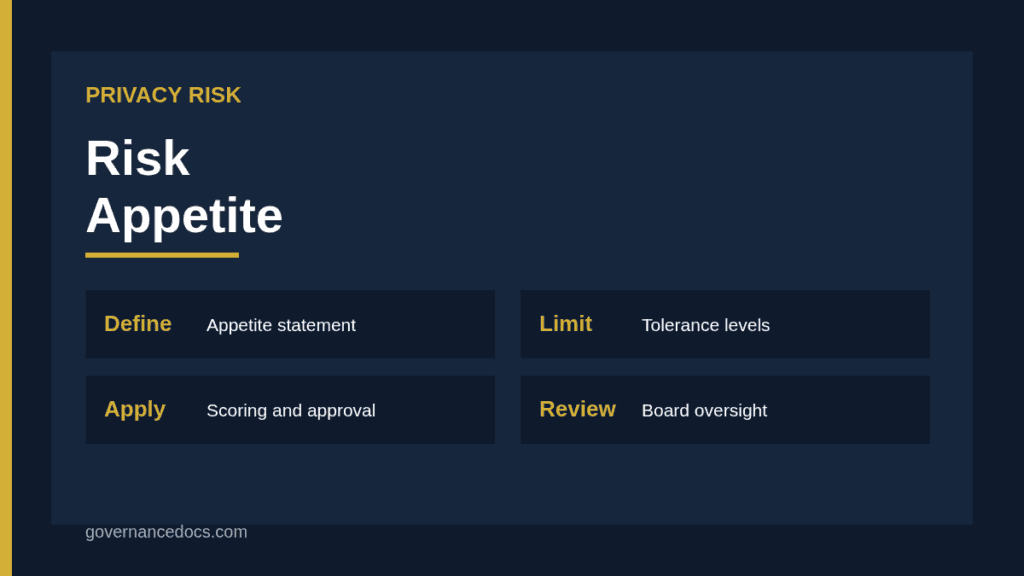
Appetite is a statement of how much risk you will take. Tolerance is the specific limit on a measure, such as the maximum number of unresolved high privacy risks. Risk capacity is the maximum you could bear before you could not continue. The three are related but separate, and mixing them causes confusion. Our overview of risk appetite explains the general concepts.
Free privacy risk assessment
Which privacy risks would hurt the people whose data you hold?
List your personal data and processing, pick from 38 privacy risk scenarios, rate them for the people concerned and for you, and plan treatment with ISO 27701 controls. You get a heat map, a process score and the findings an auditor would raise, free.
One point is specific to privacy. Compliance with law is not a matter of appetite. An organization cannot decide to accept a risk of unlawful processing in the way it might accept a risk of a slower product launch. Appetite applies to the residual risk that remains once legal requirements have been met, such as the level of intrusion to individuals that is tolerable, the exposure to breaches of well-protected data and the degree of reliance on suppliers. Statements should therefore start with a floor of compliance and set appetite above it.
Why privacy risk appetite is worth setting
Consistent decisions. Similar projects receive similar treatment regardless of who reviews them.
Faster approvals. Low-risk work is approved by the team, and only exceptions reach senior people.
Board oversight. Leaders can see and challenge how much privacy risk the business carries.
Better design. Teams know the limits at the start and design within them.
Defensible records. Approvals can be explained by reference to stated criteria.
The NIST Privacy Framework treats privacy risk management as part of enterprise risk management and asks organizations to set their risk tolerance for privacy risks. You can read more on the NIST Privacy Framework page, and our guide to the privacy risk assessment methodology shows how ratings are produced that the appetite is then applied to.
Choosing categories for privacy risk appetite
A single statement such as low appetite for privacy risk is too vague to apply. Break it down by the kinds of risk that matter to you. Suggested categories include the following.
Category
Example appetite statement
Example limit
Sensitive data
Very low appetite for processing special category data without a documented necessity case
Executive approval for all new uses
Individual harm
Very low appetite for processing that could cause serious or irreversible harm
No launch with an unmitigated high impact rating
Data breach
Low appetite for exposure of identifiable data
Encryption required for all personal data at rest
Transparency
Low appetite for unexpected uses of data
Notices updated before any change of purpose
Suppliers
Moderate appetite for supplier-related risk where assurance exists
Critical suppliers reassessed annually
Innovation
Moderate appetite for new data uses with safeguards
Pilot with DPIA before scale-up
Writing appetite statements that can be applied
Good statements are short, clear and testable. Each one should name the category, describe the appetite in words such as very low, low, moderate or high, explain the reason and give at least one measurable limit. Avoid abstract language like we take privacy seriously, which no one can apply to a decision.
Start from objectives. What does the business want to achieve, and which data uses does it depend on?
Identify the sources of privacy risk that most affect those objectives.
Draft statements by category with words and limits.
Test them on real cases. Try recent projects and see whether the statements would have led to sensible outcomes.
Agree with senior management and obtain formal approval.
Connecting appetite to scoring
The statements only work if they map to your rating scale. Define what each rating band means in terms of action. For example, a low residual rating may be accepted by the project owner, a medium rating needs the privacy lead’s review and a documented reason, and a high rating needs approval from a senior executive. Anything at the top band that cannot be reduced is not accepted, and for processing likely to result in high risk that cannot be mitigated, regulators expect prior consultation. Our guide to DPIA residual risk explains that point.
Using key indicators to monitor privacy risk appetite
Tolerance measures let you check whether you are inside the appetite. Useful indicators include the number of high-rated privacy risks open beyond their target date, the share of projects assessed before launch, breach counts and their severity, the number of overdue rights requests, supplier assessments out of date and the number of exceptions granted. Set amber and red thresholds that trigger escalation, and report them regularly. See our guide to KRI thresholds for how to set them.
Exceptions and escalation
Sometimes the business will want to go beyond the stated appetite. Provide a route for this: a written request explaining the benefit, the additional risk and the controls, reviewed by the privacy lead and approved by a named senior executive for a defined period. Record every exception in a register and review it regularly. Too many exceptions indicate that the appetite is out of step with the business, and it should be revisited rather than ignored. The privacy risk register is the natural place to track them.
A short worked example
A software company sets a very low appetite for special category data and a low appetite for unexpected uses, with a moderate appetite for supplier risk. A product team proposes using health-related survey answers to personalize recommendations. The rating is high because the data is sensitive and the use may not be expected. Under the statement, executive approval is needed and the team must show necessity. The team drops the sensitive inputs and keeps a lower-risk version using preferences that customers set themselves. The residual risk falls to medium, the privacy lead reviews it, and the project launches on time. The statement gave the team a clear decision rule instead of a debate.
Governance and review
Privacy risk appetite should be approved by the board or a senior committee, reviewed at least annually and updated after significant incidents, regulatory changes, new business lines or acquisitions. Assign a named owner, usually the privacy lead or data protection officer, with support from the risk function. Align it with the enterprise risk appetite, so that privacy is not treated as a separate world. Our privacy review process guide shows how to apply the limits at project gates.
Communicating the appetite to project teams
A statement that sits in a policy folder changes nothing. Publish a one-page summary in plain language, show the rating bands and approvals beside it, and build the key questions into the project intake form so that teams meet the limits on day one. Brief product owners, engineers, marketers and procurement staff, using recent examples rather than abstract principles. Ask for feedback each quarter on where the limits caused friction or where teams found a gap, and adjust the wording accordingly. When people understand the reason for a limit, they design within it without being asked.
Finally, remember that appetite is not static. As the business enters new markets or adopts new technology, revisit the statements so that they describe the risk the organization actually faces.
Common mistakes
Organizations write statements that are so general that they cannot be applied, set an appetite that management routinely ignores, treat legal compliance as if it were a matter of appetite, forget to link statements to rating bands and never review them. Another mistake is setting appetite in isolation without testing it on real projects. Run a few recent examples through the statements before you finalize them, and fix the ones that give absurd answers.
Using a ready structure
To avoid starting from a blank page, the Privacy Risk Assessment Report and Workbook provides a structured report with scoring and a working register into which your appetite bands can be built. Whichever tool you use, make privacy risk appetite a documented, approved and applied part of your privacy program.
Privacy risk appetite FAQ
What is privacy risk appetite?
It is the level and type of risk to individuals’ privacy that an organization is willing to accept while pursuing its objectives, stated in a way that guides decisions.
How is it different from risk tolerance?
Appetite is the broad statement of how much risk you will take. Tolerance sets specific limits on measures, such as the number of open high risks or the time to close them.
Can we have an appetite for non-compliance?
No. Legal requirements are the floor. Appetite applies to the residual risk that remains after compliance, such as the degree of intrusion or exposure the organization will accept.
Who should approve it?
The board or a senior risk committee should approve it on the advice of the privacy lead or data protection officer, and review it at least annually.
How do I apply it in practice?
Map it to rating bands so that each band has a required action and approver, then use indicators to monitor whether you stay within the limits.