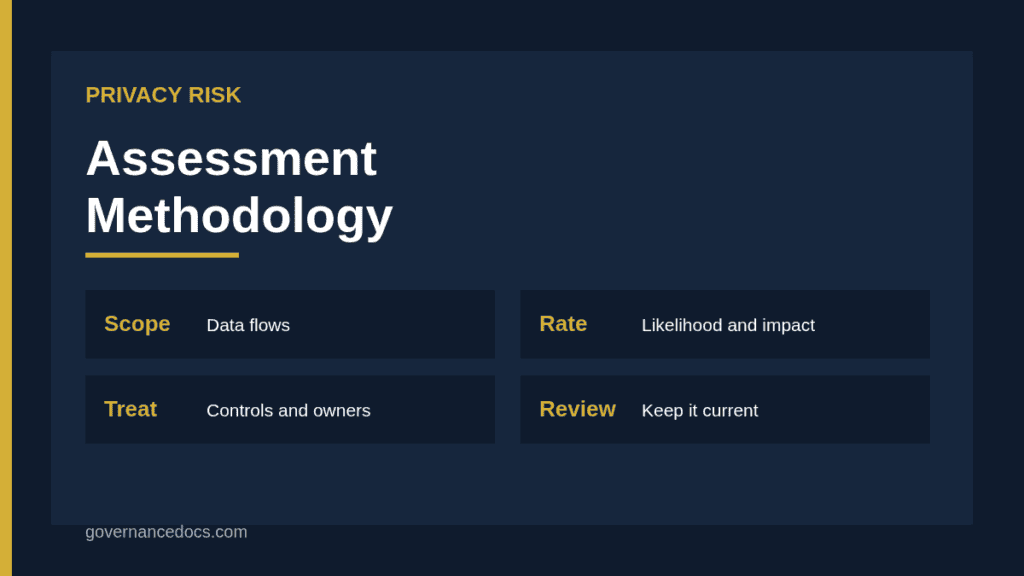
A privacy risk assessment methodology is the repeatable set of steps your organization uses to find, rate and treat risks to the people whose personal data it handles. Without one, every assessment is improvised, scores cannot be compared between projects and nobody can explain to a regulator why one processing activity was judged acceptable and another was not.
This guide sets out the parts of a workable privacy risk assessment methodology: scope, harm categories, scales, scoring, treatment, ownership and records. It is written for privacy teams building a method from scratch or tightening one that has grown inconsistent.
Free gap assessment
Could you demonstrate GDPR compliance today?
Score yourself against what a supervisory authority actually asks for, free — the records, not the policy.
What a privacy risk assessment methodology must decide
Before any scoring, the method has to settle a small number of design questions. Each one is a place where teams often leave ambiguity that later becomes disagreement.
Whose risk is being rated. Privacy risk is primarily risk to individuals: harm to their rights, freedoms and interests. Risk to the organization, such as fines or reputation damage, is real but is a separate lens and should be recorded separately.
What triggers an assessment. New systems, new purposes, new data categories, new suppliers, new countries and material changes to existing processing.
Who performs and approves it. A named assessor, a named reviewer with authority, and a route to escalate what cannot be accepted.
How results are stored. One register, with a consistent record for each assessment.
The distinction between risk to individuals and risk to the organization matters because the two can point in opposite directions. A cautious business decision to keep data longer may lower operational risk while raising the risk to individuals. Our comparison of privacy risk and cybersecurity risk explains why the two need different scales.
Step one in the privacy risk assessment methodology: scope the processing
Start from a clear description of the processing. Record what data is collected, from whom, for which purpose, on what legal basis, who receives it, where it is stored and for how long. If you keep a record of processing activities, use it as the starting point, because it already holds most of these answers. Our guide to the RoPA review process shows how to keep that record accurate enough to rely on.
Map the flow of data as well as the inventory. Risks tend to sit at the transitions: collection, transfer to a processor, access by staff, export to analytics and deletion. A simple diagram of these steps, with the systems and parties involved, gives assessors something concrete to test each threat against.
Step two: identify harms, not just vulnerabilities
A security assessment lists threats to assets. A privacy assessment starts from the effect on people. Common categories of harm to consider include:
Harm category
Example
Typical trigger
Loss of control
Person cannot find out how data is used
Unclear notices, hidden sharing
Discrimination or unfair treatment
Profile used to refuse a service
Automated scoring, biased inputs
Financial harm
Fraud after a data breach
Exposure of identifiers or account data
Physical or safety harm
Location shared with a person who poses a threat
Excess disclosure of address or movements
Distress or loss of dignity
Sensitive information exposed to colleagues
Over-broad internal access
Chilling effect
People avoid using a service they need
Intrusive monitoring
Use a list like this as a prompt, not a limit. The purpose is to make assessors think about what could actually happen to a person if the processing goes wrong, then work backwards to the causes. Threats such as unauthorized access, excessive collection, purpose creep, inaccurate data, retention beyond need and unlawful transfer all become risks only when they connect to one of these harms.
Step three: set likelihood and impact scales for privacy risk scoring
Scales are the heart of any privacy risk assessment methodology, and vague scales are the most common reason two assessors give the same activity different scores. Write each level down with a definition and an example.
Free privacy risk assessment
Which privacy risks would hurt the people whose data you hold?
List your personal data and processing, pick from 38 privacy risk scenarios, rate them for the people concerned and for you, and plan treatment with ISO 27701 controls. You get a heat map, a process score and the findings an auditor would raise, free.
For likelihood, a four-point scale is usually enough: remote, possible, probable and near certain. Anchor each level to something observable, such as whether the weakness has been seen in similar systems, whether controls are automated or manual, and how many people can reach the data. For impact, define levels by effect on individuals: minimal inconvenience, significant inconvenience that can be overcome, serious consequences that may be difficult to overcome, and severe or irreversible effects. Reversibility deserves a clear place in the scale, because harm that cannot be undone should weigh more than harm that can.
The ISO/IEC 29134 guidelines on privacy impact assessment and the NIST Privacy Framework both treat privacy risk as a function of the likelihood of a problematic data action and its impact on individuals. You can read the framework overview on the NIST Privacy Framework page. Whatever source you adapt, keep the wording in your own documented scale so that assessors apply it consistently.
Combining the scales into a rating
Multiply or map the two scores on a matrix to reach an inherent rating such as low, medium, high or very high. Decide in advance what each band means for action: for example, low can be accepted by the process owner, medium needs a documented treatment, and high or very high needs senior sign-off before the processing starts. Writing this down before scoring begins protects the method from pressure to adjust the score until the outcome is convenient.
Step four: identify existing controls and rate residual risk
List the measures already in place, both technical and organizational: encryption, pseudonymization, access controls, retention schedules, notices, contracts with processors, training and monitoring. Rate the risk again with those controls in mind. Be honest about effectiveness. A policy that staff do not follow is a weak control, and a control that has never been tested should not receive full credit.
The gap between inherent and residual rating shows how much your controls are actually doing. If it is small, either the controls are weak or the assessment is too generous. Our guide to residual risk in a DPIA covers how to judge when what remains is acceptable and when it is not.
Step five: treat the risks that remain too high
For each risk above your appetite, choose a treatment and give it an owner and a date. The usual options are to reduce the risk with new controls, avoid it by changing or dropping the processing, transfer part of it by contract or insurance where that is genuinely possible, or accept it with documented approval. Note that transfer is limited in privacy: you can share the cost of a breach, but you cannot hand away your duties to individuals.
Avoid. Stop the specific feature or data use that creates the risk.
Share. Use processor contracts and audit rights to allocate responsibility, while keeping your own duties.
Accept. Record who accepted the risk, what they saw and when it will be revisited.
Treatments should flow into the same register you use for other privacy risks. A structured privacy risk register keeps ratings, owners, actions and review dates together so that nothing is lost between assessments.
Roles and records in a privacy risk assessment methodology
Assign clear roles. The process owner knows the processing and proposes ratings. The privacy lead or data protection officer reviews the method and challenges the scoring. A senior business owner accepts residual risk that exceeds the low band. Where a data protection officer is appointed, their advice should be recorded, along with whether it was followed and why not if it was not.
Records are the evidence that the method is used. For each assessment keep the scope description, the data flow, the risk list with scores, the controls considered, the treatment plan, the approval and the review date. Keep the scales and matrix under version control so that an older assessment can be read against the scale in force when it was done.
How the method relates to a DPIA
A DPIA is required under Article 35 of the GDPR where processing is likely to result in a high risk to individuals. A general privacy risk method is wider: it can be used for lower-risk processing, for vendor onboarding and for quick project screening, and it should tell you when a full DPIA is needed. Build a short screening question set into the first step so that high-risk processing is routed to the fuller assessment automatically. For a direct comparison of the two, see privacy risk assessment versus DPIA.
Keeping the method current
Review the method at least annually and after major events such as a serious incident, a new regulation, a new technology or a regulator’s finding. Test it by re-scoring a few completed assessments with a different assessor. Large differences point to unclear scales that need tightening. Track a small number of measures: assessments completed on time, risks above appetite, overdue actions and time from trigger to completed assessment.
The privacy review process shows how to build the trigger and approval steps into project delivery so that assessments happen before launch instead of after.
Using a ready structure for your methodology
If you would rather start from a finished structure than a blank page, the Privacy Risk Assessment Report and Workbook provides a documented report, scales and a working register you can adapt to your own processing. Whether you use it or build your own, the aim is the same: a privacy risk assessment methodology that different assessors can apply and get consistent, defensible results.
Privacy risk assessment methodology FAQ
What is a privacy risk assessment methodology?
It is the documented, repeatable method an organization uses to identify, rate and treat privacy risks to individuals, including scales, roles, triggers and records.
How is privacy risk different from information security risk?
Security risk concerns harm to the organization’s assets, while privacy risk concerns harm to individuals. A system can be secure and still create privacy risk, for example by collecting too much data or using it in ways people would not expect.
Do I need a formal scoring matrix?
You need a consistent way to compare risks and decide which need action. A likelihood and impact matrix is the most common approach, but the scales must be defined in writing so that different assessors reach similar results.
How often should assessments be repeated?
Repeat them when processing changes materially and review them on a fixed cycle, commonly annually for higher-risk processing. The method itself should also be reviewed at least once a year.
Who should approve residual privacy risk?
A business owner with authority over the processing should accept residual risk, with advice from the privacy lead or data protection officer recorded. Very high residual risk should be escalated to senior management before processing begins.