CART
PCI DSS vs ISO 27001 is rarely an either/or decision, but it is asked as one, usually by a company that takes card payments and has just been sent a security questionnaire by an enterprise customer. The honest answer is that the two standards do different jobs.
PCI DSS is a prescriptive, contractually enforced set of technical requirements for protecting cardholder data; ISO 27001 is a certifiable management-system standard for protecting whatever information you decide is in scope. One is imposed on you by your acquirer and card brands; the other is chosen. This guide sets them side by side on five differences, shows where the controls overlap, and explains how organizations that need both run them from one set of documents.
Free gap assessment
How much of PCI DSS v4 is actually in place?
Score all twelve requirements at sub-requirement level, free, including the ones that stopped being future-dated in 2025.
Run the free PCI DSS 4.0 gap assessment → or View premium report sample
PCI DSS v4.0.1, published by the PCI Security Standards Council in June 2024, is the Payment Card Industry Data Security Standard: twelve requirements grouped under six goals, with several hundred testable sub-requirements, applying to any organization that stores, processes or transmits cardholder data or could affect its security. Compliance is a condition of the merchant’s or service provider’s contract with its acquiring bank, enforced by the card brands. The requirements that were future-dated in v4.0 became mandatory on 31 March 2025, and v3.2.1 was retired on 31 March 2024.
ISO/IEC 27001:2022 is the international standard for an information security management system: clauses 4 to 10 set the management-system requirements, and Annex A lists 93 controls in four themes — 37 organizational, 8 people, 14 physical and 34 technological — from which the organization selects and justifies in a Statement of Applicability under clause 6.1.3. Certification is by an accredited certification body against the organization’s own defined scope. Amendment 1 of 2024 added climate change as a context consideration; the 2013-to-2022 transition closed on 31 October 2025.
Free ISO 27001 risk assessment
Which of your risks sit above your appetite line?
Set your own risk criteria, pick from 61 information security risk scenarios, rate likelihood and impact, and decide how to treat each one. You get a heat map, a process score and the findings an auditor would raise, free.
Run the free risk assessment → or View premium report sample
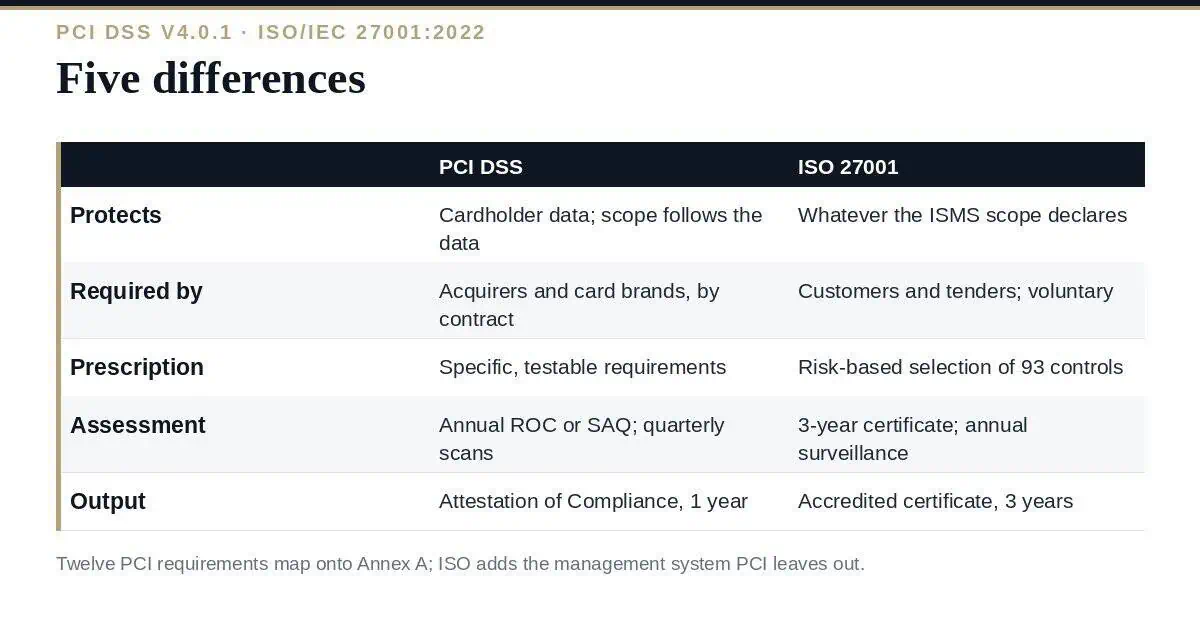
| Difference | PCI DSS v4.0.1 | ISO/IEC 27001:2022 |
|---|---|---|
| 1. What it protects | Cardholder data and sensitive authentication data; the environment is defined by where that data flows | Whatever information assets the organization puts in scope; the ISMS scope is a management decision |
| 2. Who requires it | Acquiring banks and card brands, by contract; non-compliance carries fines and, ultimately, loss of card acceptance | Nobody by default; customers, tenders and regulators may require it; certification is voluntary |
| 3. How prescriptive | Highly: specific technical requirements with defined testing procedures (e.g. MFA for all access into the CDE, quarterly ASV scans, annual penetration test) | Outcome-based: Annex A controls describe what, not how; the organization chooses measures through risk assessment |
| 4. How it is assessed | Annual validation: QSA Report on Compliance for Level 1, Self-Assessment Questionnaire for others; quarterly external scans | Three-year certification cycle: stage 1 and stage 2 audit, then annual surveillance and recertification |
| 5. What you get | An Attestation of Compliance valid for one year; no certificate | A certificate from an accredited body, valid three years subject to surveillance |
PCI DSS scope is determined by data flow: every system component that stores, processes or transmits cardholder data, every component on the same network segment, and every component that can affect the security of the cardholder data environment is in scope, whether the organization likes it or not. Reducing scope means changing the architecture — segmentation, tokenization, outsourcing the payment page.
ISO 27001 scope is declared: the organization decides which locations, services and assets the ISMS covers, and the certificate names that scope. An ISMS can be scoped to a single product team; a cardholder data environment cannot be scoped to exclude the server that holds the card numbers. Our guide to PCI DSS scope covers the three categories of in-scope component.
PCI DSS is enforced through the payment chain. The acquirer is responsible to the brands for its merchants’ compliance and passes fines, forensic costs and reissuance charges down after a breach. ISO 27001 has no enforcement body; the consequences of not having it are commercial — a lost tender, a failed vendor assessment — and the consequences of failing an audit are a suspended or withdrawn certificate.
PCI DSS tells you what to do and how it will be tested. Requirement 8 specifies multi-factor authentication for all access into the cardholder data environment; Requirement 11 specifies quarterly external vulnerability scans by an Approved Scanning Vendor and at least annual penetration testing; Requirement 3 specifies how stored account data is rendered unreadable. ISO 27001 gives you Annex A control A.8.5, secure authentication, and A.8.8, management of technical vulnerabilities, and expects the risk assessment to decide the strength and frequency. The prescriptive standard is easier to audit and harder to argue with; the risk-based one is more adaptable and demands more judgement.
PCI DSS validates annually with quarterly scanning in between; a Level 1 merchant’s QSA assessment is a fresh full assessment each year. ISO 27001 certifies for three years with lighter annual surveillance audits and a full recertification at the end. The PCI model is more demanding per year; the ISO model has a heavier first year. Our guides to PCI DSS merchant levels and PCI DSS validation explain who validates how.
An Attestation of Compliance is a signed statement, valid for a year, that the environment met the standard at the assessment date; there is no PCI certificate and the Council issues nothing to merchants. An ISO 27001 certificate is a third-party credential that customers recognize across industries and that says nothing specific about card data.
In the PCI DSS vs ISO 27001 comparison the technical core is shared. Most PCI DSS requirements have a corresponding Annex A control, and an organization with a working ISMS has policies, risk assessment, asset inventory, access control, logging, vulnerability management and incident response that a QSA will recognize. The mapping is not one-to-one, because PCI DSS is more specific, but it is close enough that a combined evidence set is realistic.
| PCI DSS v4.0.1 requirement | Closest ISO 27001:2022 Annex A controls | Where PCI is stricter |
|---|---|---|
| 1 Network security controls | A.8.20 Networks security, A.8.22 Segregation of networks | Documented rulesets reviewed every six months; CDE segmentation tested |
| 2 Secure configurations | A.8.9 Configuration management | Vendor defaults changed before deployment; one primary function per server |
| 3 Protect stored account data | A.8.24 Use of cryptography, A.8.10 Information deletion | Specific rendering methods; SAD never stored after authorization; key management detail |
| 4 Strong cryptography in transit | A.8.24, A.5.14 Information transfer | Named protocol strength; inventory of certificates |
| 5 Malware protection | A.8.7 Protection against malware | Periodic evaluation of systems considered not at risk |
| 6 Secure systems and software | A.8.25–A.8.29 Secure development, A.8.8 Vulnerability management | Critical patches within one month; payment page script management (6.4.3) |
| 7 Restrict access by need to know | A.5.15 Access control, A.5.18 Access rights | Access reviews at least every six months |
| 8 Identify users and authenticate | A.5.16 Identity management, A.5.17 Authentication information, A.8.5 Secure authentication | MFA for all CDE access; password length 12; 90-day rotation or dynamic analysis |
| 9 Restrict physical access | A.7.1–A.7.10 Physical controls | Media inventories; POI device inspection |
| 10 Log and monitor | A.8.15 Logging, A.8.16 Monitoring activities | Daily log review; 12-month retention with 3 months immediately available |
| 11 Test security regularly | A.8.8, A.8.29 Security testing | Quarterly internal and ASV scans; annual penetration test; change-detection on payment pages |
| 12 Support with policies and programs | Clauses 5–10, A.5.1 Policies, A.5.24–A.5.28 Incident management, A.5.19–A.5.22 Supplier relationships | Annual risk assessment; formal PCI DSS compliance program; TPSP monitoring |
The overlap runs the other way too. ISO 27001 requires things PCI DSS does not: a documented ISMS scope and policy, leadership commitment, risk treatment with a Statement of Applicability, internal audit, management review and continual improvement. An organization that has only ever done PCI DSS has the controls but not the system around them, and the ISO 27001 stage 1 audit finds exactly that.
Organizations that resolve PCI DSS vs ISO 27001 by holding both typically make the cardholder data environment a defined sub-scope inside the ISMS. The ISMS risk assessment covers the CDE; the Statement of Applicability marks the controls PCI DSS mandates as applicable with the PCI requirement as the justification; the PCI policies become the specific procedures under the ISO policies; and the ISMS internal audit program includes the quarterly scan reviews and the annual PCI validation as scheduled activities.
One evidence index, tagged by both standards, serves the QSA and the certification body auditor. The alternative — two teams, two document sets, two risk registers — costs roughly double and produces contradictions the auditors will find. Our guide to PCI DSS documentation lists the evidence a QSA expects, most of which an ISMS already produces.
Does ISO 27001 certification satisfy PCI DSS?
No. Card brands and acquirers require PCI DSS validation — a ROC or SAQ with an Attestation of Compliance. An ISO 27001 certificate is useful supporting evidence but does not replace it.
Does PCI DSS compliance count toward ISO 27001?
Substantially, for the technical controls. It does not supply the management-system elements — scope, risk treatment, Statement of Applicability, internal audit, management review — which ISO 27001 requires and PCI DSS does not.
Which is harder?
PCI DSS is more prescriptive and validates every year, so it is harder to sustain. ISO 27001 requires more design work up front and more judgement, so it is harder to start. Most organizations find the first ISO 27001 certification the bigger project and the annual PCI validation the bigger recurring effort.
Is there a PCI DSS certificate?
No. PCI DSS produces an Attestation of Compliance, valid for one year. Only ISO 27001 produces a certificate.
Can we scope ISO 27001 to the cardholder data environment only?
Yes, and some organizations do. It produces a certificate with a narrow named scope, which customers reading it will notice.
Read PCI DSS vs ISO 27001 as a scope question. PCI DSS applies to the cardholder data environment whether you choose it or not, prescribes the controls and validates every year. ISO 27001 applies to the scope you declare, leaves the control selection to your risk assessment and certifies for three years. If you take card payments, do PCI DSS and build it as the first sub-scope of an ISMS; if customers keep asking about security in general, add the ISMS around it.
The policy set mapped to all twelve requirements, the scoping worksheets and the evidence index a QSA works from are in the PCI DSS Toolkit, or start with the free templates.

October 11, 2026
October 11, 2026

October 11, 2026
October 11, 2026
October 11, 2026

