CART
PCI DSS merchant levels decide how you prove compliance, not what you have to comply with. Every merchant that stores, processes or transmits cardholder data is subject to all of PCI DSS v4.0.1; the level — 1 through 4 — sets whether you validate with an on-site assessment and a Report on Compliance, or with a Self-Assessment Questionnaire, and how often you scan. The levels are set by the card brands, not by the PCI Security Standards Council, and the thresholds are counted in transactions per year. This guide explains the four levels as Visa and Mastercard define them, what each one requires, the three ways a merchant gets moved up a level without its volume changing, and how to work out which level you are actually on.
Free gap assessment
How much of PCI DSS v4 is actually in place?
Score all twelve requirements at sub-requirement level, free, including the ones that stopped being future-dated in 2025.
Run the free PCI DSS 4.0 gap assessment → or View premium report sample
The PCI Security Standards Council writes the standard. It does not define merchant levels, set validation requirements or enforce anything. Those decisions belong to each card brand’s compliance program — Visa, Mastercard, American Express, Discover and JCB each publish their own — and are applied through the merchant’s acquiring bank, which is the party contractually responsible for making sure its merchants validate at the right level. Visa states that “a merchant’s total Visa transaction volume over a 12-month period determines your merchant level and the necessary requirements for validation”, counting credit, debit and prepaid together, and measured per country or per acquirer.
Two things follow. The level is per brand, so a merchant can in principle be Level 2 with Visa and Level 3 with Mastercard, though the brands have aligned their thresholds closely enough that this rarely matters. And the acquirer has the final say: it can require a higher validation than the brand minimum, and it is the acquirer, not the brand, that a merchant reports to.
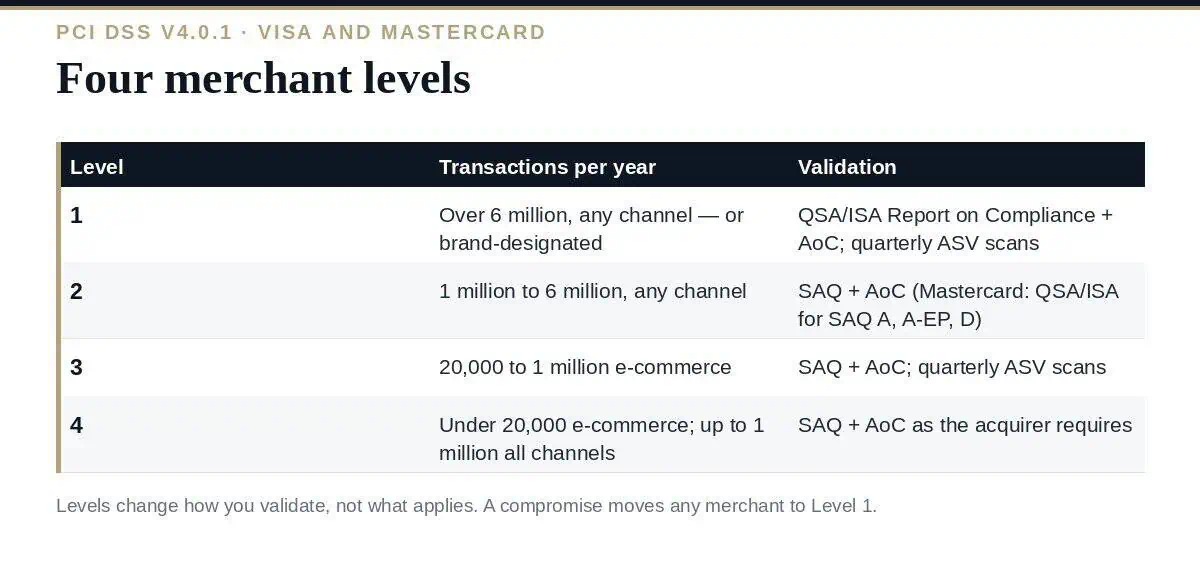
| Level | Visa and Mastercard threshold (transactions per year) | Validation | Scanning |
|---|---|---|---|
| Level 1 | Over 6 million, any channel; or any merchant the brand designates Level 1 | Annual on-site assessment by a QSA (or qualified internal auditor with an ISA) and a Report on Compliance; Attestation of Compliance | Quarterly external scans by an Approved Scanning Vendor |
| Level 2 | 1 million to 6 million, any channel | Annual Self-Assessment Questionnaire and Attestation of Compliance; Mastercard requires a QSA or ISA where the SAQ is A, A-EP or D | Quarterly ASV scans |
| Level 3 | 20,000 to 1 million e-commerce transactions | Annual SAQ and AoC | Quarterly ASV scans |
| Level 4 | Fewer than 20,000 e-commerce transactions, and up to 1 million in all channels | Annual SAQ and AoC, as required by the acquirer | Quarterly ASV scans where the SAQ type requires them |
Read the PCI DSS merchant levels thresholds carefully. Levels 1 and 2 count all channels — card-present, mail order, e-commerce. Level 3 is an e-commerce count only; a retailer with 500,000 in-store transactions and 30,000 online is Level 3 by the online figure but is also inside Level 4’s “up to 1 million in all channels”. Where a merchant meets more than one definition, the higher level applies.
Level 1 is the only tier that requires an independent assessment. A Qualified Security Assessor tests every applicable requirement against the environment and writes a Report on Compliance in the Council’s template; the merchant signs an Attestation of Compliance; both go to the acquirer, and the brands may ask for the AoC directly. Large merchants with an internal audit function can use an Internal Security Assessor instead of a QSA where the brand permits it, but the ROC format and the quarterly ASV scans are the same. Budget for the assessment as a project, not a form — our guide to PCI DSS compliance cost gives the ranges.
Everyone below Level 1 self-assesses. The SAQ type depends on how the merchant handles card data — SAQ A for fully outsourced e-commerce, SAQ A-EP where the merchant’s site affects the payment page, SAQ B and B-IP for standalone terminals, SAQ C and C-VT for payment applications and virtual terminals, SAQ P2PE for validated point-to-point encryption, and SAQ D for everyone else. The level does not choose the SAQ; the channel does. Our guide to PCI DSS SAQ types covers the selection. Mastercard’s Level 2 rule is the one exception worth remembering: a Level 2 merchant completing SAQ A, SAQ A-EP or SAQ D must engage a QSA or a PCI SSC-certified Internal Security Assessor for its validation, while Level 2 merchants on SAQ B, B-IP, C, C-VT or P2PE may self-assess without one.
Volume is the default rule for PCI DSS merchant levels, but the brands reserve the right to reassign a merchant, and three triggers are common.
One move goes the other way. Visa’s Technology Innovation Program offers validation relief to merchants whose transactions overwhelmingly originate through EMV chip terminals, validated point-to-point encryption or industry-standard tokenization — Visa cites at least 75% of yearly transactions — because the exposure of cardholder data in those environments is limited. Ask the acquirer whether it applies; it does not remove the obligation to comply.
The standard applies in full at every level. A Level 4 merchant with a single terminal is subject to all twelve PCI DSS requirements that apply to its environment, including the ones that became mandatory on 31 March 2025 when v4.0’s future-dated requirements took effect. What changes is scope — a merchant that outsources payment processing entirely has a small environment and a short SAQ — not obligation. The scoping rules are covered in our guide to PCI DSS scope; get scope right before worrying about level, because it decides the size of the job at any tier.
Nor do PCI DSS merchant levels change the consequences of a breach. Fines, forensic investigation costs and card reissuance charges are passed to the merchant by the acquirer regardless of tier, and a Level 4 merchant with no validated compliance is in the weakest position to contest them.
Who sets PCI DSS merchant levels?
The card brands — Visa, Mastercard, American Express, Discover and JCB — each through its own compliance program, applied by the acquiring bank. The PCI Security Standards Council writes the standard but does not set levels or enforce them.
Does a Level 4 merchant have to comply with all of PCI DSS?
Yes. All applicable requirements apply at every level. The level changes only how compliance is validated — SAQ versus on-site assessment — and reporting frequency.
What is the difference between Level 3 and Level 4?
Level 3 is 20,000 to 1 million e-commerce transactions a year. Level 4 is fewer than 20,000 e-commerce transactions, or up to 1 million transactions across all channels. Both validate by SAQ.
Can a small merchant be made Level 1?
Yes. A merchant that has suffered an account data compromise, or that a brand designates because of its risk profile, validates as Level 1 regardless of volume.
Do we need a QSA at Level 2?
For Visa, an SAQ is sufficient. Mastercard requires a QSA or ISA-certified staff for Level 2 merchants completing SAQ A, A-EP or D; merchants on the other SAQ types may self-assess. The acquirer may require more.
Get your transaction counts from the acquirer, per brand and per channel, apply the highest definition you meet, and check the three overrides. Then stop treating the level as the compliance problem: at every tier the standard applies in full, and the real variable is scope. A small environment with a short SAQ and clean quarterly scans is a better position than a large one with a ROC.
Scoping worksheets, the policy set behind every SAQ type and the evidence index a QSA works from are in the PCI DSS Toolkit, or start with the free templates.

October 11, 2026
October 11, 2026
October 11, 2026
October 11, 2026
October 11, 2026

